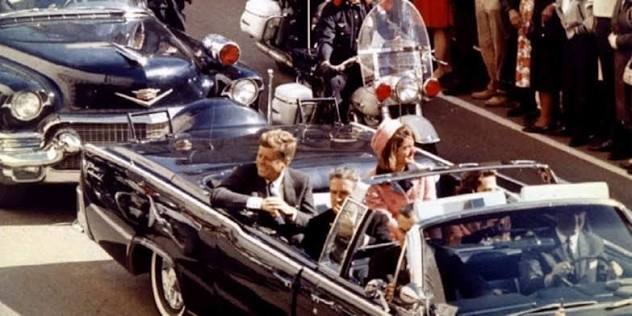
John F. Kennedy
“While the committee did not uncover evidence that the proposed Hoffa assassination plan ever went beyond its discussion, the committee noted the similarities between the plan discussed by Hoffa in 1962 and the actual events of November 22, 1963. While the committee was aware of the apparent absence of any finalized method or plan during the course of Hoffa’s discussion about assassinating Attorney General Kennedy, he did discuss the possible use of a lone gunman equipped with a rifle with a telescopic sight, the advisability of having the assassination committed somewhere in the South, as well as the potential desirability of having Robert Kennedy shot while riding in a convertible. While the similarities are present, the committee also noted that they were not so unusual as to point ineluctably in a particular direction. President Kennedy himself, in fact, noted that he was vulnerable to rifle fire before his Dallas trip.“
“Nevertheless, references to Hoffa’s discussion about having Kennedy assassinated while riding in a convertible were contained in several Justice Department memoranda received by the Attorney General and FBI Director Hoover in the fall of 1962. Edward Partin told the committee that Hoffa believed that by having Kennedy shot as he rode in a convertible, the origin of the fatal shot or shots would be obscured. The context of Hoffa’s discussion with Partin about an assassination conspiracy further seemed to have been predicated upon the recruitment of an assassin without any identifiable connection to the Teamsters organization or Hoffa himself. Hoffa also spoke of the alternative possibility of having the Attorney General assassinated through the use of some type of plastic explosives.”
– The House Congressional Committee on Assassinations John F. Kennedy and Martin Luther King Jr. Assassination Report, 1976 (declassified in 1993)
John F. Kenendy was born into a family of wealth and privledge. His father was a Massachusettes senator who lived in Boston and groomed his sons for presidency, and America grew up seeing Jack – John’s nickname – and Bobby and Teddie playing with their dad.
The future President Kenendy graduated from Boston’s Harvard University and then joined the navy reserves. He was decorated during combat service in World War II, returned to Boston, and was elected to the U.S. House of Representatives in 1947. In 1960 Kennedy defeated President Eisenhower’s vice-president, Richard Nixon, the in the first televised presidential debate. In January of 1961, John F. Kennedy assumed office as the 35th president of the United States.
Kennedy inherited a growing American military and political presence in Vietnam; France and England had already been involved since near the end of World War II, and it’s estimated that in 1955 America transitioned into the driving force of foreign presence. Maybe because of his war experiences, or perhaps because he listened to the public or was even himself against war, President Kennedy focused on preventing young American soldier deaths by focusing fewer than 50,000 specialized soldiers in Vietnam who would train local soldiers; this was the special forces or green berets that led to Vietnam movies like Rambo and, to this day, the John F. Kennedy special warfare training center that prioritizes multidisciplinary teams of educators and trainers over hoards of troops and planes dropping bombs.
Kennedy fought the cold war and sent people to the moon, and he took on Jimmy Hoffa and the American mafia using a strategy similar to his Vietnam effort: small, highly focused teams with practically unlimited resources for technology and training. Walter Sheridan and his 500 agent force targeting leaders was, to Kennedy, more efficient than dozens of thousands of uniformed police officers targeting crime.
President John F. Kennedy was shot and killed at around 1:26pm on 22 November 1963. His death was – and may still be – the most widely studied and yet still unsolved crime of the 1900’s.
My version of his story begins four days before he was murdered, because that’s when Bobby Kennedy and J. Edgar Hoover first told President Kennedy about my grandfather.
On 18 November 1963 President Kenendy was preparing for a trip to Dallas when Bobby and Hoover requested a private meeting with and told the president there was a credible and imminent threat on his life. The president listened, and Bobby described my grandfather and Jimmy Hoffa plotting to shoot and kill Bobby Kennedy as he rode through a southern town in a convertible by a sniper with a scope who would not be traced back to Hoffa and the Teamsters. Hoover said his agents verified what they could, and that he personally oversaw my grandfather’s lie detector tests and believed everything Big Daddy said. They had checked other sources. They believed the plot was not for Bobby, but for the president himself.
The scenes of that plot were the basis of 1983’s Blood Feud; Bryan Dennehy as Big Daddy and Robert Blake as Jimmy Hoffa acted them out in slow, precise face shots to show Hoffa asking Big Daddy to obtain C4 plastic explosives from his connections with New Orleans mafia boss Carlos Marcello and known – but rarely discussed – weapons trading with Fidel Castro. Bobby wanted to blow up Bobby Kenendy’s home with him and his wife and children inside.
In the film and in real life Big Daddy refused. The JFK Assassination Report makes it seem like the sniper was their first choice, but their first discussion was about blowing up Bobby’s home with everyone inside. Big Daddy told Hoffa he would not harm children.1
After discounting blowing up Bobby’s family, Hoffa and my grandfather discussed killing Bobby by recruiting a sniper to shoot Bobby in a southern town.
“That son-of-a-bitch has to go,” Hoffa said
“He’s always riding around in that convertible,” he pointed out.
The JFK Assassination Report contained most reasons why they chose a southern town and in a convertible. The part about obscuring shot origins of a sniper was spot-on; it would also allow several snipers to site in simultaneously without a car roof obstructing their view. I never completed sniper school, but friends and colleagues have, and we’ve discussed assignations for decades, and they agree that whoever planned killing President Kennedy knew what they were talking about. And as a person who has trained with the JFK special warfare center and has a lifetime of contemplating small teams taking and saving lives, I concur. Twenty years later, even the pope would be shot driving around in a convertible; in the 1960’s, that was a revolutionary plan.
As a person born in the deep south, I was surprised no one also commented that our warm weather meant there was more of an opportunity to catch Kennedy with the top down. In Baton Rouge November brought LSU football season and crisp, sunny days that begged to be enjoyed outside; Dallas was similar, and a convertible procession made sense. Whomever plotted shooting Kenendy in a convertible while he rode through a southern town probably had a local’s perspective.
A top down would also imply slower speeds that are easier to track with a scope. And, as my grandfather testified to the congressional JFK Assassination committee, an open convertible would mask where the shot (or shots) came from.
And much of the south was – and is – politically right wing. Though Kennedy is looked upon favorably by history, he was a left-leaning politician and was already a target of right fanatics. Dallas was – and is – one of the most right wing cities in the south, built upon oil money and fueled by desire for fewer regulations and more money. Even Bobby and Hoover were targets. This was before Johnson signed the civil rights act, and the Kennedy’s were publicly pro-unity; people in southern towns lynched and burned effigies of Bobby and Hoover.
And though not known even by Hoover back then – though probably suspected – was that New Orleans mafia boss Carlos Marcello’s territory stretched all across the south and included Dallas. Marcello had his own rivalry with the Kennedys, and by mentioning Big Daddy’s ties to Marcello to get C4 explosives they may have been alluding to getting his assistance – or his blessing – anywhere in the south.
The JFK Assassination report says taht Hoffa and Big Daddy never went beyond plotting Bobby’s death, but the level of detail they discussed, Hoover’s continued monitoring of Marcello and organized crime, and Bobby’s daily pursuit of Hoffa led them to meet with the president and warn him that he could be the intended target.
Their conversation was so intense that Kennedy would discuss it the next day with his white house historian, advisor, and close friend from their days at Harvard together; two-time Pultizer prize winning author and historian Arthur Meier Schlesinger Jr., and it would be summarized in his 1966 Pulitzer prize winning biography, “A Thousand Days: John F. Kennedy in the White House.” But, because in 1963 Big Daddy and Hoffa’s records were still blacked-out in classified FBI documents, their names were omitted; it probably took another Partin to persist though all of the redacted files and point out what is now commonly known. Instead of who the plotters were, Schlesinger instead focused on Bobby and Hoover being so convinced that, even with everything in the cold war going on, they met with the president privately, and whatever they said sowed a seed of doubt in Kennedy’s mind and that’s why he discussed the plot with Schlessinger and admitted he was vulnerable in a convertible. But he decided to stick with his plans and go to Dallas, anyway.
Four days later President Kennedy was riding through downtown Dallas in his open convertible and was shot and killed by at least one 6.5mm rifle round from an Italian surplus WWII rifle.
The main suspect in Kennedy’s death was New Orleans native Lee Harvey Oswald. This is what I’ve curated and believe about him.
Family lore says he knew Big Daddy, though I’ve never found evidence. What is documented enough for me is that in the 1950’s and while he lived in New Orleans, Oswald trained in the Baton Rouge civil air patrol four miles from Grandma Foster’s house under the alias Harvey Lee; it’s the neighborhood I grew up in, and I recall people saying they saw Oswald there.
In 1959 Lee Harvey Oswald defected to Russia and married a Soviet citizen named Marina Nikolayevna Prusakova. They had a baby while Oswald toiled at menial jobs granted by the Soviet government. He grew disillusioned with the menial work and complained there about nothing in particular, just like he had in America. To most, he sounded like a depressed misanthrope, even in stoic communist era Russia. Three years after defecting, the FBI inexplicably paid for all three of the Oswalds to fly back to New Orleans. They arranged for Oswald to have work.
It was menial office and wharehouse work; Oswald soon began complaining again. Despite not finding a home in Russia, Oswald was adamantly pro-communist and pro-Cuba and pro-Castro. In between shifts at his jobs he handed out fliers trying to rally support for some type of revolution to anyone in New Orleans willing to listen. To this day you can tour New Orleans bars and taverns with small plaques pointing to the stool where Oswald sat and the door he was tossed out of by patrons tired of hearing him complain.
It was easy for the FBI and CIA to follow Oswald’s every blunder. In addition to him being known around town, his office for his pro-Castro moonlighting was in a building between New Orleans FBI and CIA offices (a fact that became one of the most cited arguements for an FBI-CIA assisted conspiracy to kill Kennedy. Oswald was so overt to anyone in New Orleans that he became a known character in the Crescent City of Sin; on walking tours in New Orleans, guides point out building after building where Oswald lived, worked, and was fired in the year after he returned from Russia. Most of us growing up in the area knew his history so well we show sites to friends as if we were tour guides ourselves.
In the spring of 1963 Oswald was offered a job in a downtown Dallas book repository. I do not know for certain the details of how that happened, but I know that he left New Orleans and moved into a Dallas apartment with his wife and son. He ordered a WWII era 6.5mm Italian carbine from a mail order catalog, similar to what Frank “The Irishman” Sheeran would describe as being hauled around in duffle bags by Italian mafia.
That model carbine was cheap and easily available after the war. It was notoriously inaccurate, mostly because it was mass produced with loose tolerances and used in an assembly line of soldiers fighting close-up battles. Oswald paid a local gunsmith to outfit his with a scope, then took a photo brandishing it and his .38 caliber Smith and Wesson Model 10 pistol, the same hefty revolver most police used back then. He made his most fierce facial expression and asked the printer for a few extra copies to share with people he had met and listened to what he had to say.
Soon after that photo was distributed, Oswald shot at but missed an army general while the general was in his Dallas home. He was working at his desk and illuminated by office lights, yet somehow Oswald missed. His marine records would show that Oswald was an abysmal shot. Even with a scope on an Italian carbine, he’d have to be lucky to hit anything smaller than a car or farther away than you could throw a football. FBI investigators pulled a 6.5mm slug out of the general’s wall and stored it for future evidence.
A few months later, on 22 November 1963 at an estimated 1:26pm, President Kennedy was shot by Oswald’s rifle from the 6th floor window of the book repository where Oswald worked. That window was 88 yards away from the president’s head, about a football field away from Oswald’s window.
The president was and his wife were riding with the Texas governor and his wife on a small parade through downtown Dallas. Hundreds of people saw the president’s head explode, and video footage captured the exact moment where fragments flew before his head snapped back.
Kennedy was rushed to the hospital. The Texas governor beside him had been injured by a bullet, too (some would say the same bullet that killed Kennedy – I’ll touch on that in a minute). The governor was taken to the same hospital as Kennedy.
Oswald’s rifle was soon found at the open window; cartridges were laid out on the windowsill like a sniper expecting to take several shots, and another round was inexplicably found beside the Texas governor’s hospital gurney. Oswald’s prints were all over the room and rifle, and repeated FBI and independent analysis continues to show that a round recovered from Kennedy was fired from that rifle.
Oswald was missing.
Two hours later he nervously emerged from a nearby movie theater and impulsively shot and killed Dallas police officer JD Tippit with the pistol he had brandished in photos with his rifle. As he was arrested for Tippit’s murder, Oswald exclaimed: “I’m just a patsy!” (he said that two years before Chief Justice Earl Warren oversaw Miranda versus Arizona, which led to the Miranda Rights being read to anyone arrested so they know their right to remain silent and wait for an attorney).
President Kennedy was pronounced dead around that same moment and an hour later Oswald was charged with multiple counts of murder. Oswald’s words sparked conspiracy theories as soon as reporters repeated them.
Police quickly concluded that Oswald’s rifle had been used in the attempted assassination of the army general, and markings on that recovered bullet matched the ones that killed Kennedy. Few people doubted Oswald was involved, but his words and the shock of one person changing the course of history instantly led to most of the world believing a larger conspiracy was behind Kennedy’s assassination.
Two days later Oswald was handcuffed and being led out of the Dallas police station when Dallas nightclub owner, mafia runner, and Hoffa associate Jack Ruby walked past police and removed a small Colt .38 detective’s special from his trench coat pocket and used it to shoot Oswald from an arms-reach away and on international live television.
A reporter snapped a photo of a handcuffed Oswald doubling over and his face screaming in pain, and Ruby’s hand holding the pistol from two feet away with Ruby’s middle finger on the trigger and his first finger aligned with the barrel; that was known to be mafia guidance for accuracy when firing at with a small pistol whipped from your pocket. The next day that photo would be on the front page of newspapers around the world; two hours later, Oswald died in the same hospital where President Kennedy had been pronounced dead.
There was no doubt Ruby was guilty of killing Oswald.
Records showed he called Hoffa and several of Hoffa’s lieutenants multiple times in the weeks leading to Kennedy and Oswald’s deaths, but no correlation could be proved.
Ruby pleaded temporary insanity and claimed that he adored the Kennedy’s and was so distraught that acted on impulse to protect Kennedy’s wife from a lengthy trial by killing Oswald. But Ruby slipped out that he planned on shooting more than once, which implied he planned the murder rather than acting impulsively. A few months later a jury found Ruby guilty of first-degree murder and he was sentenced to life in prison. But, before he died he reversed his testimony and said he was set up and there was a conspiracy, and that the FBI was giving him pills that caused cancer. He died from complications secondary to lung cancer two years into his life sentence. He had been a lifelong smoker and was known to perjure at least once before.
Oswald was never tried because the U.S. does not try deceased people. It’s likely no one will ever know what he meant about being a patsy. But most people suspected someone was pulling the strings of people like Oswald and Ruby.
When news broke that Kennedy had been murdered, Jimmy Hoffa was sitting with colleagues in Florida and surrounded by reporters. He told them: “Bobby’s just another lawyer now,” and ordered all Teamster local halls to fly their flags full mast and. He would soon tell anyone who asked that he was glad Kenendy was dead, but that he had nothing to do with it. He repeated that he was happy to finally be rid of Bobby, and that he expected newly appointed president Lyndon B Johnson would him with a more experienced and less problematic attorney general.
But Johnson kept Bobby as attorney general and tasked him with finding who killed JFK. The U.S. attorney general oversees all U.S. FBI and justice investigations, so Bobby was expected to participate. But he wouldn’t lead the effort. A team was assembled of politicians (including future president Gerald Ford), a wealthy banker, and a former CIA director was assembled; and Johnson asked Chief Justice of the Supreme Court Earl Warren to oversee the investigation.
Warren was famous in his own right. He was a WWI veteran and attorney who became governor of California, and was controversial for supporting the unconstitutional detainment of 250,000 Japanese-Americans including the ones held in remote California concentration camps. Despite controversy, his transparency and almost religious adherence to the U.S. Constitution were unassailable (though it’s ironic that man of those Japanese families were American citizens who were not given the right to an attorney, which Warren would champion later in life).
Warren ran for president in the 1952 but was overshadowed by WWII war hero General Eisenhower, who became president and appointed Warren as Chief Justice of the nine-justice Supreme Court in 1953. One of his first cases was Brown versus The Board of Education, which began making segregated schools illegal in 1954; that case alone made him a household name. Despite his personal views, Warren was a devout believer in a systematic approach to justice. He was the ideal choice for Johnson to appoint as head of the who killed Kennedy committee.
Members of the committee interviewed hundreds of people including Big Daddy, and they had access to all FBI reports including the 1962 report brought to President Kennedy’s focused attention four days before he was shot and killed. Back then the CIA and FBI were notoriously non-communicative with each other, and the commission uncovered details about Oswald’s efforts to reach Cuba through Mexico City that were not shared between the agencies despite both having offices bookending Oswald’s office in New Orleans. The more they dug, the more conflicting – or at least confusing – information they uncovered.
Judge Warren and his committee were followed internationally by a world suspecting that a bigger conspiracy was at work: The Soviet Union, Fidel Castro, the mafia, and factions inside the FBI and CIA were – and still are – the most discussed suspects. Some people saw an collaboration on a global scale linked to the industrial military complex that President Eisenhower had famously warned of in his final speech; the evidence they saw was a rapid escalation of American’s involvement in Vietnam after Kennedy’s death (Kennedy had intended to use fewer than 50,000 elite soldiers trained in what is now known as the Kennedy Special Forces Center and train Southern Vietnam instead of fight for them, but Johnson quickly ramped up to 550,000 drafted soldiers with an average age of 19 and added another ten years to the war). Who killed Kennedy and why was the most discussed global topic of 1964 and for many years that followed.
After only ten months, the Warren committee reached their verdict and mistakenly said Lee Harvey Oswald acted alone when he shot and killed Kennedy, and that Ruby acted alone when he shot and killed Oswald. The multiple bullet wounds were attributed to a “bouncing bullet” theory that few believed. There were no plausible explanation for the bullets found beside the Texas governor’s hospital gurney. Nor was there any credence given to countless witnesses who heard multiple gunshots a grassy knoll near where Kennedy had been shot, or to witnesses who saw local police shuttling young and well-shaven men dressed like hobos away from the scene and onto waiting rail cars.
I don’t know why the 1964 Warren Report was so flawed. The classified 1976 congressional committee on assassinations John F. Kennedy and Martin Luther King Junior Assassination Report would reverse most of it, but that wouldn’t be made public until 1993. I’ll get to that soon. For now, there’s an important part of the report that explains why Bobby Kennedy and J. Edgar Hoover protected Big Daddy and used his testimony against Hoffa ten months after President Kennedy was murdered.
The classified report said:
Partly as a result of their knowledge of Hoffa’s discussion of assassination with Partin in 1962, various aides of the late President Kennedy voiced private suspicions about the possibility of Hoffa complicity in the President’s assassination. The committee learned that Attorney General Robert F. Kennedy and White House Chief of Staff Kenneth O’Donnell contacted several associates in the days immediately following the Dallas murder to discuss the possibility of Teamsters Union or organized crime involvement.
Bobby believed that Hoffa had escalated the Blood Feud by killing his big brother; that’s why he set his sites on nailing Hoffa to a cross as quickly as possible. It wasn’t the first time a major head of organized crime was charged, not with the violent crimes they orchestrated broadly and without hard evidence, but with minor crimes pursued with the government’s most intense and costly investigations and then prosecuted to the maximum possibility for those minor crimes. Chicago’s infamous Al “Scarface” Capone went to prison for not paying taxes, and “Crazy Joe” Gallo’s lesser-known brother and mafia assassin Louis Gallo, went to prison for false statements on a Veterans Administration loan application for a home mortgage. Around the time of Hoffa’s trials, approximately 60% of all organized crime cases were for taxes. In the case of Jimmy Hoffa, Bobby Kennedy used Big Daddy’s 1964 testimony to convict Hoffa of jury tampering in the 1962 Test Fleet case.
In 1966, Chief Justice Earl Warren was the only supreme court justice to vote against using my grandfather’s testimony to send Hoffa to prison. With the Warren Report having been released in 1964, I don’t believe everyone had enough reliable information to make decisions.
After Martin Luther King Junior was assassinated in 1968, Congress launched another investigation began behind the scenes, and it would become the U.S. Congressional Committee on Assassinations John F. Kennedy and Martin Luther King Junior Assassination Report. They would have fifteen years and unlimited reach and resources to produce that report; it was finalized in 1976. Hoffa had vanished from the parking lot of Detroits Red Fox Lounge Restaurant a year earlier and was presumed dead. The JFK and MLK Assassination Report reversed the Warren Report and implicated Jimmy Hoffa in Kennedy’s murder based on what Big Daddy said.
The next chapter jumps forward in time to that report’s 1993 release, then jumps back to what happened to Hoffa on 22 July 1975.
Go to the Table of Contents
- I can attest that to most people who knew him, Big Daddy was a caring, charming, smiling grandfather; is criminal past wasn’t known to even his family back then. If I believe what I’ve read, even his kidnapping charges were, in the end, probably over-played; I’ve read and heard that Simpson witheld turning over the children after the court ordered him to, and Big Daddy lent him a Teamsters car and gave him some cash from the safe and asked some of the big guys hanging around Local #5 to give him a hand. It was the charges for manslaughter and fleeing an accident and obstructing justice by hiding evidence that would have sent him to prison, at the very least because he was having other charges rain down almost daily and was very likely facing life in prison. ↩︎