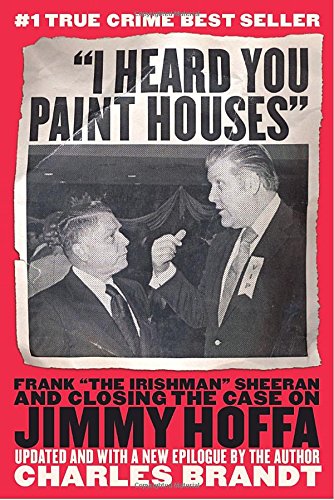
Frank “The Irishman” Sheeran
Jimmy Hoffa: “Would you like to be a part of this, Frank? Would you like to be a part of this history?”
Frank Sheeran: “Yes, I would. Whatever you need me to do, I’m available.”
– Frank Sheeran in “I Heard You Paint Houses: Frank ‘The Irishman’ Sheeran and Closing the Case on Jimmy Hoffa,” 2004
Frank Sheeran probably killed hundreds of people in his two years of service as an infantryman in World War II.
He was deployed for an unprecedented 345 days of hands-on combat at a time when soldiers still died hearing each side scream from only a few feet away. By comparison, most soldiers would see around 30 days of combat during a year of deployment. Frank had PTSD, like Rambo portrayed and countless war veterans experience. He became a functional alcoholic to combat his stress.
The army honorably discharged Frank and he quickly became a hitman for the Italian mafia. He was a calm but big and powerful Irish American brute who towered over anyone near him. And he had a work ethic honed by years of fighting in trenches, where even a single moment of lax attention led to death of your and your teammates. He had been stationed in Italy, where he learned a bit of Italian and acquired a thirst for red wine. It was so rare for the Italian mafia to welcome an Irishman into their family that they nicknamed Frank The Irishman.
In the 1950’s, dozens of thousands of WWII veterans were looking for work, and they were hired by mafia families to do what the government had trained them to do. Some were hired by companies to fight off unions trying to take over jobs, and some where hired by unions to balance the odds. By then the mafia and Teamsters shared their resources.
Pennsylvania mob boss Russell Bufalino introduced The Irishman to Jimmy Hoffa. The first thing Hoffa said to him was:
“I heard you paint houses.”
Hoffa and the mafia spoke in code, and in mafia lingo to paint houses meant to splatter a wall red with blood. The Irishman was a strong 6’6″ tall and towered a foot and two inches over Hoffa, yet Hoffa was so intense that even the combat veteran was shocked by his direct, no-nonsense introduction that he stammered before he regained his composure and replied;
“Yes. And I do my own carpentry work,”
meaning he also disposed of the bodies.
The rest is history. Hoffa set up The Irishman became a delivery truck driver for Teamster local #107 in Philadelphia. When not painting houses for Bufalino, Frank was a hard working Teamster who diligently loaded and unloaded products for Philadelphia businesses.
Working with the Teamsters was always a double-edged sword. Companies needed big trucks to stock shelves and carry away manufactured or grown products, and those trucks were ripe so ripe for picking that many companies just assumed a 10% cost of doing business with Teamsters.
“I work hard for them when I ain’t stealing from ’em,” Frank said.
He also ensured companies were incentivized to work with Local #107. If someone wouldn’t use union labor, their building would catch on fire or non-union workers would be beaten to the brink of death but left strong enough to share their story with other workers.
But if you were in the union you were like family, and Teamster membership soared during Jimmy Hoffa’s tenure. Members of Teamsters Local #326 in Delaware elected Frank Sheeran president in a role similar to Big Daddy’s in Baton Rouge Local #5. The FBI called both lieutenants in Hoffa’s army; the military reference would continue with them calling Big Daddy Hoffa’s sergeant at arms (the one tasked to maintain order, enforce rules, and provide security). The lines between the Teamsters and the mafia blurred; if there were a war, they were both against the Kennedys, especially after the president publicly declared he was going after the mafia.
Frank rose in the ranks of both the Teamsters and the Pennsylvania mafia families. To quench dissent of non-union laborers, or to silence mouthy members of the mafia, or to simply burn down a building, people called The Irishman. Sometimes he painted houses.
Though The Irishman was more than 6’6″ tall and still strong from his days in the infantry, he chose to use a pistol instead of beating someone to death because it was always business, never personal, and a pistol is quick and reliable and sends layered messages. And so did the quality of the work; the better the hit, the higher up the hitter. Frank used a bulky .357 when he wanted a loud bang! to disperse and confuse possible witnesses, and a smaller .38 when he wanted a mild pop! so someone would drop unnoticed. After a hit, he’d immediately wipe evidence off the pistol and throw it in a river and find a new one. This was long before DNA analysis, but FBI technology could lift fingerprints from anything touched and match bullets pulled from bodies or nearby buildings with the barrel that shot it.
Frank painted houses for more than thirty years without being caught. He was one of the last survivors of Hoffa’s inner circle when The Teamsters drove America. Long after both Hoffa and Big Daddy died, Frank went to prison, not for murder but for labor law violations and racketeering – the same charge that would stick to Big Daddy and Governor Edwin Edwards.
Frank had systemic arthritis, probably from years of humping heavy ruck sacks in the army, and he withered away in prison down to a thin 6’0″ version of his former self. An attorney and true-crime author named Charles Brandt facilitated The Irishman’s release from prison due to declining and probably terminal health. Charles wanted to document The Irishman’s history while there was time.
Charles had a reputation for extracting truth from witnesses and convincing juries of their authority. He was aided in coaxing stories from The Irishman by the coincidentally named Frank Weisman, a literary agent fascinated with Hoffa and the mafia and my grandfather and their roles in killing President Kennedy. That Frank knew what questions hadn’t been asked in all the books before, and he worked with Charles Brandt to dig deep into The Irishman’s memories and look for clues with relevance that even The Irishman wouldn’t have realized; there were so many pieces of the puzzle that very few, if any, people saw a bigger picture materializing from thousands of fragments.
Frank The Irishman was a tenacious old man who lived longer than anyone expected. Brandt and Frank the agent worked with him for 14 years to nurture I heard You Paint Houses into a narrative memoir that is also a treatise on Hoffa and the mafia. Aiding their effort was Frank Sheeran’s latent Irish Catholic upbringing: he wanted to confess his sins before he died. The Irishman confessed to around a dozen murders, including open FBI cases for famous mobsters like “Crazy Joe” Gallo. The FBI always followed hits on mafia hitmen because it usually led them to someone giving the orders. The big hit that Frank admitted two quick shots in the back of Jimmy Hoffa’s head with a pocket-sized .38 that painted a Detroit suburban house red on 22 July 1975.
Killing was business. Brandt develops The Irishman’s story to show that had he refused, he would have been a witness to the mafia’s plot and they would have killed him and probably his family, too. Towards the end of their 14 year effort, Brandt and Frank the agent got The Irishman to imply how big their business was.
“If they can whack a president, they can whack a president of a union,” Frank quoted mob boss Russell Bufalino as having said when planning Hoffa’s demise in the spring of 1975. The Irishman also says he saw other mafia hitmen carrying duffle bags that he, as an infantryman, recognized as bulging with assault rifles.
Frank passed away six weeks before his memoir was finally published. He died an subdued alcoholic confined to a wheelchair and barely recognizing people. Most people who knew him said that after Hoffa died, The Irishman was never the same and drank from what he says was guilt at killing his friend and mentor. What’s interesting to me, as a fellow combat infantryman, is that even with all of the violence Frank Sheeran saw in the Teamsters and mafia, he either refused to talk about his two years in combat or he couldn’t find the words to explain what he experienced and how it changed him into The Irishman and led him to shoot Hoffa in the back of his head.
Neither Hoffa’s body nor evidence of his demise have been found, not even with modern DNA analysis that was unfathomable back when Frank was doing carpentry work. Like tossing used pistols into a river, whatever they did with Hoffa’s body was done knowing that everyone would be looking for evidence with the best resources money could provide.
But The Irishman’s story seemed plausible, and the literary agent was reputable and the publishing company was thorough in editing; Frank the agent had been doing his job all along, and that led Martin Scorcese to buy the movie rights to I Heard You Paint Houses from Steerforth Press and raise $257 Million to make his opus about Hoffa and the mafia. Scorcese was of Hoffa’s generation, and I presume so were the investors.
By the time Scorcese bought the rights and began writing a film centered on the Irishman’s life, Hoffa had been missing 30 years; and by the time The Irishman film was released in theaters it had been 40 years. Younger people were fascinated: what about Hoffa made investors dump a quarter of a Billion dollars into a film about an old dead guy?
And some people doubted Frank’s word. Dan Moldea, an investigative journalist and author of Teamster history who was himself a Teamster under Hoffa and knew Big Daddy, The Irishman, and of course Hoffa, called The Irishman’s deathbed confession “a fabricated, self-serving confession from a pathological liar trying to secure money for his family.” Modela pointed at his own book with it’s own version of what happened, and he may one day get a movie deal for it.
And former assistant U.S. attorney general Jack Goldsmith, coincidentally the adopted son of Jimmy Hoffa’s mentee and runner and suspect in Hoffa’s disappearance, Chuckie O’Brien, became a Harvard professor and spent seven years writing a book that exonerated O’Brien. Coincidentally, he had released his memoir, “In Hoffa’s Shadow, “In Hoffa’s Shadow: A Stepfather, a Disappearance in Detroit, and My Search for the Truth” in 2019, just before The Irishman was released in theaters. In response to The Irishman’s claims about killing Hoffa, Goldsmith was much more subtle correct than the cranky old Teamster Moldea, and he said that facts did not support The Irishman’s claims; specifically, Goldsmith pointed to The Irishman claiming he flew into Detroit on a private plane but the timing not being possible based on FBI records of Hoffa’s final calls and the distance to the suburban house The Irishman allegedly painted with Hoffa’s blood; and, because The Irishman said Chuckie O’Brien drove them to the house, which was a common belief for decades, Goldsmith pointed to his book that exonerated O’Brien as evidence The Irishman fabricated the final parts of his book.
When it comes to solving Jimmy Hoffa’s disappearance, the jury’s still out.
In the months before Wendy died, Scorcese’s marketing budget poured advertisements for The Irishman’s summer release. After she died thoughts of The Irishman and my family’s part in history plagued my waking moments, and I woke up with my mind cluttered from visions of Wendy and me in the 1970’s and images of Big Daddy before he went to prison in 1980. I ordered around 50 books from Amazon not already on my bookshelf, and I used the internet to research what was publicly known and compare that to what existed in letters and memorabilia packed in tattered cardboard boxes, or in anecdotes stored in the dusty attic of my memories. My search was akin to digging up random football fields looking for the decomposed body of an old dead guy, but for me it was more like trying to find out what happened back then that made my mother abandon me and die an alcoholic decades years later?
To learn what I uncovered, it’s useful to start with Jimmy Hoffa.
He famously vanished from Detroit’s Red Fox diner parking lot on 22 July 1975. Though there may be debate on whether or not The Irishman killed him, the details of Jimmy Hoffa’s rise and his life up until the day he vanished are well known. What I write next is what I believe – based on what I’ve read about Hoffa and the mafia – and how it relates to Wendy and me and growing up in the Partin family.
Go to the Table of Contents