The JFK and MLK Assassination Report
“Finally, a note on Hoffa’s character. He was a man of strong emotions who hated the President and his brother, the Attorney General. He did not regret the President’s death, and he said so publicly.”
– The John F. Kennedy and Martin Luther King Junior Assassination Report.
I’m Jason Ian Partin.
A few months after my grandfather’s funeral on 11 March 1990, I served with Anti-Tank Platoon #4, Delta Company, 1/504th Parachute Infantry Regiment, 82nd Airborne Division of the United States army in Desert Shield and Desert Strom, which began on 03 August 1990 and ended on 04 March 1991, one week shy of being a year since Big Daddy had died. In 1993, when the 1976 John F. Kennedy and Martin Luther King Junior Assassination Report was first made public, I was still in the 82nd Airborne and was on newly elected President William “Bill” Clinton’s quick-reaction force; that was when Clinton released the first part of the 1976 John F. Kennedy Assassination Report, and 1993 was the first time I first saw Big Daddy implicated in killing President Kenndy.
It took Oliver Stone’s 1991 film JFK to prompt the release of the report. JFK was based on New Orleans attorney general Jim Garrison’s memoir about the only trial against alleged Kennedy assassination contributors and implicated FBI and CIA agents that voters demanded to see the file; like The Irishman, JFK was layered with stars to sell tickets and some would overlap with The Irishman decades later (Jim Garrison, the New Orleans district attorney who arrested Big Daddy based on photos of him with Oswald and Ruby, had a cameo as Chief Justice Earl Warren, and Joe Pesci played the pilot who was in the civil air patrol with Oswald in JFK and mob boss Russel Bufalino in The Irishman).
10 Million people saw JFK in theaters, and in 1992 voters demanded that incumbent president William “Bill” Clinton to release part of the report when he assumed office in January of 1993.
The report was released publicly, but the internet was so nacent in 1993 that few people were logged on and practically no documents were released. And the report was too massive to publish; when I downloaded a copy after Wendy died in 2019, it took almost ten minutes using relatively high end WiFi connections in the technology hub of San Diego; with a modem in 1993, that file would probably still be downloading today. But, an army of journalists, hobbyists, and people hoping to cash in on solving Kennedy’s murder quickly published excerpts, pamphlets, and – over the next two years – entire books.
Fayetteville, the small civilian town next to Fort Bragg, didn’t have a Barnes and Noble or Borders bookseller, so I dug deeper into my family’s history using my Fort Bragg library card.
With a pen and notepad in hand, I began cross-referencing the assassination report with books I remembered on all of my grandmothers’s shelves. My mind overlaid family memories. These are some of the things that stood out to me.
The JFK and MLK Assassination Report reverased the hastily assembled 1964 Warren Report.
It said:
“Since the Warren Commission’s and FBI’s investigation into the possibility of a conspiracy was seriously flawed, their failure to develop evidence of a conspiracy could not be given independent weight.”
They refuted that Lee Harvey Oswald acted alone.
“The committee conducted a three-pronged investigation of conspiracy in the Kennedy assassination. On the basis of extensive scientific analysis and an analysis of the testimony of Dealey Plaza witnesses, the committee found there was a high probability that two gunmen fired at President Kennedy.“
And after enough paperwork to fill a fleet of Teamster dump trucks, the committee narrowed down the suspects for orchestrating Kennedy’s murder to three men.
“Following the completion of its investigation of organized crime, the committee concluded in its report that Carlos Marcello, Santos Trafficante, and James R. Hoffa each had the motive, means, and opportunity to plan and execute a conspiracy to assassinate President Kennedy.”
Hundreds of pages of evidence pointed to my grandfather being behind the scenes of killing President Kennedy. But the fingers pointed past him and at Jimmy Hoffa. And I realized that all of that had been hidden from even the highest source of justice in America, the United States Supreme Court.
They report said:
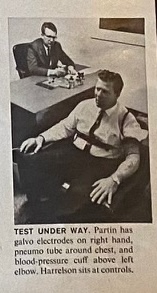
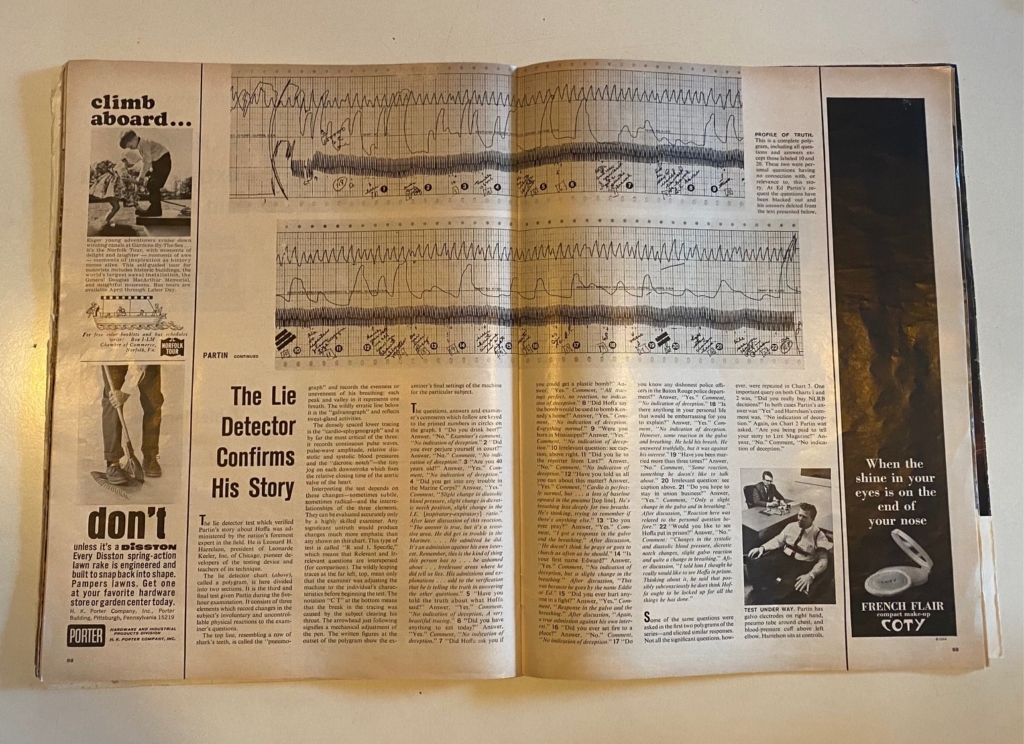
In October 1962, acting under the orders of Attorney General Kennedy, FBI Director Hoover authorized a detailed polygraph examination of Partin. In the examination, the Bureau concluded that Partin had been truthful in recounting Hoffa’s discussion of a proposed assassination plan. Subsequently, the Justice Department developed further evidence supporting Partin’s disclosures, indicating that Hoffa had spoken about the possibility of assassinating the President’s brother on more than one occasion.
And more and more.
Clinton had released approximately 60% of the report, which, despite the Freedom of Information Act, meant that 40% of the report was kept classified. Apparently, a president got the last word on what was too important for national security or other reasons, and even the Freedom of Information Act couldn’t force the president into releasing the almost 20 year old JFK and MLK Assassination Report until they decided it was time.
I don’t know why presidents Johnson, Ford, Carter, Reagan, Bush Senior, Clinton, Bush Junior, Obama, Trump, and Biden kept what they knew classified; or why Trump in his second presidential win decided to release the final part in January of 2025, sixty two years and ten presidents after Kennedy was shot and killed. If I were president, I’d want everyone to know how to stop people from killing presidents.
Thoughts about what happened and how to prevent it formed in my head over the years, especially after focusing on nothing else during the Covid-19 pandemic, and I’ll let those drip out in other parts of this book. But I want to end this part by touching on why the congressional committee on assassinations grouped the murders of John F. Kennedy and Martin Luther King together into one report. I have only begun digging into it’s trove of history.
This is what I believe as of now.
Martin Luther King Junior was shot and killed by a lone sniper in Memphis, Tennesee, on 04 April 1968. The evening before, King gave his final public speech entitled “I’ve been to the mountaintop,” which proved to be prophetic. Near the end of his final speech, Martin Luther King Junior said:
“And then I got to Memphis. And some began to say the threats … or talk about the threats that were out. What would happen to me from some of our sick white brothers? Well, I don’t know what will happen now. We’ve got some difficult days ahead. But it doesn’t matter with me now. Because I’ve been to the mountaintop. And I don’t mind. Like anybody, I would like to live a long life. Longevity has its place. But I’m not concerned about that now. I just want to do God’s will. And He’s allowed me to go up to the mountain. And I’ve looked over. And I’ve seen the promised land. I may not get there with you. But I want you to know tonight, that we, as a people, will get to the promised land! And so I’m happy, tonight; I’m not worried about anything; I’m not fearing any man. Mine eyes have seen the glory of the coming of the Lord!“
The next day he was shot through the cheek by a single .30-06 rifle round, pronounced 30 ot’ 6, a former military round and to this day one of the most common long-range, big game hunting cartridges.
Escaped convict and racist James Earl Ray confessed to killing King, but, like Jack Ruby, later recanted his confession and asked for a trial by jury. Parole boards denied Ray’s request, and in 1988 he died in prison. Some historians say he was a scapegoat, similar to how Lee Harvey Oswald claimed to be “just a patsy,” and that, like conspiracy theories about Kennedy, King’s death was orchestrated by a collaboration between people in the FBI and CIA, the mafia, and local police. Like with JFK, the jury is still out and may never reach a conclusion about what happened to Martin Luther King. To me, any answer would have to come from a bigger picture view, which is what I would spend my lifetime pondering yet still do not fully understand. The 1960’s were known to many as a time of peace and love and the hippie movement in California that drew Wendy there, but it was also a time of racial unrest, widespread violence against African Americans by Americans in uniform armed with attack dogs, fire hoses, billy clubs, and conspiracy plots to kill anyone seeking change.
After John F. Kennedy, Malcom X was shot and killed by three armed men from a rival Nation of Islam following in 1965, though even that trial has decades of controversy and may never be fully understood. And after Martin Luther King’s murder, Bobby Kennedy would soon be shot and killed. But first he would announce the news of King’s death at his presidential campaign rally in a predominately African American community of Indianapolis.
He said: “For those of you who are black and are tempted to be filled with hatred and mistrust of the injustice of such an act, against all white people, I would only say that I can also feel in my own heart the same kind of feeling. I had a member of my family killed, but he was killed by a white man.”
Kennedy’s words were impromptu, and the touch of humanity cooled flames of hatred in Indianapolis. Nationwide, though, riots engulfed America. President Johnson called for a day of peace and mourning, and launched an investigation that would eventually be included with the investigation into President Kennedy’s murder.
Bobby Kennedy was shot and killed in June of 1968 by the redundantly named Serhan-Serhan soon after the six-part 1968 Life expose on organized crime that highlighted Big Daddy’s defiance against the mafia. At the time, Kennedy was expected to win the democratic presidential nomination and go on to win the presidency.
J. Edgar Hoover died from a heart attack at age 74 in May of 1972, coincidentally when I was beginning my second trimester inside of Wendy, and only a few weeks longer than Hoffa was released from prison. Johnson died of a heart attack at 64 years old in January of 1973. No one reputable suspects foul play in Hoover’s or Johnson’s deaths. Serhan-Serhan is still in jail without any conspiracy links. All have been subjected to intense scrutiny by historians, investigative journalists, and an internet overflowing with conspiracy enthusiasts. As I write this, I’m convinced that Hoover was a detailed and analytical FBI agent, and there were reasons he personally oversaw each of the photos Life and Look! used to showcase my family in national media.
Later research would uncover that the lifelong bachelor J. Edgar Hoover was married to the FBI and spent 45 years shaping modern surveillance technology. He would be remembered also become known for using that technology to collect embarrassing and sometimes illegal information on politicians and judges and then blackmail them; Hoover shaped America from behind his desk. In that desk, he kept copies of shirtless FBI agents and his old college fraternity brothers; that may explain why he chose the shirtless photo of Big Daddy in the 1964 Life magazine. I never learned if he kept the original copy, or if he just taped the copy from Life magazine somewhere.
Whatever happened, I believe that J. Edgar Hoover and Bobby Kennedy used Big Daddy’s handsome, smiling, aryan face to frame Jimmy Hoffa because they believed Hoffa was behind killing President Kennedy.
In his two autobiographies, Hoffa admitted he went to prison because he lost the Blood Feud to Bobby Kennedy, and he lost because he trusted Big Daddy. Hoffa also casually admits he was happy when he learned President Kennedy died; his hatred of the Kennedy’s was never in doubt, nor did he every contest Big Daddy’s testimony. Not once.
Some people say Big Daddy had recordings or other evidence of Hoffa’s involvement in killing Kennedy. Others say Hoffa, like most people who knew my grandfather, was simply afraid of crossing him. I never learned more, though I suspect it was a combination of the two.
Solving Kennedy’s murder became something like a hobby. And so did America’s system of justice.
Time and time again, I kept finding myself turning back to Big Daddy’s testimony against Hoffa and the resulting Supreme Court verdict in Hoffa versus the United States, which is the next chapter.
Go to the Table of Contents