
The JFK and MLK Assassination Report
“We can report that Edward G. Partin has been under investigation by the New Orleans District Attorney’s Office in connection with the Kennedy Assassination investigation… based on an exclusive interview with an Assistant District Attorney in Jim Garrison’s office. We can report that Partin’s activities have been under scrutiny. In his words: “We know that Jack Ruby and Lee Harvey Oswald were here in New Orleans several times… there was a third man driving them and we are checking the possibility it was Partin.”
WJBO radio, New Orleans, 23 June1964
“As noted in the account of Ruby’s telephone records, the committee confirmed the existence of several contacts between Ruby and associates of Hoffa during the period of October and November 1963, including one Hoffa aide whom Robert Kennedy had once described as one of Hoffa’s most violent lieutenants.”
– The 1976 Congressional Committee on Assassinations John F. Kennedy and Martin Luther King Jr. Assassination Report
The congressional committee on assassinations finalized the John F. Kennedy and Martin Luther King Jr. Assassination Report in 1976, thirteen years after Kennedy was shot and killed and eight years after Martin Luther King was. But the report remained classified until President William “Bill” Clinton released part of it in 1993.
It took Oliver Stone’s 1991 film JFK to prompt the release of the report. JFK was based on New Orleans attorney general Jim Garrison’s memoir about the only trial against alleged Kennedy assassination contributors and implicated FBI and CIA agents that voters demanded to see the file. The 6’8″ and flamboyant Jim Garrison had a cameo in JFK as Chief Justice Earl Warren, otherwise Oliver Stone’s promotions and the list of actors in JFK was enough to draw audiences to the theater. The film was timed to resonate with voters for the 1992 presidential election.
10 Million voters saw JFK in theaters and then demanded that whomever was elected release the report. Attorney and Arkansas governor Bill Clinton had campaigned saying that his role model was John F. Kennedy, so he may have been motivated to released the report on his own. Regardless of his motivation, when Clinton assumed office in January of 1993 he released approximately 60% of the report.
Chronologically, the report began in October of 1962, when my grandfather and Jimmy Hoffa plotted killing Bobby Kennedy. It was a massive report; even with only 60% released, the piles of paperwork would filled a fleet of Teamster dump trucks. But what floated to the top of the pile was that the years of investigation leading up to the 1976 JFK Assassination Report reversed the hastily assembled 1964 Warren Report. It said:
“Since the Warren Commission’s and FBI’s investigation into the possibility of a conspiracy was seriously flawed, their failure to develop evidence of a conspiracy could not be given independent weight.”
And:
“The committee conducted a three-pronged investigation of conspiracy in the Kennedy assassination. On the basis of extensive scientific analysis and an analysis of the testimony of Dealey Plaza witnesses, the committee found there was a high probability that two gunmen fired at President Kennedy.“
And it highlighted three suspects, or at least three people capable of orchestrating Kennedy’s murder. It said:
“Following the completion of its investigation of organized crime, the committee concluded in its report that Carlos Marcello, Santos Trafficante, and James R. Hoffa each had the motive, means, and opportunity to plan and execute a conspiracy to assassinate President Kennedy.”
Chronologically, the report began in October of 1962, when my grandfather and Jimmy Hoffa plotted killing Bobby Kennedy and cross-referenced FBI reports centered around their meeting.
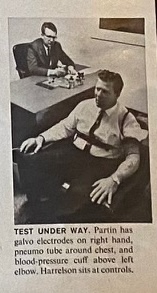
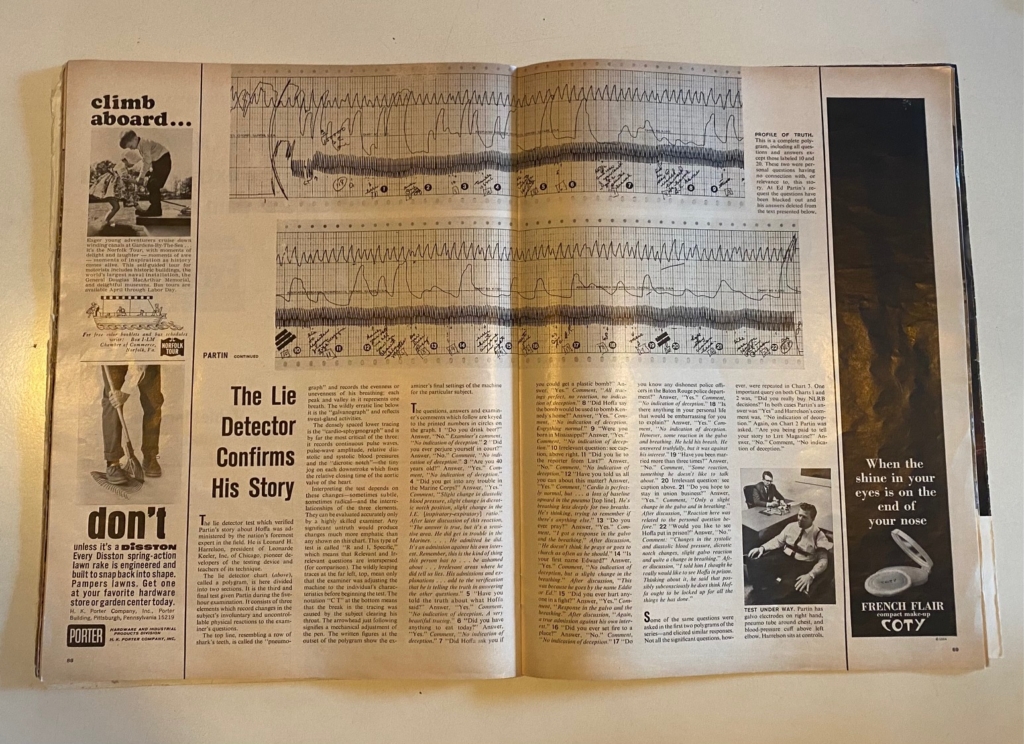
In October 1962, acting under the orders of Attorney General Kennedy, FBI Director Hoover authorized a detailed polygraph examination of Partin. In the examination, the Bureau concluded that Partin had been truthful in recounting Hoffa’s discussion of a proposed assassination plan. Subsequently, the Justice Department developed further evidence supporting Partin’s disclosures, indicating that Hoffa had spoken about the possibility of assassinating the President’s brother on more than one occasion.
Hundreds of pages of evidence pointed to my grandfather being behind the scenes of killing President Kennedy. But the fingers pointed past him and at Jimmy Hoffa.
All of that had been hidden from even the highest source of justice in America, the United States Supreme Court in Hoffa versus The United States.
When I first read the report in 1993, I was coincidentally a paratrooper on President Clinton’s quick-reaction force and under review for a national security clearance and diplomatic passport. From that point on, I followed every president’s release of more of the report all the way until January of 2025, when President Trump released the final part at the beginning of his second presidency. I don’t know why presidents Johnson, Ford, Carter, Reagan, Bush Senior, Clinton, Bush Junior, Obama, Trump, and Biden kept what they knew classified; if I were president, I’d want everyone to know how to stop people from killing presidents.
But I never saw much use from anything released after 1993, but that’s because I knew Big Daddy and grew up hearing the names I read in the JFK Assassination Report and believed then, like I do now, that my grandfather was one of the orchestrators; or, he was at a high enough level and talented enough at hiding his trail that he would have known who – and how – people orchestrated murdering President Kennedy.
Solving Kennedy’s murder became something like a hobby of mine. And so did America’s system of justice. A quirk of joining the military that few people ponder is that you swear not to follow people or orders blindly, but to “defend the Constitution of the United States from all enemies, foreign and domestic.” I wanted to always be aware of my legal rights, and how they changed from the U.S. Constitution’s original Bill of Rights. As books and theories and films followed the 1993 release of the JFK Assassination Report, I kept seeing Pulitzer prized awarded to “definitive” works, a slew of other awards for conflicting “definitive” works, and a tsunami of opinions on who killed Kennedy and why.
I never saw anything useful until The Irishman film was advertised in 2019 and I read the original 2004 book and an additional paperback printing that had a few more specific comments on Kennedy’s murder. It took Wendy’s death in 2019 and the two-year global shutdown from Covid-19 for me to focus and begin writing drafts of what you’re reading now.
Time and time again, I kept finding myself turning back to Big Daddy’s testimony against Hoffa and the resulting Supreme Court verdict in Hoffa versus the United States, which is the next chapter.1
Go to the Table of Contents
- I want to end this part by touching on why the congressional committee on assassinations grouped the murders of John F. Kennedy and Martin Luther King together into one report. I have only begun digging into it’s trove of history. Bobby Kennedy authorized FBI surveillance of Martin Luther King as a threat to America, or at least one establishment’s version of it; and, conversely, effigies of both Bobby Kennedy and J. Edgar Hoover were publicly lynched and burned in the American south by people who thought they were sympathetic to African Americans. Understanding Martin Luther King Junior’s life and assassination and legacy would require a seperate focus.
This is what I believe as of now; to be transparent, most of what I know is from Wikipedia, which will show up later in this story.
I believe Martin Luther King Junior was shot and killed by a lone sniper in Memphis, Tennesee, on 04 April 1968.
The evening before, King gave his final public speech entitled “I’ve been to the mountaintop,” which proved to be prophetic. Near the end of his final speech, Martin Luther King Junior said:
“And then I got to Memphis. And some began to say the threats … or talk about the threats that were out. What would happen to me from some of our sick white brothers? Well, I don’t know what will happen now. We’ve got some difficult days ahead. But it doesn’t matter with me now. Because I’ve been to the mountaintop. And I don’t mind. Like anybody, I would like to live a long life. Longevity has its place. But I’m not concerned about that now. I just want to do God’s will. And He’s allowed me to go up to the mountain. And I’ve looked over. And I’ve seen the promised land. I may not get there with you. But I want you to know tonight, that we, as a people, will get to the promised land! And so I’m happy, tonight; I’m not worried about anything; I’m not fearing any man. Mine eyes have seen the glory of the coming of the Lord!“
The next day he was shot through the cheek by a single .30-06 rifle round, pronounced 30 ot’ 6, a former military round and to this day one of the most common long-range, big game hunting cartridges.
Escaped convict and racist James Earl Ray confessed to killing King, but, like Jack Ruby, later recanted his confession and asked for a trial by jury. Parole boards denied Ray’s request, and in 1988 he died in prison. Some historians say he was a scapegoat, similar to how Lee Harvey Oswald claimed to be “just a patsy,” and that, like conspiracy theories about Kennedy, King’s death was orchestrated by a collaboration between people in the FBI and CIA, the mafia, and local police.
Like with JFK, the jury is still out and may never reach a conclusion about what happened to Martin Luther King. To me, any answer would have to come from a bigger picture view, which is what I would spend my lifetime pondering yet still do not fully understand; if I realize anything useful, it’ll be in another book.
Bobby Kennedy was one of the first people to announce King’s murder. He was about to speak at one of his presidential campaign rallies in a predominately African American community of Indianapolis . This was long before cell phones or other forms of instant news; one of Bobby’s aides told him what had happened, and Bobby began his campaign by telling the audience what happened, and by saying:
“For those of you who are black and are tempted to be filled with hatred and mistrust of the injustice of such an act, against all white people, I would only say that I can also feel in my own heart the same kind of feeling. I had a member of my family killed, but he was killed by a white man.”
↩︎