
Partin vs Partin
“[Jimmy Hoffa’s] mention of legal problems in New Orleans translated into his insistence that Carlos Marcello arrange another meeting with Partin, despite my warning that dealing with Partin was fruitless and dangerous.”
“He wanted me to get cracking on the interview with Partin. In June, Carlos sent word that a meeting with Partin was imminent and I should come to New Orleans. As [my wife] watched me pack in the bedroom of our Coral Gables home, she began crying, imploring me not to see Partin. She feared that it was a trap and that I would be murdered or arrested.”
– Frank Ragano, J.D., attorney for Jimmy Hoffa, Carlos Marcello, and Santos Trafacante Jr., in “Lawyer for the Mob,” 1994
As soon as Murphy died, Big Daddy recanted his recant. The mafia spread word that Big Daddy had Audie Murphy and the passengers on his plane killed rather than free Jimmy Hoffa. That belief was so strong that it stuck in Doug Partin’s mind until the day he died. In his 2014 book, Doug dedicates two chapters to describing two plane crashes at that time, Audie’s and another person who challenged Big Daddy’s authority, and Doug always swore that his big brother was capable and willing to kill even a true All American hero to get what he wanted. That’s how I grew up believing my grandfather had killed America’s most decorated war hero.
Hoffa grew agitated in his prison cell. Word got out that Hoffa was using insight into President Kennedy’s assassination to get out of prison; in other words, Hoffa could point a finger in exchange for his freedom. But the mafia still clung to the temptation of $121 Million of debt forgiven, and then more access to the Teamster pension fund, if they helped Hoffa. I also assume that some people believed it would be easier to silence Hoffa outside of prison than deal with the fallout of him dying in prison.
The mafia continued to help Hoffa; simultaneously, they sent a strong message that he should stop talking about President Kennedy because his control of the pension fund used for Hollywood films and mafia businesses was over.
At least one mafia family was known to be advising Francis Ford Copula for 1972’s The Godfather, a masterpiece film released the year I was born that set the standard for realistically depicting organized crime families; behind the scenes, leaders of mafia advised Copula on the first true depiction of mafia and Hollywood overlap. In one of the most famous scenes, an arrogant Hollywood producer who disrespects The Godfather wakes up with a severed horse head bleeding across his bedsheets, which is, to me at least, an obvious reference to the Teamsters horse heads of Thunder and Lightening shown at the end of older Hollywood films.1
Hoffa pursued every chance of freedom he could envision. While The Godfather was being filmed, Hoffa funded Nixon’s campaign and gave his endorsement even without Big Daddy’s affidavit.
It was the first time in history a major labor union endorsed a republican. When asked, Hoffa said in his typical personalized approach: “I would say President Nixon is the best qualified man at the present time for the Presidency of the United States in my own personal opinion.”
Nixon was re-elected and commuted Hoffa’s sentence in time for Christmas in 1971, only days before Wendy met Edward Grady Partin Junior and I was conceived. The news quietly mentioned my family daily but it was drowned out by the Mai Lai massacre by teams of American soldiers who raped, killed, and tortured a village of hundreds of women, children, and elderly men not conscripted into service had just become the focus of anti-war protests; even heroes like Audie Murphy were shunned as part of the out of control war machine; no hero would fight, a real hero would refuse the draft and become a conscientious observer (Vietnam was no WWII in their eyes, and the Vietcong were not Nazis; to my parents’s generation, the new all-American hero was a pacifist). Audie’s status as an American hero diminished, and politicians began an anti-war rhetoric in response to voter demands.
Nixon had campaigned that he’d begin withdrawing the 550,000 American soldiers in Vietnam, and part of his deal with Hoffa included Hoffa was wooing veterans by saying Hoffa would represent Nixon in negotiating the return of American Prisoners of War and – ironically, as it would turn out for Hoffa – find remains of around 50,000 unaccounted for soldiers, most of who remain hidden and probably will be forever. Hoffa, known for his successful negotiation tactics, rallied; he also began his own campaign for prison reform, saying that not even he had realized how cruel and hopeless prison could be (a stark difference from Big Daddy’s eventual role in a minimum security prison with his own color television to watch him and Hoffa portrayed by actors).
But Nixon wasn’t altruistic. He famously said “I’m not a crook” soon before facing an inevitable impeachment for the Watergate scandal and his role in obstructing justice and, ironically given Hoffa versus The United States, illegal wiretapping. He resigned the presidency in 1975, and Richard Nixon’s role in history is immortalized in the surf break under his San Clemente mansion named after him: Slippery Dick.
Slipper Dick impacted my life directly with a subtle caveat in Hoffa’s 1971 release from prison; Richard Nixon slipped a clause into Jimmy Hoffa’s contract that surprised even Hoffa’s legal team: Nixon barred Hoffa from Teamster activity for another eight years and stipulated that Hoffa would return to prison if he violated the terms. In other words, Big Daddy’s word still kept the freed Hoffa away from his coveted Teamster leadership role.
The Irishman wrote:
“It said that Jimmy could get out with his good time and all in November 1975, but Nixon was letting him out now. It didn’t say one word about Jimmy not being able to run for office until 1980. I can assure you that I would have picked that up right away. Jimmy was already planning to run in 1976. I might not have a lott of education, but I had been reading union contracts and legal documents for a living for many years. I had read hundreds of documents that were far more complicated than that pardon. All it said was that Jimmy was getting out, finally. We were happy people in that lunchroom, and after a lot of double-crossing by Partin and Fitzsimmons and Nixon and Mitchel, Jimmy was finally getting what he paid for. He was getting out for Christmas.”
Hoffa got out of prison and wanted back in control of the Teamsters. The Irishman said:
“Once he got out of jail he was goin gto take back control of everything. And I was going to help him.”
Frank knew how to help Hoffa get what he wanted. He knew a lot of men with names who would show up in his memoir and on film in Martin Scorcese’s The Irishman, men like Felix “Skinny Razor” DiTullio, Joseph “Crazy Joe” Gallo, Salvatore “Sally Bugs” Briguglio, Whispers DiTullio, and more. To get what they wanted or what was asked of them, these men were known to torture victims, kill their family members, or do whatever their bosses ordered. To refuse was to end up dead at the hands of your peers. The entire U.S. mafia was alerted that Edward Grady Partin still needed to change his testimony.
Frank Sheeran grew up Irish Catholic and like most people had probably heard the bible’s guidance to “do onto others as you would have them do onto you.” Because of Time magazine and Hoffa’s rants, all of America knew that Big Daddy was in jail for kidnapping when he made a deal to get Hoffa. Frank said he may not have much education but he could read contracts, and I assume most mafia hitmen back then could read the phone book or knew someone who could. He would have sent word that Edward Partin was needed alive, and mafia families who knew what he meant responded. Their only restraint was that my grandfather should not be killed.
As a coincidence, J. Edgar Hoover died in 1972; even Nixon’s desire to use Big Daddy to get rid of Hoover became old news. Hoffa’s importance was dwindling and the mafia was growing frustrated with his arrogance. Bobby Kennedy had been shot and killed in 1968, and only Walter Sheridan was left to oversee my family’s safety. The Partins had lost the judges who gave them legal protection, the black-suited agents who protected their bodies, and the patriarch, Big Daddy, who was being flown all over the country for meetings and court dates, which the mafia knew about, and he was rarely at home. Starting in 1972, men behind the scenes of The Godfather and killing President Kennedy set their sites on Baton Rouge.
There were only five Partins listed in the Baton Rouge phone book back then. Big Daddy’s daughters had married and taken other names that no one knew, and my grandmother, Mamma Jean Partin, had moved to Houston under FBI protection after Big Daddy testified against Hoffa. The Partins in the phone book were my grandfather’s little brothers, my great-uncles and equally as huge as Big Daddy, Douglas Wesley Partin, a senior Teamster manager, and Donald Joseph “Coach Joe” Partin, Zachary High School’s football coach; two of my cousins, Doug and Don; and a listing for Edward G. Partin near the Comite River Bridge.
With the new Interstate 10 connecting New Orleans to Baton Rouge it was only an hour drive between the two, and there was a phone book in every phone booth and convenience store once they arrived. No one would have known there was an Edward Grady Partin Junior. They would have approached the house thinking whoever lived there put fear into Jimmy Hoffa, demanded respect by Carlos Marcello, and could kill Audie Murphy.
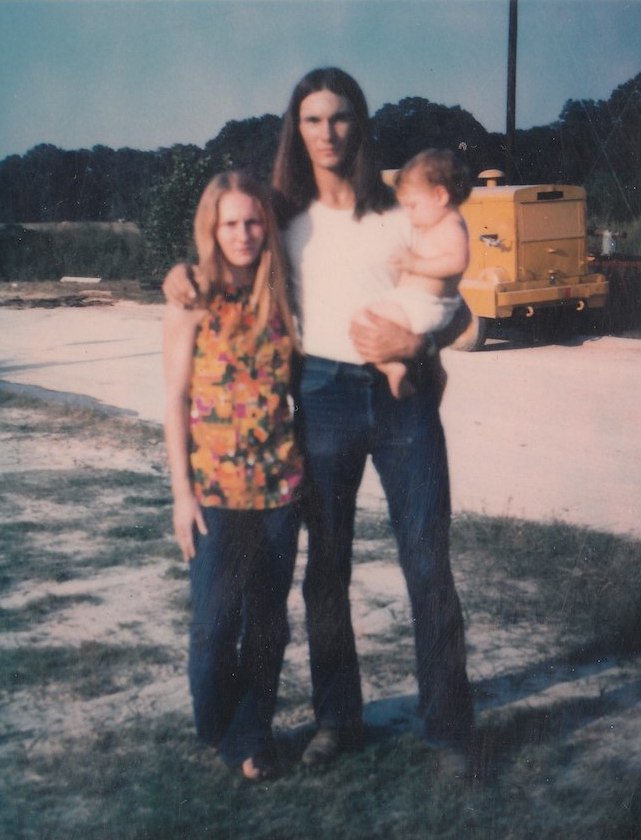
My dad was rarely home, so Wendy and I were usually there alone. She was a petite teenager and I called her Wendy; most people thought I was her little brother. I believe anyone looking up Edward G. Partin’s home address and showing up unannounced and when my dad was away would have assumed Wendy and I were Big Daddy’s children.
I have flashes of memories from my first few years of life, and they’re all centered around bursts of pain and fear and fire and explosions and burning houses and Wendy screaming and people grabbing my arms and me waking up in hospitals. I have scars on the back of my head I do not recall receiving, and x-rays of my left elbow show growth plates hindered by an old fracture I do not remember breaking.
All of my Partin family had the same experiences in Baton Rouge. In 1973 my cousin Don was run off the road and has spent his life since then in a wheelchair. Uncle Doug was beaten and his house ransacked and then set on fire; he assumed it was Teamsters looking for the $450,000 Big Daddy had stashed inside the walls of one of his houses along with other cash and explosives; he was mostly out of town, but news reports would show him with knife and bullet wounds, and the Local #5 was shot up and reported at least once.
I don’t know what Wendy remembers from that time. She would never talk about it, and she passed away just as I was beginning to put all of this together into a plausible version of what led her to abandon me. But nothing from that time period sticks in my memory as fact; it’s just stories from books and movies and Doug and Don and Big Daddy, but at a time where Big Daddy was rarely home and was instead flying all over America meeting presidents and trying to stay out of jail. My dad was out of the country buying drugs. Wendy was still just a teenager when she abandoned me and fled for California.
I was in foster care when Hoffa vanished on 22 July 1975. Whether or not Frank Sheeran pulled the trigger that killed Hoffa is probably less important than the accepted belief that the national mafia kissed him into silence and what happened to Jimmy Hoffa became America’s most famous unsolved mystery. What’s known fits his persona. He was waiting for a 2pm meeting at The Machus Red Fox Restaurant in Detroit with what we presume were mafia leaders to discuss Hoffa regaining control of the Teamster pension fund. Whoever was supposed to meet him was late, and that sparked Hoffa’s intense anger. Telephone records show him using the Machus Red Fox pay phone to call and speak with his his wife from around 2:15pm to 2:30pm; he told her he’d be home around 4pm. He hung up and vanished like a magician’s pet rabbit.
The next day, the name Edward Partin lost its use and federal protection. That’s when Judge JJ Lottinger assumed oversight of my case in the East Baton Rouge Parish 19th Judicial District and began helping Wendy get custody of me.
Lottinger was the family name of many Louisiana attorneys back then. At least one of the Lottingers was a legislative attorney on Governor McKeithan’s staff when McKeithan spent eight years trying to rid the state of Big Daddy. When I began cross-referencing names during my 2020 internet search, I stumbled upon my 1976 custody court records, and the presiding judge was JJ Lottinger, a newly appointed family court judge in East Baton Rouge Parish and I believe one of McKeithen’s staff who knew the name Partin well.
For decades my custody report was only available in the East Baton Rouge Parish 19th Judicial District under Partin versus Partin. It was the same courthouse that had removed a young Teamster’s kids in 1964 that led to Big Daddy kidnapping them as part of what Hoffa called “a minor domestic problem,” and I assume any judge there would have known my family name, especially because Hoffa versus The United States was fresh in everyone’s mind and the Partins were so well known in Baton Rouge.
When I read it in 2020, what surprised at first was that I had – and still have – a fuzzy memory of Judge Lottinger and Wendy and me. I can see us in what must have been his private chambers in the downtown courthouse; he had a kind smile and asked me to call him Judge JJ and I felt I could trust him. That felling persisted for more than 40 years, which was the surprise. What Judge JJ learned he documented in Partin versus Partin, and this is what he had to say about Wendy and me in 1976:
This is a suit by Edward Partin, Jr., plaintiff, seeking a divorce from his wife, Wendy Rothdram Partin, defendant, after having lived separate and apart for more than one year following a judgment of separation from bed and board. Plaintiff also seeks custody of the minor child, Jason Ian Partin, and the defendant reconvened asking that she be granted the permanent care, custody and control of the minor child.
The Trial Court had previously, by ex parte order, awarded the temporary care, custody and control of the minor to Mr. and Mrs. James Ed White. Following trial on the merits, plaintiff was awarded a divorce as well as the permanent care, custody and control of the minor child, with the temporary physical custody of the minor child to remain with Mr. and Mrs. James Ed White. The defendant has appealed this judgment as it regards the custody of the child.
This couple was married when plaintiff was 17 and the defendant was 16 years of age. Nine months following the marriage, they gave birth to young Jason. While we are not concerned with the facts surrounding the separation and divorce, it was apparently one of incompatibility as defendant testified that at the age of 17 she found herself married to a man who did not love her and so she left. Her testimony was as follows:
“As I say I was emotionally upset. I was receiving little support from Edward. I was scared, very confused. I didn’t know exactly which way to turn. I felt I had no one to listen and help with the situation at hand.”
Several weeks later she returned and lived with her husband again. She found that the situation hadn’t changed, and felt she had to get away again. She heard of a man who wanted someone to share expenses on a trip to California, so she quit her job and with her last wages left with him. She testified that she had no sexual relations with this man, and plaintiff does not accuse her of such. Following this trip she returned to Baton Rouge still emotionally upset. Her husband was suing her for separation and told her he was going to take custody of Jason. She went to live with her aunt and uncle, got a full time job with Kelly Girls paying $512.00 per month.
In February, 1975, the defendant’s mother was injured in an accident and she moved in with her to care for her. In September, 1975, following the recuperation of the mother she returned to live with her aunt and uncle.
During these above periods of time, the minor child lived with Mr. and Mrs. White. The Whites came to regard Jason as their own and, although the separation judgment awarded custody to the plaintiff with reasonable visitation privileges to the defendant, the Whites decided the defendant-mother could only see the child two days a month and that she could never keep the child over night. The reason the defendant did not contest custody at the separation trial was because at the time she felt unable emotionally and financially to care for her son.
We note that the petition for separation was grounded on habitual intemperance, as well as abandonment of the husband and the minor child. There are no other grounds listed for the separation nor for custody. The petition for the separation and custody of the minor child was not contested by the defendant, and a default judgment was granted. Defendant testified in the instant proceedings that the reason she did not contest custody in the separation proceeding was that she was not financially or emotionally capable of caring for the minor, and that knowing the Whites were going to be caring for him, she knew he would be in good hands.
Though the petition for separation had as one of its allegations “habitual intemperance”, the plaintiff in the instant proceeding testified that he had never accused his wife of drinking, nor had he ever seen her drink.
The welfare of the child is the main issue that the Court is concerned with. This issue is more important than any wishes or wants the parents may have. Fulco v. Fulco, 259 La. 1122, 254 So.2d 603 (1971), rehearing denied (1971). As a general rule, and in particular where children of young age are involved, preference is given to the mother in custody cases. This preference is very simply explained, the mother is normally better able to care for the child and look after the education, rearing, and training necessary. Estes v. Estes, 261 La. 20, 258 So.2d 857 (1972), rehearing denied (1972).
No argument is made that the mother is not now morally or emotionally fit to care for the child, or that the house in which she lives is not a proper place to rear a child. In fact, the Trial Judge admitted that it was a fine home.
The Trial Judge has not favored us with written reasons for judgment, however, we must conclude from various statements by the Trial Judge that appear in the record that he could find no fault with the defendant, nor was there anything wrong with the house in which she lived. It thus becomes apparent to this Court that the Trial Judge applied the “double burden” rule to the defendant. We have already ruled that the “double burden” rule does not apply in this situation, and thus, under the established jurisprudential rules, we can see no reason why the defendant-mother should not be granted the permanent care, custody and control of the minor child with reasonable visitation privileges granted to the father.
In consideration of our above opinion, there is no need to discuss the specification of error as to the ex parte granting of custody to the Whites.
Therefore, for the above and foregoing reasons, the judgment of the Trial Court is reversed, and IT IS ORDERED, ADJUDGED AND DECREED that the defendant-appellant, Wendy Rothdram Partin, be and she is hereby granted the permanent care, custody and control of the minor, Jason Ian Partin, and IT IS FURTHER ORDERED, ADJUDGED AND DECREED that this matter be and it is hereby remanded to the Trial Court for the purpose of fixing specific visitation privileges on behalf of plaintiff-appellee Edward Partin, Jr. All costs of the appeal are to be paid by plaintiff-appellee.
Like how I knew Big Daddy punched out the marine base commander and then stole his watch, settling a discrepancy between Jimmy Hoffa’s and Walter Sheridan’s account of Big Daddy’s dishonorable discharge, I know that the original trial judge who removed me from Partin custody was named Judge Pughe (a Cajun name pronounced Puh-yew, like the sound you make when smelling something that stinks). Judge Pughe died of alleged suicide soon after removing me from Partin custody – Ed Partin was suspected of killing the judge, though that was never proven – and Judge JJ Lottinger assumed oversight of my case immediately after Hoffa vanished. He worked with Wendy for more than a year to ensure she had the support she needed to regain my custody, then he overrode Judge Pughe’s decision. Like a lot of details in court reports about my family, I loose track of when and where I heard details not mentioned.
What’s also interesting to ponder is that Judge Pughe didn’t leave a reason for his decision. That’s an artifact of France’s Napoleonic legal system, which Louisiana inherited and still lingers in our judicial system so strongly that American students wanting to practice international law often choose Tulane or LSU because Louisiana’s system is more like Europe’s than the United States’s. Louisiana, named after King Louis and Queen Anna, inherited a system that allows judges more leeway in decisions than the Bristish commonwealth system that relies more on documented predicate cases, like how the U.S. Supreme court documents their logic so that lower courts can reference it rather than reinventing the wheel for each case. That’s why no one wondered when Judge Pughe didn’t leave the logic of his decision for posterity to ponder.
I’m that posterity. I have a slight memory of Judge JJ saying something to the effect that Judge Puh-yew didn’t write down what he thought, which is why we had to start from the beginning. And that’s why he provided so many references in his decision of an otherwise unremarkable child custody case. I never learned what motivated Judge JJ to help Wendy, but I know that as a little kid I felt he was kind and I trusted him. As an adult, my childhood trust is still there, and I wonder why he chose to include some things and omit others for posterity to ponder in Partin versus Partin.
The first is that he barely mentioned my dad, which is remarkable given Big Daddy’s history and Lottinger’s history with Ed Partin senior. Criminal court records show that when I was removed from my parents’s physical custody – but inexplicably with Ed Partin Junior still having legal custody – my dad had been arrested for bringing crates of prescription opioids back from his travels.
It turns out that was related to Big Daddy, too; Miami was home of a strong Teamster local and mafia boss Todos Santos Trafacante Junior, who knew the New Orleans boss Carlos Marcello well and therefore would have at least heard of Big Daddy. Across the water from Miami on their way to Jamaica was Puerto Rico, a burgeoning Teamster hub and recent off-shore manufacturer of American pharmaceuticals, like prescription opiods, in a tax-deffered way to show communist Cuba how American capitalism could work in Latin America. When Hoffa went to prison, Puerto Rico’s Teamster president, another coincidentally named Frank Chavez, was quoted as saying: “I’m going to fucking kill Ed Partin!” That Frank was shot and killed by his bodyguard soon after, and his replacement never said an unkind word about Ed Partin. I’m sure that like in Woodville, Mississippi, my dad would have easily found a place to sleep and a hand to help obtain whatever he wanted.
Yet Judge JJ left all of that out of Partin versus Partin and focused on Wendy and me.
Knowing what I knew in 2020, when I re-read what Judge JJ had to say about Wendy and me in 1976 I hear her soft southern accent with a slight Canadian twinge telling him, again, why she left me at that daycare center:
“As I say I was emotionally upset. I was receiving little support from Edward. I was scared, very confused. I didn’t know exactly which way to turn. I felt I had no one to listen and help with the situation at hand.”
If anyone had listened, would they have believed her? She was married to a family that bought and sold drugs wholesale; traded arms with Fidel Castro; killed Audie Murphy; framed Jimmy Hoffa; was hunted by the American mafia; and casually raped, murdered, and beat human beings to death with his bare hands. But only a few people knew that back then, and most of them had been killed or were serving life in prison.
It took me half a century to put together all of this using the internet and a bookshelf full of references curated since I was a young adult; I can’t imagine my teenage mom realizing what was happening. I would find a lot of mistakes in my years of research – like learning that Audie Murphy’s plane crash was a combination of pilot error and faulty maintenance – but that doesn’t change what Wendy felt in 1976 or what I believed in 1990 when I looked at Audie’s photo in the Infantry Museum and pondering nature versus nurture.
What Wendy said was true to her at that time: she felt there was no one to listen and help. I can read between the lines, but I do not know what happened to Jimmy Hoffa or President John F. Kennedy any more than I know what happened to Wendy. I can only assume what happened based on what I’ve read and experienced in the half a century since.
It isn’t until the summer of 1976 that my memories begin to take root and I can trace back what I know or believe deeply versus what I read and assume. Coincidentally, 1976 was also when the John F. Kennedy and Martin Luther King Junior Report was finalized but kept classified from public review. That’s probably related to Hoffa’s disappearance, too, because he would not be around to defend himself. That report shaped my belief that Big Daddy was involved in Kennedy’s murder. And the verdict of Hoffa versus The United States continues to shape American policies.
I’ll focus on those next.
Go to the Table of Contents
- The link between the Teamsters, the mafia, Hollywood, and public perception of the mafia persists to this day: Al Pacino was a costar in 1972’s The Godfather, and the star of The Godfather II in 1974 and The Godfather III in 1990; and then as a Las Vegas mafia and casino boss in Scorcese’s 1995 Casino; and he would portray Jimmy Hoffa in 2019’s The Irishman. We associate actors with roles; the mafia’s real world was similar, and everyone knew the reputation of men like Frank “The Irishman” Sheeran and knew how to read between the lines when talking about family business. ↩︎