
Hoffa vs The United States
“I cannot agree that what happened in this case is in keeping with the standards of justice in our federal system and I must, therefore, dissent.“
– Chief Justice Earl Warren in Hoffa vs The United States
Only around 50 to 80 court cases out of dozens of thousands a year reach the U.S. Supreme Court. Chief Justice Earl Warren was the only one of nine Supreme Court justices to vote against using my grandfather’s testimony to convict Hoffa and send him to prison. Six justices voted to allow his testimony; two abstained.
Hoffa lost his final appeal and immediately began serving his prison sentence. Hoffa versus The United States became archived and, because of America’s predicate-based system, forever changed our interpretation of the U.S. constitution’s 4th Amendment. That case is, to this day, still taught in every law school in America, though most students impersonally refer to the people involved as “the defendant” and “the witness.”
Big Daddy – and using his testimony – was so controversial that Hoffa versus The United States cites the name Edward Partin or Partin 44 times across 22 pages, more than even Hoffa himself. To see why, it’s useful to start at the 1964 case where Big Daddy stood up as the prosecution’s surprise witness, and to do that it’s best to start with when Big Daddy was in jail and first agreed to be a mole in Hoffa’s inner circle. That’s such an important point that the justices all began with Big Daddy in prison for kidnapping and had additional charges for manslaughter added. He was facing life in prison.
The manslaughter charge was for killing a soldier in Alabama. The soldier’s name and their branch of service was never identified, but there’s no doubt that Big Daddy hit a pedestrian and fled the scene with obvious damage to his car. According to Doug’s autobiography, Big Daddy arrived in Baton Rouge and they tasked a Teamster to have the car fixed. He was arrested for some minor traffic violation while driving the car, and police traced it back to Alabama and the scraped paint matched what was found with the dead soldier. Alabama traced the car and issued a warrant for Big Daddy’s arrest; it arrived less than 48 hours after Big Daddy had been arrested for kidnapping.
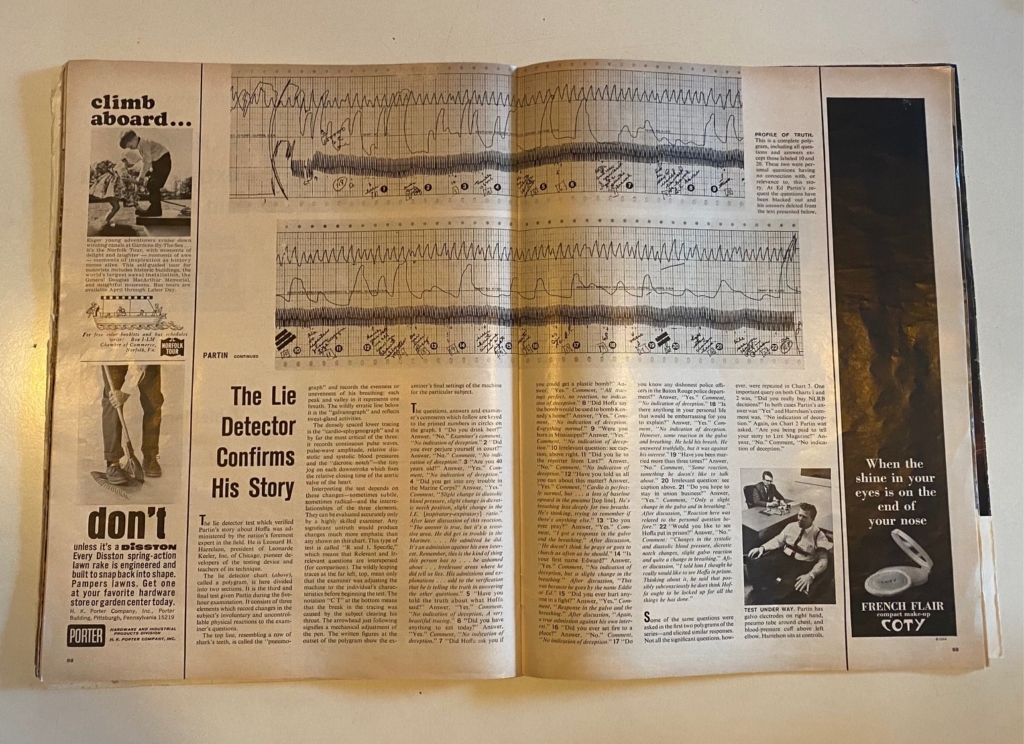
Earl Warren documented the testimony of Big Daddy’s cellmate, a 22 year old Baton Rouge Teamster named Sydney Simpson and attached it to Hoffa vs. The United states for posterity to review and form our own conclusions.
Warren wrote:
One Sydney Simpson, who was Partin’s cellmate at the time the latter first contacted federal agents to discuss Hoffa, has testified by affidavit as follows:
“Sometime in September, 1962, I was transferred from the Donaldsonville Parish Jail to the Baton Rouge Parish Jail. I was placed in a cell with Partin. For the first few days, Partin acted sort of brave. Then when it was clear that he was not going to get out in a hurry, he became more excited and nervous. After I had been in the same cell with Partin for about three days, Partin said, ‘I know a way to get out of here. They want Hoffa more than they want me.’ Partin told me that he was going to get one of the deputies to get Bill Daniels. Bill Daniels is an officer in the State of Louisiana. Partin said he wanted to talk to Daniels about Hoffa. Partin said that he was going to talk to Captain Edwards and ask him to get Daniels. A deputy, whose name is not known to me, came and took Partin from the cell. Partin remained away for several hours.“
“A few days later Partin was released from the jail. From the day when I first saw the deputy, until the date when Partin was released, Partin was out of the cell most of the day and sometimes part of the night. On one occasion Partin returned to the cell and said, ‘It will take a few more days and we will have things straightened out, but don’t worry.’ Partin was taken in and out of the cell frequently each day. Partin told me during this time that he was working with Daniels and the FBI to frame Hoffa. On one occasion I asked Partin if he knew enough about Hoffa to be of any help to Daniels and the FBI, and Partin said, ‘It doesn’t make any difference. If I don’t know it, I can fix it up.’
“While we were in the cell, I asked Partin why he was doing this to Hoffa. Partin replied: ‘What difference does it make? I’m thinking about myself. Aren’t you thinking about yourself? I don’t give a damn about Hoffa. . . .”
It turns out that the kidnapping charge was not for snatching kids, it was for keeping kids hidden after their mother won them in custody court. Big Daddy lent another one of his cars to Sydney, provided cash, and asked a handful of Teamsters to help out their Local #5 brother. The mother filed kidnapping charges, and Big Daddy was one of the ones put in jail.
Simpson’s testimony alone should have slain Big Daddy’s testimony against Hoffa, but the supreme court sees cases challenging the constitution, not personalities. In other words, regardless of the character of the witness, a jury believed the evidence therefore any challenge to Hoffa’s conviction should focus on the U.S. Constitution. Warren focused on that.
The 4th Amendment was penned with quill and ink by our founding fathers in the 1700’s and ratified in 1784, and they evoked a 1600’s British case that led to a then-revolutionary concept that a person should feel safe from government intrusion in their home. The 4th Amendment is a single sentence that says:
The right of the people to be secure in their persons, houses, papers, and effects, against unreasonable searches and seizures, shall not be violated, and no Warrants shall issue, but upon probable cause, supported by Oath or affirmation, and particularly describing the place to be searched, and the persons or things to be seized.
That single sentence was Jimmy Hoffa’s strongest shield against Big Daddy’s testimony.
Hoffa was running Teamster business in a hotel room near a courtroom where he was appearing every day in The Test Fleet case, a relatively minor charge that a fleet of Detroit trucks called The Test Fleet was, on paper at least, owned by Hoffa’s wife and therefore a conflict of interest with Hoffa’s role as the Teamsters president. He asked Big Daddy to be his seargent at arms, standing by the door and standing up against anyone not welcome inside. To test the 4th Amendment, attorneys had to first show that a hotel room was included in the right against unlawful search and seizure.
The justices were in agreement that the 4th amendment applied to a person’s car, hotel room, or office; the right to be free from unlawful search and seizure should be universal; several predicate court decisions were shown as historical trends in the U.S. Supreme Court. Judge Stewart summarized the predicate court cases that supported this when he wrote:
A hotel room can clearly be the object of Fourth Amendment protection as much as a home or an office. United States v. Jeffers, 342 U. S. 48. The Fourth Amendment can certainly be violated by guileful as well as by forcible intrusions into a constitutionally protected area. Gouled v. United States, 255 U. S. 298. And the protections of the Fourth Amendment are surely not limited to tangibles, but can extend as well to oral statements. Silverman v. United States, 365 U. S. 505.
Stewart then said that using Big Daddy’s word didn’t violate the 4th Amendment because:
When Hoffa made incriminating statements to or in the presence of Partin, his invitee, he relied, not on the security of the hotel room, but on his misplaced confidence that Partin would not reveal his wrongdoing.
Stewart’s lengthy response kept focusing on Big Daddy being invited into the hotel, not sneaking in. Three other justices made similar statements, and two abstained from voting.
In Warren’s statements of why he dissented, he chose specific words to show that Big Daddy’s testimony had, in unassailable fact, violated the U.S. Constitution’s Bill of Rights; he said that when Big Daddy was in the room and listening to Hoffa and his defense team as the room’s Sergeant at Arms, he was, in effect, “a walking bugging device,” a predecessor of today’s common technologies, and that the FBI had failed to give him a warrant specifying what he was there to search, seize, or monitor.
Warren said:
Pursuant to the general instructions he received from federal authorities to report “any attempts at witness intimidation or tampering with the jury,” “anything illegal,” or even “anything of interest,” Partin became the equivalent of a bugging device which moved with Hoffa wherever he went. Everything Partin saw or heard was reported to federal authorities and much of it was ultimately the subject matter of his testimony in this case.
The reason Big Daddy was a walking bugging device instead of a person wearing an actual bugging device is described in Walter Sheridan’s The Fall and Rise of Jimmy Hoffa. He frist met Big Daddy in a hotel lobby a few blocks from Hoffa’s hotel. Bobby and Hoover had arranged the meeting, and Walter was looking for a big man with wavy blonde hair wearing a suit with a white silk handkerchief embroidered with a P and tucked in the chest pocket.
“He was even bigger than I imagined,” Walter said.
Walter tried hiding a bugging device in the suit. “It was about as big as a pack of a king-size pack of cigarettes,” Walter said.
But they couldn’t squeeze it anywhere in his suit. And Big Daddy’s pockets were sewn shut to add to the tapered look, and as an old habit to prevent someone from dropping drugs or money or anything incriminating into a pocket. Big Daddy didn’t want to be late for his meeting with Hoffa, because Hoffa was notorious for erupting when someone was late and wasted his time. Walter decided to skip the recording device and trust whatever Big Daddy reported to him. That part was in Walter’s book, but wasn’t mentioned in Hoffa versus The United States.
After using my grandfather’s name more than 45 times, Warren even mentioned Mamma Jean. By then Hoffa’s attorney’s had uncovered that she was paid by the government; at the time, news reports were saying the Partins were “paid witnesses,” which implied they were bribed.
For his services he was well paid by the Government, both through devious and secret support payments to his wife and, it may be inferred, by executed promises not to pursue the indictments under which he was charged at the time he became an informer.
Warren also explains why so much of Big Daddy’s past vanished as thoroughly as Jimmy Hoffa’s body. He wrote:
In the four years since he first volunteered to be an informer against Hoffa he has not been prosecuted on any of the serious federal charges for which he was at that time jailed, and the state charges have apparently vanished into thin air.
The manslaughter charge is a perfect example. And so are the charges for weapons trafficking to Fidel Castro in Cuba. The list was long and distracting; to bring attention to his fellow eight supreme court justices, Warren emphasized that while they debated using Big Daddy’s testimony to send a person to prison, he was on trial in another court for perjury.
Given Warren’s statements, I do not understand how the supreme court voted to use Big Daddy’s testimony. Maybe because I knew him. Regardless if Hoffa placed, as Stewart said, “misguided confidence” in my grandfather, it was obvious, as Warren pointed out again and again, that my grandfather was incentivized to say whatever he needed to remain out of jail, and his background demonstrated he was willing to perjure; but none of the justices had met Big Daddy, or they may have realized that he was so charming it was possible he influenced Hoffa to say and do things without Hoffa realizing it.
That’s where the 6th Amendment should have come in; but, all of the justices missed that point, probably because they didn’t know Big Daddy. The 6th Amendment is long and convoluted, but essentially ensures a defendant can face his accuser with an attorney present. This helps ensure that someone like Big Daddy doesn’t influence what someone like Hoffa says without an attorney being present to add context and rephrase the defendants statements if necessary.
The 6th amendment also ensures that a mole for the prosecutor can not eavesdrop on the defendant’s legal defense strategy. When Hoffa’s team petitioned that the 6th Amendment was violated, they emphasized that Big Daddy overheard everything they said. Justice Stewart offered conflicting statements about this. He wrote:
Petitioners’ own witnesses testified that Partin was in the suite “virtually every day” as well as the “nightly meetings,” had “ready access” to the files and offices and acted as “sergeant-at-arms” just outside the door of the suite.
And also:
[Partin] said he might have heard some of the lawyers’ conversations, but he didn’t know what they were talking about, “because I wasn’t interested in what they had to say about the case.” He testified that he did not report any of the lawyers’ conversations to Sheridan, because the latter “wasn’t interested in what the attorneys said.” Partin’s testimony was largely confirmed by Sheridan.
Sheridan did testify, however, to one occasion when Partin told him about a group of prospective character witnesses being interviewed in the suite by one of the petitioner’s lawyers, who “was going over” some written “questions and answers” with them. This information was evidently relayed by Sheridan to the chief government attorney at the Test Fleet trial.
Stewart voted to allow Big Daddy’s testimony, seemingly believing his word that he didn’t listen to what the lawyers said because he “wasn’t interested,” though I can’t imagine that was true, especially because he relayed information to Walter.
I’m not a lawyer, much less a supreme court justice, but I’ve always believe using Big Daddy’s word violated both the 4th and the 6th amendments. That doesn’t mean he lied in his testimony; to Warren’s point, the supreme court should focus on defending the constitution, not judging a witness’s character or a jury’s decision. After all, because of America’s predicate-based system, allowing a “walking bugging device” tasked with finding “anything illegal” or “something of interest” without a warrant sets the precedent for prosecutors to bypass the weakened U.S. constitution’s Bill of Rights in perpetuity, or at least until congress acts again.1
I can understand the jury at Hoffa’s first trial believing everything Big Daddy said, because they saw and heard him in person. He was so charming that they only deliberated three hours before finding Hoffa guilty of jury tampering. Though in their defense, the prosecuting attorneys under Bobby Kenndy’s guidance did their job well and built a strong case based on what Big Daddy leaked to them. When he took the stand, he spoke as an expert on what the jury had been told by prosecutors because he was the one who had been telling prosecutors that all along. The jury saw a handsome, charming, confident Edward Partin tell them what they already had been hearing, and it painted a picture of Hoffa tampering with justice. As Hoffa wrote in mixed metaphors, Edward Partin was the killing shot that nailed him to a cross.
Hoffa went to prison immediately after Hoffa versus the United States upheld Big Daddy’s testimony. He would find a way out of prison in December of 1971, coincidentally a week before I was conceived and Wendy was just a 16 year old girl who knew nothing of Ed Partin’s history. Earl Warren would pass away in 1974, before Hoffa vanished, so we’ll never know what he thought with his additional years of experience; his 1977 posthumous memoir doesn’t mention Hoffa versus The United States.
Though Wendy didn’t know it, by the time Wendy met my dad Jimmy Hoffa had spent almost six years thinking about nothing but Ed Partin and how to get out of prison and regain power of the Teamsters. He would use America’s most decorated war hero and famous movie star, Audie Murphy, to champion his release until Audie died in a plane crash in 1971, then Hoffa would find a way to get President Nixon to release him a few days before Christmas so he could spend the holiday with his family for the first time since Big Daddy sent him to prison.
To understand how that happened, I’ll share what I know about Audie Murphy’s relationship with my grandfather and President Nixon next.
Go to the Table of Contents

- In the months following the terrorist airline hijackings that took down New York’s twin towers of the World Trade center and almost took out Washington DC’s pentagon, President George Bush Junior and attorney general John Ashcroft’s team of attorneys cited my grandfather’s testimony in Hoffa versus The United States that allowed him to be “the equivalent of a walking bugging device” tasked to find “anything illegal” or “something of interest” against Hoffa as the foundation of 2001’s PATRIOT Act that allowed the unwarranted monitoring of hundreds of millions of Americans’s cell phones calls and text messages for “something” or “anything” about plots against the government.
And in 2025, President Trump’s administration would build upon that to allow dozens of thousands of ICE agents, an three-letter agency that had grown exponentially since budget shifting after the PATRIOT Act, to listen to anyone and immediately arrest, detain, and deport people from American soil. Part of the PATRIOT Act would also be used to detain and torture suspects in Cuba’s American-controlled Guantanamo Bay without warrants, an attorney, or a trial.
All stemmed from my grandfather’s testimony being allowed in Hoffa versus The United States, which cited a few other predicate cases, but the key to Big Daddy’s testimony were the words “anything” rather than specifying what to search and seize, including words and presumed intentions. ↩︎