Big Daddy
“Edward Grady Partin was a big, rugged guy who could charm a snake off a rock.”
– Jimmy Hoffa in Hoffa on Hoffa, published months before his disappearance in 1975
Edward Grady Partin Senior was always the biggest man in the room. Everyone called him Big Daddy, which made sense to me as a kid because my daddy was Edward Grady Partin Junior.
Big Daddy was built like a bull. He was a former heavyweight boxer with arms the size of tree trunks and fists the size of boxing gloves, but what most people noticed first was not his brute strength, it was that he was handsome and always wore a subtle smile that oozed confidence, and his smooth southern drawl drew people in and led them to trust him. And they looked up to him. Not just because he was big, but because Big Daddy had an all-American aryan look with sky blue eyes and wavy strawberry blonde hair that appealed to the masses.
He was born that way. His father, Grady Partin, was also big and strong. Grandma fled him and then returned just before Grady left his family with my grandfather being the oldest Partin male left in Woodville.
In his self-published 2014 autobiography, “From My Brother’s Shadow: Teamster Douglas Westley Partin Tells His Side of The Story,” Big Daddy’s little brother, my great-uncle Doug Partin, who was himself around 6’4″ and 260 pounds when I knew him, summarized Big Daddy as a teenager and said: “[Ed] was a big, strong, handsome, young man, and everyone liked him.” And he was successful; that added to his appeal, because not only did people look up to him, they wanted to be like him. Big Daddy overshadowed Doug and anyone who stood near him.
In the early 1950’s and when he was 26 years old and already married with children, my grandfather’s good looks and charm and leadership reputation in Woodville led 18 year old Norma Jean Stidell Partin – who knew nothing of Big Daddy’s past or his other wife – to marrying Big Daddy only six weeks after meeting him. She became Norma Jean Partin, my Mamma Jean.
Big Daddy and Mamma Jean moved into a modest two-bedroom home in Woodville. There wasn’t a lot to do at night, and they quickly had Aunt Janice, then my dad, aunts Cynthia and Theresa, and Uncle Keith. I never learned what happened to Big Daddy’s former wife and children.
By the time Hoffa heard of Big Daddy’s work running unions in Mississippi, my family had outgrown their small town. They moved to Baton Rouge and took Big Daddy’s mother, stepfather, sister, and three younger brothers with them. Grandma Foster took her new husband’s name and my great-aunt married and took her husband’s name. That led to the first and only Partins in the Baton Rouge phone book being Douglas W. Partin, Donald Partin, Joseph P. Partin, and Mr. and Mrs. Edward G. Partin. In 1957, Big Daddy was elected president of Baton Rouge Teamsters Local #5 and began working directly with Jimmy Hoffa, who had by then been elected president of The International Brotherhood of Teamsters.
Big Daddy’s life paralleled Jimmy Hoffa’s. In his 1972 opus, The Fall and Rise of Jimmy Hoffa, the former FBI agent who led the 500 agent Get Hoffa Task force in the 1960’s and became an investigative journalist for NBC who led a televised documentary on President Kennedy’s assassination in the late 60’s, wrote the definitive guide on Hoffa’s life; in it, he cited around 1,000 names from FBI files during his time leading the Get Hoffa task force. The index cites Edward Partin more than any character other than Jimmy Hoffa and Bobby Kennedy. In a one paragraph summary of Big Daddy and Mamma Jean, Walter simplified Big Daddy’s life up until he took over the Baton Rouge Teamsters by saying:
Partin, like Hoffa, had come up the hard way. While Hoffa was building his power base in Detroit during the early forties, Partin was drifting around the country getting in and out of trouble with the law. When he was seventeen he received a bad conduct discharge from the Marine Corps for stealing a watch. One month later he was charged in Roseburg, Oregon, for car theft. The case was dimissed with the stipulation that Partin return to his home in Natchez, Mississippi,. Two years later Patin was back on the west Coast where he pleaded guilting to second degree burglary. He served three years in the Washington State Reformatory and was paroled in February, 1947. One year later, back in Mississippi, Partin was again in trouble and served ninety days on a pleas to a charge of petit larceny. Then he decided to settle down. He joined the Teamster Union, went to work and married a quiet, attractive Baton Rouge girl. In 1952 he was elected to the top post in Local 5 in Baton Rouge. When Hoffa pushed his sphere of influence into Louisiana, Partin joined forces and helped to forcibly install Hoffa’s man, Chuck Winters from Chicago, as head of the Teamsters in New Orleans.
I never learned what it meant to “forcibly” install Chuck Winters, but in Hoffa and Big Daddy’s world, extortion, beatings, kidnappings, and murder were as common as contract negotiations. But whatever happened, Big Daddy’s reputation grew and so did his wealth. He bought a big home and several smaller homes around town, like the one Wendy, my dad, and I lived in for a while. And for the next several decades no one in Louisiana challenged a Partin’s reign over the Teamsters; Big Daddy would be re-elected president of Local #5 every year for almost 30 years, then my great-uncle Doug Partin would be elected and serve another 30 years, and currently my dad’s little brother, the 6’6″ 280 pound Kieth Partin, is president.
And like how the Partins are a legacy in Louisiana Teamsters, James R. Hoffa Junior is currently president of the International Brotherhood of Teamsters; our family trees have stood beside each other for three generations. Keith says he and Hoffa Junior don’t discuss their fathers’s shared history, all of the books about them, or the films. But Keith and my dad and aunts agree that Walter Sheridan was mistaken about something: Mamma Jean was not quiet.
She first suspected Big Daddy was not what he appeared when he began skipping church on Sundays and taking my five year old dad to Teamster meetings instead. When she learned of Big Daddy’s crimes, she chastised him for breaking at least five of the 10 commandments – adultery, murder, theft, and bearing false witness, and keeping the sabbath holy – and fled with their five children, part of a long history of women fleeing Partin men.
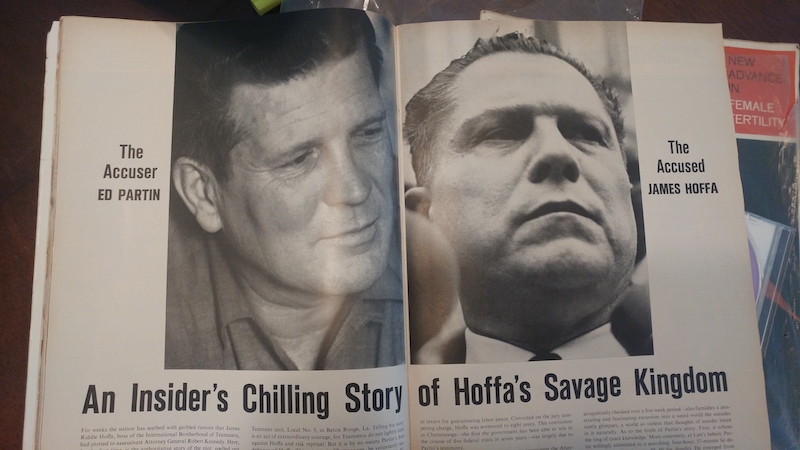
Mamma Jean hid my dad, Keith, and my three aunts in remote hunting and fishing camps her Stidwell family owned throughout southern Louisiana. Walter used his talents as an FBI agent and investigative journalist to find them. He negotiated with Mamma Jean to keep her safe and to use my dad and his siblings in Life magazine photo shoots portraying Big Daddy as a caring family man, which, by all family accounts including mine, he was; none of Big his children knew his history until after Hoffa began shouting it publicly, and even then they believed Look! and Life and newspapers that said Hoffa was exaggerating Big Daddy’s past in a desperate attempt to stay out of prison.
Hoffa lost his final appeal in Hoffa vs The United States and went to prison. From his cell, he penned his first autobiography and published it in 1966. This is what he had to say about Big Daddy:
“It was Edward Grady Partin who volunteered the testimony that sealed my doom in the Chattanooga court.
You may have read about him. Thanks to a government sponsorship he was portrayed as something of a national hero. he somehow looked the part, too: a rugged, firm-jawed man with slightly wavy hair and the appearance of sincerity and honesty that would have made him a successful salesman. Ah, you’d say upon meeting him, there’s a true-blue blood American, a churchgoer, no doubt, a man who contributes regularly to charity, a fellow who devotes much time to community-service groups, a chap who turns over most of his paycheck to a divorced wife.
But there’s another Edward Grady Partin, one the jury never got to hear about.
This Edward Grady Partin is mentioned in criminal records from coast to coast dating from 1943, when he was convicted on a breaking and entering charge, to late 1962, when he was indicted for first-degree manslaughter. During that twenty-year period Partin had been in almost constant touch with the law. He had had a bad-conduct discharge from the Marine Corps. He had been indicted for kidnapping. He ha been charged with raping a young Negro girl. He had been indicted for embezzlement and for falsifying records. He had been indicted for forgery. He had been charged with conspiring with one of Fidel Castro’s generals to smuggle illicit arms into communist Cuba.“
A close ally of Hoffa’s and mafia hitman named Frank “The Irishman” Sheeran knew my grandfather well, and in his 2004 memoir summarized Big Daddy by saying:
“Partin was a big tough-looking man with an extensive criminal record as a youth. Hoffa misjudged the man and thought that because he was big and tough and had a criminal record and was out on bail and was from Louisiana, the home states of Carlos Marcello, the man must have been a guy who paints houses.”
To paint houses was mafia lingo for painting a wall red with splattered blood. That was the world Big Daddy thrived in, and anytime someone was “forcibly” installed or removed from power it’s likely a house was painted in the process.
Big Daddy thrived running Local #5. Southern Louisiana was – and is – an agricultural and petroleum economy that needed Teamsters just as much as Woodville, but Baton Rouge had around 150,000 residents and was the state capita. As president of Local #5, Big Daddy had constant contact with the governor and legislators, local companies and major corporations, and heads of every other union in the states. And Baton Rouge’s position only 80 or so miles up the Mighty Mississippi River from the port of New Orleans and access to all of Latin America led him to trade with Cuba’s Fidel Castro.
In The Hoffa Wars, investigative author, historian, private investigator, and former Teamster who knew both Big Daddy and Jimmy Hoffa well, wrote:
Edward Partin, a Teamster leader in Louisiana – a close Hoffa aide during the late 1950’s and early 1960’s, and later a government informant – explains the operation: “Hoffa, Bill Presser, and another person had bought a bunch of arms and were selling them to anyone who wanted them in Cuba. They bought some planes from the army surplus, and they were ferrying these weapons and planes from Florida to Cuba.”
Discrepancies in Big Daddy’s background wouldn’t matter much to most people. The evidence for selling arms to Cuba vanished when Bobby Kenendy cornered congressmen leading the national security level investigation and got them to back down, so Walter didn’t include those parts about Big Daddy’s background. The rape was whitewashed and omitted, too. As for the discrepancy between Hoffa saying Big Daddy had a bad conduct discharge and Walter saying he stole a watch, it turns out that after my grandfather punched out the marine base commander, on a whim he reached down and removed an expensive watch from the mouthy but now unconscious captain. Each and every one of the dozens of charges against Big Daddy had different perspectives from people involved, but in the end not a single charge stuck to him after he testified against Hoffa.
My grandfather’s tough reputation, ability to stay out of jail, and skill at negotiating labor union contracts led Big Daddy to become so popular in Louisiana that governors sought his endorsement, and the state’s district attorney said that if Edward Partin had a college degree he’d be governor himself.
Big Daddy’s confidence grew after he testified against Hoffa. Walter Sheridan said:
“Most of the sources I had dealt with in the past had asked for anonymity and for promises that they’d never be called to testify. Partin made no such request.”
The publicity bolstered Big Daddy’s image as a man behind the scenes who could get things done and was unafraid to stand up against anyone. But he was also controversial. From the 1960’s until Jimmy Hoffa vanished in 1975, three Louisiana governors tried to rid the state of my grandfather the same way the Kennedys had tried to rid America of Hoffa. But, to protect the reputation of their only witness against Hoffa, Bobby Kennedy and J. Edgar Hoover influenced local police officers and judges so that Ed Partin wouldn’t be convicted of any crimes.
One of the governors who tried to remove Big Daddy from power was Governor John McKeithen, who won two terms from 1964 to 1972 and was famous for, among many things, paving the way for the massive New Orleans Superdome. That Superdome is now known around the world; it is the home of the New Orleans Saints football team and countless international spectator events, and in 2005 international news showed it crawling with waterlogged residents after Hurricane Katrina drowned the city.
Despite having the level of influence to build the Superdome, in eight years as governor McKeithen failed at every attempt to convict Big Daddy of anything. McKeithen’s empty threats accumulated in the New Orleans Times Picayune and the Baton Rouge Advocate but amounted to nothing other than idle words that, ironically, fueled Big Daddy’s reputation as a man above laws, governors, heads of mafia families, and even Jimmy Hoffa.
“I won’t let Edward Partin and his gangster Teamsters run this state!” McKeithen proclaimed early in his governorship.
“[We’re going to arrest Partin] as soon as we get the evidence against him.” McKeithen promised several times over the years.
‘Partin has two Justice Department guards with him for fear Hoffa will retaliate against him,’ Gov. McKeithen said, ‘This gives him immunity.’ Newspapers quoted McKeithen as saying.
“Baton Rouge has never has such a siege of labor violence as it’s seen since Partin came back from the Chattanooga trial with two Justice Department guards to protect him.” McKeithen said. (The reporter clarified what McKeithen meant by adding: “The governor referred to an incident in Plaquemine when 45 to 50 men shot up 30 workers of the W.O. Bergeron Construction Co.”)
McKeithen despondently admitted:“These [Baton Rouge Teamster] hoodlums make Marcello and the Mafia look pretty good.”
But Bobby Kennedy and J. Edgar Hoover protected Big Daddy from prosecution all of those years. McKeithen tried to compromise when he met with Walter Sheridan, the head of the Get Hoffa squad who was my family’s contact for our FBI protection, and begged and bargained for help.
McKeithen said: “Walter, get him out of my state. Now listen to what I am saying to you. Just get him out of my state. I’ll help you do it and I’ll give him immunity. You write it up and I’ll sign it. Just please get him across that state line.”
Walter’s response to the governor was published in the New Orleans State Times on 08 March 1968:
McKeithen is Warned to ‘Lay Off’ Partin
“Gov. John J. McKeithen reportedly received suggestions last month during a trip to Washington not to press the state Labor-Management Commission’s investigation of Baton Rouge Teamster Boss Edward G. Partin.”
“McKeithen said he met with [Walter] Sheridan, who is now an investigator for the National Broadcasting Company, to allay any suspicion that his motives in pressing the Baton Rouge labor investigation were to get Hoffa Free.
The governor said that the meeting was pre-arranged on a mutual basis, with each desiring to talk with the other. He said that Sheridan was a focal point of persons in the Justice Department and “national magazines” interested in seeing that Hoffa is not released.”
“The governor said he felt the recent series of Life Magazine articles on organized crime in Louisianan and the alleged bribe offers to free Hoffa were promoted by Partin. Since then, he said, Life Magazine has placed full confidence in him.”
Nothing stopped Big Daddy’s momentum in the 1960’s and 70’s. It wasn’t until after Hoffa vanished that Big Daddy finally went to prison in 1980. He was found guilty of racketeering – a fancy name for running a business that makes money through threats and extortion and is usually associated with the mafia – and for stealing $450,000 from a Local #5 safe; that refrigerator-sized thick steel safe was found empty in the murky waters of the Comitte River near my childhood home; the two witnesses were found beaten and bloody and unconscious, and the survivor refused to testify. But there was enough evidence for a Grand Jury to begin an investigation, and by then Jimmy Hoffa was missing and presumed dead, Bobby Kennedy was assassinated in 1968, and J. Edgar Hoover passed away in 1972. By 1975 Big Daddy was unprotected and in a city too big for his influence in a court of law.
A jury to found Big Daddy guilty of a long list of crimes, and the judge to sentence him to eight years in prison in 1979. He lost all of his appeals and left for a Texas minimum security prison when I was eight years old.
But he was so charming that even from prison Big Daddy remained influential. Local #5 unanimously voted to keep him as president and pay Big Daddy while he watched color television in a relatively cushy minimum security Texas penitentiary, just like the International Brotherhood of Teamsters had voted to keep Hoffa in power while he pounded mattresses eight hours a day in his maximum security New Jersey penitentiary.
Louisiana governors courted Big Daddy less after he went to prison, though that was their mistake. In a famous exchange, from his prison cell Edward Parting offered to endorse returning governor Edwin Edward’s 1980 campaign. Edwards had already served two terms, taking over from McKeithen in 1972 and lasting until 1980. He shouldn’t have been able to run a third time, but Edwards was popular and corrupt and forced loopholes to remain in office, including having been impeached just before completing a term and therefore being edible for another. Wikipedia says he’s known as one of only seven U.S. Governors to serve four terms, though that’s debatable because impeachments kept him from completing two of them.
Edward’s had spent eight years in the governor’s mansion during the time when my dad was buying drugs in the Carribbean and Wendy was on her way to California. The governor’s mansion in Baton Rouge is down the street from Teamsters Local #5, and Edwards knew Big Daddy and all of the Partins well. He declined Big Daddy’s endorsement, telling reporters that my grandfather was too controversial, and that he didn’t need Ed Partin’s endorsement because he was so popular that the only way he could lose was if he were caught in bed with a dead hooker or a live boy.
I don’t recall if Edwards was found in either of those situations, but he lost the 1980 election and would practically beg my uncle Doug for Local #5’s endorsement four years later. He received and won and served his third term as Louisiana governor from 1984-1988. He’d run again after Big Daddy died, and he’d receive Doug’s endorsement again and serve as governor from 1992-1996.1 Edwin Edwards, like Puerto Rico’s assassinated Teamsters president and all of the Teamsters in New Orleans, never said a negative word about a Partin again.
Even while in prison, news like what happened to Edwin Edwards made Edward Partin seem bigger in Louisiana than he had been in reality. Nationally, his image was immortalized by the media portrayal Bobby Kennedy had cultivated in the 1960’s.
Americans knew what Ed Partin Senior looked and sounded like in his prime, especially because after Hoffa vanished in 1975 and those old photos and news interviews resurfaced. That’s why when producers of a 1983 national two-part movie about Hoffa and Kenendy cast actors, they had to find someone who resembled my grandfather and could mimic his southern drawl. That film was called Blood Feud, which was what people in the 1960’s called the violent public clashes and obvious hatred between Jimmy Hoffa and Bobby Kennedy. For Big Daddy’s role in The Blood Feud, they chose a new actor named Brian Dennehy, who would go on to be one of America’s most celebrated actors known for portraying ruggedly handsome men.2
Dennehy had green eyes and was smaller than Big Daddy, but otherwise the resemblance was so close that even I was confused when watching Blood Feud on a small black and white TV. Veteran actor Robert Blake with his hair slicked back looked just like Jimmy Hoffa, and that Blake won an Academy award for “channeling Hoffa’s rage.” Ernest Borgnine – the guy from McCall’s Navy everyone knew – was a convincing J. Edgar Hoover. Some tall daytime soap opera heartthrob whose name I can never recall portrayed Bobby Kenendy.
From behind his big color television in Texas, Big Daddy said he thought Blake nailed Hoffa and that Dennehy did a fine job portraying him. By coincidence in the summer of 1983, Brian Dennehy would rise to fame in another film with Blood in the name, Rambo: First Blood, as the ruggedly handsome Korean war veteran and mountain-town sherif pursuing Sylvester Stalone as a special forces commando with PTSD named Rambo. But there was no streaming back then, so the only way to see films was in the theater and I never learned what Big Daddy thought of Rambo.3
Two years later, Big Daddy portrayed in by the wavy-haired handsome Ben Fuhrman 1985’s TV miniseries, Robert Kennedy and His Times. I never learned what he thought of that, either. By that time, his health was declining and he was probably more focused on getting paroled than discussing what he watched on television.
In 1986 Big Daddy was released early from prison due to declining health and he returned to Baton Rouge and spent most of his leisure days driving around town in his massive luxury Cadillac, attending LSU football games in his VIP box seats, and visiting with Grandma Foster. She lived a few streets over from Granny near the Baton Rouge airport and Glenoaks subdivision, which is how my dad had met Wendy in 1971.
Big Daddy died in 1990, my senior year of high school and just before I left Louisiana for the army, which may be why I remember that his funeral seemed like a military assault on Greenoaks Funeral Home. Hundreds of Teamsters clogged the Baton Rouge arteries leading to Greenoaks with their lumbering and rumbling 18 wheeler trucks, and every Baton Rouge police car and motorcycle surrounded the parking lot with silent flashing lights so that no one would miss their presence. A couple of politicians and former mayors attended, and the 1954 national champion Louisiana State University football team reunited to attend. And of course my dad’s side of my family was there and so were Big Daddy’s latest wife and kids, who were technically my cousins though I barely knew them.
Officers stood at intersections directing traffic and at the entry doors controlling crowds trying to peek inside; though to be fair, not all of that attention was for my grandfather. Baton Rouge is home of the LSU Tigers, and a lot of the crowd was there to see LSU’s 1954 Heisman trophy winner, former pro footballer, and hometown hero who was chosen to wave down from Mardi Gras parades and whose face smiled down from billboards along I-10 and I-110, Billy Cannon. He was one of Big Daddy’s six hefty pallbearers who asked to help carry the truck-sized coffin (my great uncle Doug Partin and uncle Keith Partin were another two, and three burly Baton Rouge Teamsters who had been Big Daddy’s muscles completed the team). Billy Cannon alone would have brought hoards of Baton Rouge LSU Tiger fans to any event.
There are many reasons LSU adored Big Daddy. His Teamsters helped build LSU facilities, and – just because he could – he had hired many of the burly 1954 team who couldn’t find work after football to be his entourage of bodyguards in the late 1950’s and early 1960’s. And it turns out that Joe Partin, Big Daddy’s equally big little brother, became Zachary High School’s respected and talented football coach and grew players for LSU like farmers nurtured a garden to grow the biggest pumpkins for a parish fair.
Perhaps the strongest reason was that, like Hoffa’s Teamsters funded Hollywood films, Big Daddy had brought Hollywood to Baton Rouge with films still fresh in everyone’s minds. His first films were John Wayne civil war films that used Baton Rouge and Saint Francisville plantations as backdrops in the 1950’s, and by the 1980’s popular movies were still being filmed in town. 1983 brought in Richard Pryor and Jackie Gleason to live in a local mansion for The Toy, and in 1985 Dennis Quaid, Jessica Lang, and John Goodman were in town to shoot scenes with around 10,000 locals dressed in 1950’s costumes and serving as backdrops for football scenes in Everybody’s All American, a film loosely based on Billy Cannon and with a title that led everyone in Baton Rouge to become movie stars and talk about how Big Daddy was an all-American hero.
Almost everyone in town somehow had their jobs, careers, or livelihood touched by my grandfather. He was a local legend and his funeral was a royal procession of people I had grown up known, people who did not know that most of my grandfather’s real history was still hidden then, even if only in dusty books on library shelves, and in the bowels of FBI records about Fidel Castro, Jimmy Hoffa, and President Kennedy.
Mamma Jean skipped Big Daddy’s funeral, but was in town to visit us and talk about the good times with him and was still kept under FBI protection. Attending the funeral and mixed among local fans were Walter Sheridan and a gaggle of FBI agents. They wore Hoover-era G-man black suits that became the Men in Black comic and film series, but was still a lingering costume for aging Hoover loyalists. They had pot bellies and didn’t try to hide the squiggly white wire trailing from an ear. The case against Hoffa was still open, and they unabashedly served as both security for my family and as what Earl Warren called “walking bugging devices,” a reference to using Big Daddy to listen in on whatever Hoffa’s inner circle said.
Because everyone was so used to G-Men following Big Daddy and his LSU bodyguards around, no one seemed surprised they were at his funeral, especially because their black suits blended in with everyone’s funeral attire. And it had only been twenty years since Big Daddy’s testimony against Hoffa, so most people at his funeral remembered the hoopla in daily news and everyone had loose tongues that expounded on his life running Louisiana from behind the scenes; after all, you’d have to be important to have Billy Cannon as your pallbearer and personal bodyguard.
Teams of reporters from most major newspapers stood outside snapping photos of everyone who entered. The New York Times and Los Angeles Times summarized what was known of Big Daddy’s history back then in front page articles. The LA Times wrote this:
March 11th, 1990, BATON ROUGE, La. — Edward Grady Partin, the labor leader whose testimony sent Teamsters boss Jimmy Hoffa to prison in 1967 and who himself was convicted of extortion, has died at 66.
Partin, who died Sunday at a nursing home here, suffered from heart disease and diabetes.
A native of Woodville, Miss., Partin was business manager of Teamsters Local 5 in Baton Rouge for 30 years.
Partin, a close associate of Hoffa, helped then-Atty. Gen. Robert F. Kennedy convict the Teamsters boss in 1964 of jury tampering. Partin testified that Hoffa had offered him $20,000 to fix the jury at Hoffa’s 1962 trial on charges of taking kickbacks from a trucking company. That trial ended in a hung jury, but Hoffa eventually was convicted of jury tampering and mail fraud and served nearly five years in federal prison.
James Neal, a prosecutor in the jury-tampering trial in Chattanooga, Tenn., said that when Partin walked in the courtroom, Hoffa gasped, “My God, it’s Partin!”
The government later spent several years and three trials prosecuting Partin on labor corruption charges before he went to prison in 1980 for conspiracy to obstruct justice by hiding witnesses and arranging for perjured testimony.
While in prison, he pleaded no contest to conspiracy, racketeering and embezzling $450,000 in union money. He was released to a halfway house in 1986.
Union members at one time voted to continue paying his salary while he was in prison. He was removed from office in 1981.
Survivors include his mother, two brothers, a sister, five daughters, two sons and several grandchildren and great-grandchildren.
I remember noticing that I was mentioned in national news, though not by name. I was Big Daddy’s oldest grandson and second oldest grandchild and the reason everyone called Ed Partin Big Daddy, but by 1990 Big Daddy had seven grandchildren so I was relatively inconsequential. To confuse things, my great-uncle Joe Partin had become the popular football coach of Zachary High School, and Joe’s burly football playing son at Zachary was also named Jason Partin. I was a wrestler at Belaire High School, so anyone who followed the local sports section probably assumed that Joe’s son was such a star athlete that he won most valuable player awards in local football and also placed in city wrestling tournaments. He was younger than I was, and that Jason Partin was a rising star in Louisiana sports while I was a graduating senior on my way out of Louisiana and into the army.
I left for basic training soon after my name almost appeared in front page news, and the 1990-1991 Gulf war would dominate my thoughts and time for a while. But when I returned from the war and after the John F. Kennedy and Martin Luther King Junior Assassination Report was partially declassified in 1993 I would see my grandfather’s name in books and films practically every year since.
More than 2,000 books were written about Hoffa and the Kennedys since Big Daddy testified against Hoffa. Most mention his name or refer to him as the witness or the mole or simply a controversial Teamster. Countless television series, documentaries, and news specials would try to find Hoffa’s body or put clues together on who killed Kennedy. Sensationalist reporter Geraldo Rivera even scored a two hour prime-time live event digging up a New Jersey football stadium that had been built by Teamsters and was reputed to have Hoffa’s body buried under the 50 yard line. In every situation, Big Daddy lurks in the background, though to focus on Hoffa many journalists called him the witness, the mole, or simply a controversial character.
Hoffa’s legend grew bigger and Big Daddy’s role grew smaller. By the early 1990’s, my dad was in his 30’s and in law school and, like every other law student in America, he studied Hoffa versus The United States. But though Big Daddy’s name is cited 144 times in the findings, most law students were born in the 70’s and didn’t remember all the publicity and simply referred to hims as “the witness” and Hoffa as “the defendant,” and their focus was on how Hoffa versus The United States changed America’s use of paid informants and weakened our 4th Amendment rather than the personalities and events behind a case that was decided before they were born.
Gradually, everyone who knew the people involved died. By the 2000’s, authors publishing books on Hoffa were born after Hoffa had vanished, and the FBI agents assigned to still-unsolved case were born after Big Daddy died. What was known became the retelling of a story photocopied from a old Zerox of an even older faxed document. Everyone involved originally became tropes of the actors who had portrayed them over the decades.
But one of the books co-written by someone who knew both Hoffa my grandfather stood out; it was the 2004 memoir “I heard you paint houses: Frank ‘The Irishman’ Sheeran and closing the case on Jimmy Hoffa.” Frank was one of the few people who knew both my grandfather and Hoffa, and he provided an insider’s perspective that even I would not have known. Frank claims to have painted a Detroit suburb house red with Hoffa’s blood on 22 July 1975.
The legendary film maker Martin Scorcese snatched up the film rights for I Heard You Paint Houses and raised $257 Million to make an opus about Hoffa and the mafia. Scorcese had already made influential films like Raging Bull, Taxi Driver, Cape Fear, Casion, Goodfellas, The Wolf of Wall Street, and many more. Hollywood’s best actors stared in his films for decades:Al Pacino, Joe Pesci, Robert DeNiro, and many more. He called all of them to star in his new film, and he asked Craig Vincent, a big brute who wore a cowboy hat in 1995’s Casino, alongside Pesci and Pacino, to portray Big Daddy. To research his role, Craig reached out my uncle Kieth Partin, who ran the Baton Rouge Teamsters and was easy to find on the Teamsters web site, and Aunt Janice, who had changed names when she married but still ran an online Partin genealogy project. And me. My grandfather is mentioned throughout I Heard You Paint Houses, and Craig was planning on a big role in another Scorcese film.
But Scorcese renamed I Heard You Paint Houses as The Irishman to focus the story around Frank Sheeran, and he omitted most parts about Big Daddy in order to squeeze the epic tale into 3 hours and 29 minutes, the most even die-hard Scorcese fans would tolerating sitting in a theater. Scorcese said he was making a film for entertainment, not a documentary, and to match Craig’s dark complexion and northeastern Italian accent, he recast Big Daddy as Big Eddie Partin and shrunk the role into only 20 minutes; after editing, Big Eddie shows up in five minutes of film about The Irishman.
The Irishman opened in theaters a few months after Wendy passed in 2019 and set summer box office records for the year. In March of 2020 Covid-19 hit and shuttered theaters globally, but Netflix picked up The Irishman’s streaming rights and moved it online and it set global streaming records. More than one billion people – one out of 8 people on Earth – watched a fictionalized version of my grandfather.
Scorcese was an artist. In one of Big Eddie Partin’s brief scenes, Scorcese had Craig Vincent stand behind the easily recognized big names of acting. Robert DeNiro was The Irishman, Al Pacino was Hoffa, Joe Pesci was mafia boss Russel Bufalino, and a few other of the Goodfellas sat beside them. Scorcese lowered the camera and peered up at them with Big Eddie standing silently in the background and listening to everything, making the already massive Craig Vincent seem larger than life and implying, very subtly, like an artist would, that my grandfather was a puppet master controlling the smaller men speaking freely beneath his observant eyes.
I didn’t read I Heard You Paint Houses until March of 2019, coincidentally just before Wendy passed away. I put my pen-marked copy aside when I bought a plane ticket home to be by her side as she passed. I picked it up again during the pandemic, and continued trying to write down my grandfather’s part in history.
To share what I learned, it’s best to begin Frank “The Irishman” Sheeran and how he knew my family.
Go to the Table of Contents
- In 2001, after 16 years in a governor’s role, something so rare that only seven or so governors in America’s history come close, Edwards would ironically be sentenced to ten years in prison for racketeering, the same crime as one of the charges that sent Big Daddy to prison in 1980. From what I heard, his comments about being found in bed with a live boy came back to haunt him in prison. ↩︎
- Brian Dennehys’ breakout was in 1983’s summer hit coincidentally also with blood in the name; he costarred with Sylvester Stalone in Rambo: First Blood, and was the decorated Korean war veteran and rural mountain-town sheriff who pursued Sylvester Stalone as a Vietnam special forces veteran with PTSD named Rambo. A few years before, Stalone had portrayed a fictionalized version Hoffa in the 18-Wheeler union uprising film F.I.S.T. – the Federation of Inter-State Truckers – based loosely based on Hoffa and used Stalone, in his first film after the boxer Rocky, to show just how rough Hoffa had been; but I don’t know Dennehy’s overlap with Hoffa in Blood Feud influenced Stalone to work him in Rambo. A point I’m making is that it took Sylvester Stalone’s physique and brute force approach to convey what Robert Blake channeled and Al Pacino delivered; and all of them were probably understatements of the original. I never asked my grandfather what it was like to stand up against a man like Jimmy Hoffa, because in our mind everyone else would be asking that about Big Daddy. ↩︎
- Brian Dennehy portrayed so many war hero’s that his ego led him to lying about his service; he admitted to stealing valor and using it to help promote his tough-guy persona. Dennehy died in 2020 during the Covid-19 pandemic. I never got to discuss stolen valor with him; or ask him if he met Big Daddy when researching his role in Blood Feud, and if so what was the impression; or hear what he thought of Craig Vincent in The Irishman, which had been out a year by the time Brian Dennehy passed. ↩︎