Hoffa vs. The United States
“You either loved or hated Ed Partin. There was no in between.”
– My great-uncle Doug in “From my Brother’s Shadow: Teamster Douglas Westley Partin Finally Tells His Side of The Story,” self published in 2017.
Big Daddy was interviewed for both the Warren Report and the JFK and MLK report, but not even Judge JJ or media would know that until President William “Bill” Clinton would release the first part in 1993. Chronologically, the report began with 1962 meetings between my grandfather and Jimmy Hoffa. Those meetings were the basis of 1983’s Blood Feud movie and JFK miniseries, but the details were kept classified for 31 years.
It took Oliver Stone’s 1991 film JFK to prompt the release of the report that had been classified since 1976. His film was based on New Orleans attorney general Jim Garrison’s memoir about the only trial against alleged Kennedy assassination contributors and implicated FBI and CIA agents that voters demanded to see the file; like The Irishman, JFK was layered with stars to sell tickets and some would overlap with The Irishman decades later (Jim Garrison, the New Orleans district attorney who arrested Big Daddy based on photos of him with Oswald and Ruby, had a cameo as Chief Justice Earl Warren, and Joe Pesci played the pilot who was in the civil air patrol with Oswald in JFK and mob boss Russel Bufalino in The Irishman). 10 Million people saw JFK in theaters, and in 1992 voters demanded that incumbent president William “Bill” Clinton to release part of the report when he assumed office in January of 1993
As soon as Clinton assumed office I was in the 82nd Airborne and, technically, on his quick-reaction force. The president may command things, but each and every soldier can speak to the higher source of our contract, if they knew the constitution and the Uniform Code of Military Justice and stood by their convictions. By the time Clinton came into office, I was a decorated combat veteran – no where near the level of Audie Murphy, but respected enough to win a few awards and to be drilled by 82nd Airborne generals for soldier of the year based on, among many things, my knowledge of the constitution and the UCMJ; at the same time, I was being reviewed by Clinton’s administration for a national security clearance and diplomatic passport to serve as an unarmed peacekeaper in the Middle East. That’s when the report was unleashed upon the public in a deluge of information, and when I first read about my grandfather probably being behind President Kenendy’s assassination.
The report included names I had grown up hearing but hadn’t pondered, the same way a kid hears of George Washington, Paul Bunyon, John Henry, Santa Claus, and John F. Kennedy; all were just names without a personal connection until I read them in a report that had been classified since my first memories formed.
It was too massive to publish, but people quickly published excerpts, pamphlets, and, over the next two years, entire books. But in 1993 the internet was still an infant and I had never logged on; Amazon didn’t exist to order books, and Fort Bragg didn’t have a Barnes and Noble or Borders bookseller. Instead, I dug deeper with my Fort Bragg library card.
With a pen and notepad, I began cross-referencing the assassination report with books I remembered on all of my grandmothers’s shelves. My mind overlaid family memories. I’ve already shared the strongest statements from the report focused on Big Daddy, and I’ll share some of those memories later as part of a narrative memoir from when I was a kid, but what I uncovered as a 20 year old paratrooper is easily searchable now that most word processor or online program that lets you search for one name within a paragraph of another, like Partin, Hoffa, and Marcello. I learned all of that with pen and paper and patience in 1993, and these are some of the things that stood out to me.
The JFK and MLK Assassination Report reverased the hastily assembled 1964 Warren Report. It said:
“Since the Warren Commission’s and FBI’s investigation into the possibility of a conspiracy was seriously flawed, their failure to develop evidence of a conspiracy could not be given independent weight.”
They refuted that Lee Harvey Oswald acted alone.
“The committee conducted a three-pronged investigation of conspiracy in the Kennedy assassination. On the basis of extensive scientific analysis and an analysis of the testimony of Dealey Plaza witnesses, the committee found there was a high probability that two gunmen fired at President Kennedy.“
And after enough paperwork to fill a fleet of Teamster dump trucks, the committee narrowed down the suspects for orchestrating Kennedy’s murder to three men.
“Following the completion of its investigation of organized crime, the committee concluded in its report that Carlos Marcello, Santos Trafficante, and James R. Hoffa each had the motive, means, and opportunity to plan and execute a conspiracy to assassinate President Kennedy.”
I’m not sure why he Big Daddy was overlooked as an orchestrator, but I believe it was because so many people were focused on Hoffa that they stepped over Big Daddy on their way to point fingers at a larger conspiracy. They wrote:
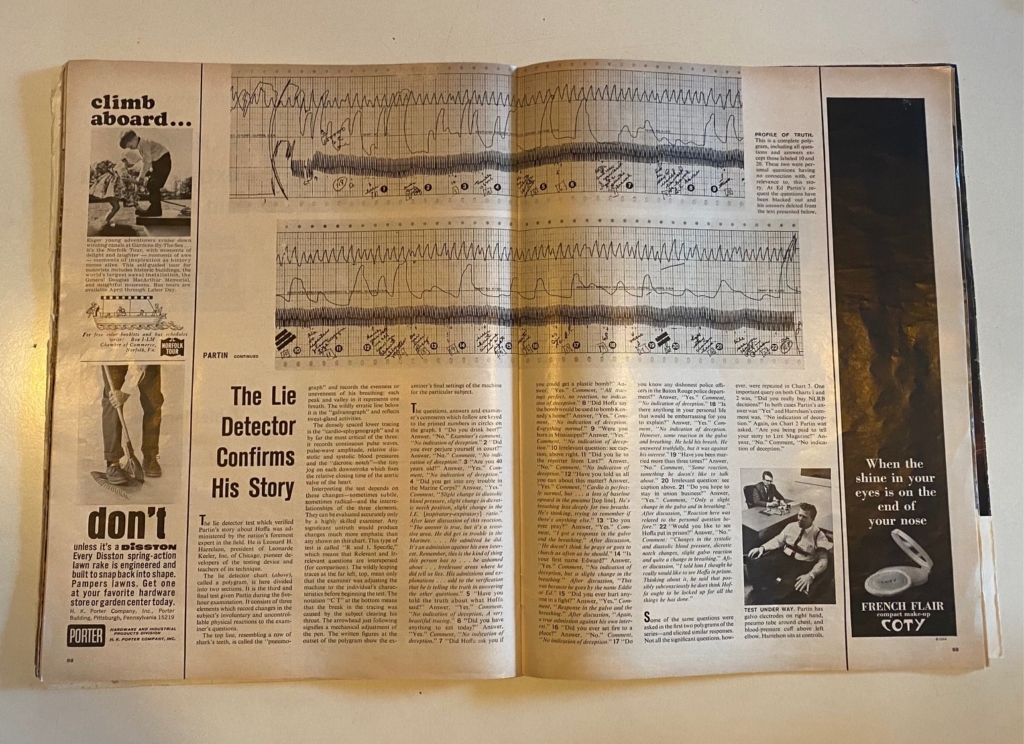
In October 1962, acting under the orders of Attorney General Kennedy, FBI Director Hoover authorized a detailed polygraph examination of Partin. In the examination, the Bureau concluded that Partin had been truthful in recounting Hoffa’s discussion of a proposed assassination plan.(333) Subsequently, the Justice Department developed further evidence supporting Partin’s disclosures, indicating that Hoffa had spoken about the possibility of assassinating the President’s brother on more than one occasion.
But there it was in an official government report: Big Daddy was one of the men behind killing president Kennedy. I didn’t know why or how yet; though I have an idea now, what jumped out and hit me when I served on President Clinton’s quick-reaction force in 1993 is that after thirty years and all of America’s spending on the FBI and CIA and all the armies of investigative journalists who delved deep into Kennedy’s murder, not only did they all fail to answer who killed Kennedy, no one, not once, discussed what to do about it going forward. Clinton, who frequently said Kennedy was his idol, released approximately 60% of the report but kept the rest classified.
I was granted the national security clearance and diplomatic passport, and after I returned from my peacekeeping mission in the Middle East I followed each president’s additional release for the next thirty-two years. I don’t know why presidents Johnson, Ford, Carter, Reagan, Bush Senior, Clinton, Bush Junior, Obama, Trump, and Biden kept what they knew classified; or why Trump in his second presidential win decided to release the final part in January of 2025, sixty two years and ten presidents after Kennedy was shot and killed. If I were president, I’d want everyone to know how to stop people from killing presidents.
Thoughts about what happened and how to prevent it formed in my head over the years, especially after focusing on nothing else during the Covid-19 pandemic, and I’ll let those drip out in other parts of this book. But I want to end this part by touching on why the congressional committee on assassinations grouped the murders of John F. Kennedy and Martin Luther King together into one report. I have only begun digging into it’s trove of history.
This is what I believe as of now.
Martin Luther King Junior was shot and killed by a lone sniper in Memphis, Tennesee, on 04 April 1968. The evening before, King gave his final public speech entitled “I’ve been to the mountaintop,” which proved to be prophetic. Near the end of his final speech, Martin Luther King Junior said:
“And then I got to Memphis. And some began to say the threats … or talk about the threats that were out. What would happen to me from some of our sick white brothers? Well, I don’t know what will happen now. We’ve got some difficult days ahead. But it doesn’t matter with me now. Because I’ve been to the mountaintop. And I don’t mind. Like anybody, I would like to live a long life. Longevity has its place. But I’m not concerned about that now. I just want to do God’s will. And He’s allowed me to go up to the mountain. And I’ve looked over. And I’ve seen the promised land. I may not get there with you. But I want you to know tonight, that we, as a people, will get to the promised land! And so I’m happy, tonight; I’m not worried about anything; I’m not fearing any man. Mine eyes have seen the glory of the coming of the Lord!“
The next day he was shot through the cheek by a single .30-06 rifle round, pronounced 30 ot’ 6, a former military round and to this day one of the most common long-range, big game hunting cartridges.
Escaped convict and racist James Earl Ray confessed to killing King, but, like Jack Ruby, later recanted his confession and asked for a trial by jury. Parole boards denied Ray’s request, and in 1988 he died in prison. Some historians say he was a scapegoat, similar to how Lee Harvey Oswald claimed to be “just a patsy,” and that, like conspiracy theories about Kennedy, King’s death was orchestrated by a collaboration between people in the FBI and CIA, the mafia, and local police. Like with JFK, the jury is still out and may never reach a conclusion about what happened to Martin Luther King. To me, any answer would have to come from a bigger picture view, which is what I would spend my lifetime pondering yet still do not fully understand. The 1960’s were known to many as a time of peace and love and the hippie movement in California that drew Wendy there, but it was also a time of racial unrest, widespread violence against African Americans by Americans in uniform armed with attack dogs, fire hoses, billy clubs, and conspiracy plots to kill anyone seeking change.
After John F. Kennedy, Malcom X was shot and killed by three armed men from a rival Nation of Islam following in 1965, though even that trial has decades of controversy and may never be fully understood. And after Martin Luther King’s murder, Bobby Kennedy would soon be shot and killed. But first he would announce the news of King’s death at his presidential campaign rally in a predominately African American community of Indianapolis.
He said: “For those of you who are black and are tempted to be filled with hatred and mistrust of the injustice of such an act, against all white people, I would only say that I can also feel in my own heart the same kind of feeling. I had a member of my family killed, but he was killed by a white man.”
Kennedy’s words were impromptu, and the touch of humanity cooled flames of hatred in Indianapolis. Nationwide, though, riots engulfed America. President Johnson called for a day of peace and mourning, and launched an investigation that would eventually be included with the investigation into President Kennedy’s murder.
Bobby Kennedy was shot and killed in June of 1968 by the redundantly named Serhan-Serhan soon after the six-part 1968 Life expose on organized crime that highlighted Big Daddy’s defiance against the mafia. At the time, Kennedy was expected to win the democratic presidential nomination and go on to win the presidency.
J. Edgar Hoover died from a heart attack at age 74 in May of 1972, coincidentally when I was beginning my second trimester inside of Wendy, and only a few weeks longer than Hoffa was released from prison. Johnson died of a heart attack at 64 years old in January of 1973. No one reputable suspects foul play in Hoover’s or Johnson’s deaths. Serhan-Serhan is still in jail without any conspiracy links. All have been subjected to intense scrutiny by historians, investigative journalists, and an internet overflowing with conspiracy enthusiasts. As I write this, I’m convinced that Hoover was a detailed and analytical FBI agent, and there were reasons he personally oversaw each of the photos Life and Look! used to showcase my family in national media.
Later research would uncover that the lifelong bachelor J. Edgar Hoover was married to the FBI and spent 45 years shaping modern surveillance technology. He would be remembered also become known for using that technology to collect embarrassing and sometimes illegal information on politicians and judges and then blackmail them; Hoover shaped America from behind his desk. In that desk, he kept copies of shirtless FBI agents and his old college fraternity brothers; that may explain why he chose the shirtless photo of Big Daddy in the 1964 Life magazine. I never learned if he kept the original copy, or if he just taped the copy from Life magazine somewhere. Whatever happened, I believe that J. Edgar Hoover and Bobby Kennedy used Big Daddy’s handsome, smiling, aryan face to frame Jimmy Hoffa.
In his two autobiographies, Hoffa admitted he went to prison because he lost the Blood Feud to Bobby Kennedy, and he lost because he trusted Big Daddy. Hoffa also casually admits he was happy when he learned President Kennedy died; his hatred of the Kennedy’s was never in doubt, nor did he every contest Big Daddy’s testimony. Not once.
He attacked his character and the surveillance techniques Hoover oversaw and Bobby Kennedy authorized (or at least allowed and probably encouraged). But, to his dying day, Hoffa said his only two regrets were locking horns with Bobby Kennedy, and appointing the wrong person to oversee the Teamsters while he was in prison, a guy name Fitzsimmons who grew used to overseeing $1.1 Billion Teamster pension fund and being courted by presidents. Big Daddy remained Local #5 president during his tenure. But Hoffa never questioned my grandfather. He held up a shield of his 4th Amendment Rights, and his sword to attack Bobby’s role in violating his rights was Big Daddy’s motivation and questionable character.
The most obvious challenge to Big Daddy’s testimony against Hoffa came from Chief Justice Earl Warren’s three-page rant about Big Daddy and using his testimony in Hoffa versus The United States. Warren cited the words of Sydney Simpson, the 22 year old Baton Rouge Teamster in jail with Big Daddy on kidnapping charges, and quoted Simpson as saying:
One Sydney Simpson, who was Partin’s cellmate at the time the latter first contacted federal agents to discuss Hoffa, has testified by affidavit as follows:
“Sometime in September, 1962, I was transferred from the Donaldsonville Parish Jail to the Baton Rouge Parish Jail. I was placed in a cell with Partin. For the first few days, Partin acted sort of brave. Then when it was clear that he was not going to get out in a hurry, he became more excited and nervous. After I had been in the same cell with Partin for about three days, Partin said, ‘I know a way to get out of here. They want Hoffa more than they want me.’ Partin told me that he was going to get one of the deputies to get Bill Daniels. Bill Daniels is an officer in the State of Louisiana. Partin said he wanted to talk to Daniels about Hoffa. Partin said that he was going to talk to Captain Edwards and ask him to get Daniels. A deputy, whose name is not known to me, came and took Partin from the cell. Partin remained away for several hours.
“A few days later Partin was released from the jail. From the day when I first saw the deputy, until the date when Partin was released, Partin was out of the cell most of the day and sometimes part of the night. On one occasion Partin returned to the cell and said, ‘It will take a few more days and we will have things straightened out, but don’t worry.’ Partin was taken in and out of the cell frequently each day. Partin told me during this time that he was working with Daniels and the FBI to frame Hoffa. On one occasion I asked Partin if he knew enough about Hoffa to be of any help to Daniels and the FBI, and Partin said, ‘It doesn’t make any difference. If I don’t know it, I can fix it up.’
“While we were in the cell, I asked Partin why he was doing this to Hoffa. Partin replied: ‘What difference does it make? I’m thinking about myself. Aren’t you thinking about yourself? I don’t give a damn about Hoffa. . . .”
That alone should have slain Big Daddy’s testimony against Hoffa. But the supreme court sees cases challenging the constitution, not personalities, and Warren went on to agree with Hoffa’s defense using the 4th Amendment. As Warren said, the violation was so blatant that the case should have been squelched in a lower court and not risen to the supreme court at all.
I copied the 4th Amendment earlier in this story and emphasized that it was penned by our founding fathers using quill and ink in the 1700’s and ratified in 1784, but envoking a 1600’s case to support the adamancy that a person should feel safe from government intrusion in his home. It’s worth repeating how succinct our founding fathers emphasized a person’s rights over the urges of a government. They wrote:
The right of the people to be secure in their persons, houses, papers, and effects, against unreasonable searches and seizures, shall not be violated, and no Warrants shall issue, but upon probable cause, supported by Oath or affirmation, and particularly describing the place to be searched, and the persons or things to be seized.
That one sentence was Jimmy Hoffa’s shield. It was his best defense against going to prison.
The justices were in agreement that the 4th amendment applied to a person’s car, hotel room, or office; the right to be free from unlawful search and seizure should be universal; several predicate court decisions were shown as historical trends in the U.S. Supreme Court. Judge Stewart summarized the predicate court cases that supported this when he wrote:
A hotel room can clearly be the object of Fourth Amendment protection as much as a home or an office. United States v. Jeffers, 342 U. S. 48. The Fourth Amendment can certainly be violated by guileful as well as by forcible intrusions into a constitutionally protected area. Gouled v. United States, 255 U. S. 298. And the protections of the Fourth Amendment are surely not limited to tangibles, but can extend as well to oral statements. Silverman v. United States, 365 U. S. 505.
Stewart then said that using Big Daddy’s word didn’t violate the 4th Amendment because:
When Hoffa made incriminating statements to or in the presence of Partin, his invitee, he relied, not on the security of the hotel room, but on his misplaced confidence that Partin would not reveal his wrongdoing.
Three other justices made similar statements; two abstained from voting.
In Warren’s statements of why he dissented, he chose specific words to show that Big Daddy’s testimony had, in unassailable fact, violated the U.S. Constitution’s Bill of Rights; he said that when Big Daddy was in the room and listening to Hoffa and his defense team as the room’s Sergeant at Arms, he was, in effect, “a walking bugging device,” a predecessor of today’s common technologies, but just a risk to our 4th Amendment in Warren’s mind in 1966,
He expounded by saying:
Pursuant to the general instructions he received from federal authorities to report “any attempts at witness intimidation or tampering with the jury,” “anything illegal,” or even “anything of interest,” Partin became the equivalent of a bugging device which moved with Hoffa wherever he went. Everything Partin saw or heard was reported to federal authorities and much of it was ultimately the subject matter of his testimony in this case.
After using my grandfather’s name more than 45 times and will blatant ill contempt to both his character and the government’s affront on the 4th Amendment, Warren even mentioned Mamma Jean. By then Hoffa’s attorney’s had uncovered that she was paid by the government to remain silent as long as Hoffa was in prison.
For his services he was well paid by the Government, both through devious and secret support payments to his wife and, it may be inferred, by executed promises not to pursue the indictments under which he was charged at the time he became an informer.
Warren also explains why so much of Big Daddy’s past vanished as thoroughly as Jimmy Hoffa’s body. He wrote:
In the four years since he first volunteered to be an informer against Hoffa he has not been prosecuted on any of the serious federal charges for which he was at that time jailed, and the state charges have apparently vanished into thin air.
And, to bring attention to his fellow eight supreme court justices, Warren emphasized that while they debated using Big Daddy’s testimony to send a person to prison, he was on trial in another court for perjury. He concluded his missive by saying:
I cannot agree that what happened in this case is in keeping with the standards of justice in our federal system and I must, therefore, dissent.
Given Warren’s testimony, I do not understand how the supreme court voted to use Big Daddy’s testimony. Maybe because I knew him. Regardless if Hoffa placed, as Stewart said, “misguided confidence” in my grandfather, it was obvious, as Warren pointed out again and again, that my grandfather was incentivized to say whatever he needed to remain out of jail, and his background demonstrated he was willing to perjure; but none of the justices had met Big Daddy, or they may have realized that he was so charming it was possible he influenced Hoffa to say and do things without Hoffa realizing it.
That’s where the 6th Amendment should have come in; but, all of the justices missed that point, probably because they didn’t know Big Daddy. The 6th Amendment is long and convoluted, but essentially ensures a defendant can face his accuser with an attorney present. This helps ensure that someone like Big Daddy doesn’t influence what someone like Hoffa says without an attorney being present to add context and rephrase the defendants statements if necessary. If you knew Big Daddy, you’d believe he could get anyone to say anything.
The 6th amendment also ensures that a mole for the prosecutor can not eavesdrop on the defendant’s legal defense strategy. When Hoffa’s team petitioned that the 6th Amendment was violated, they emphasized that Big Daddy overheard everything they said. Justice Stewart offered conflicting statements about this. He wrote:
Petitioners’ own witnesses testified that Partin was in the suite “virtually every day” as well as the “nightly meetings,” had “ready access” to the files and offices and acted as “sergeant-at-arms” just outside the door of the suite.
And also:
[Partin] said he might have heard some of the lawyers’ conversations, but he didn’t know what they were talking about, “because I wasn’t interested in what they had to say about the case.” He testified that he did not report any of the lawyers’ conversations to Sheridan, because the latter “wasn’t interested in what the attorneys said.” Partin’s testimony was largely confirmed by Sheridan.
Sheridan did testify, however, to one occasion when Partin told him about a group of prospective character witnesses being interviewed in the suite by one of the petitioner’s lawyers, who “was going over” some written “questions and answers” with them. This information was evidently relayed by Sheridan to the chief government attorney at the Test Fleet trial.
Stewart voted to allow Big Daddy’s testimony, seemingly believing his word that he didn’t listen to what the lawyers said because he “wasn’t interested,” though I can’t imagine that was true, especially because he relayed information to Walter.
The arguments of each justice are documented for posterity to ponder. I’m not an attorney, much less a supreme court justice, but I believe using Big Daddy’s word violated both the 4th and the 6th amendments. But, I can understand the jury at Hoffa’s first trial believing everything Big Daddy said, because they saw and heard him in person.
Big Daddy He was so charming that they only deliberated three hours before finding Hoffa guilty of jury tampering. Though in their defense, the prosecuting attorneys under Bobby Kenndy’s guidance did their job well and built a strong case based on what Big Daddy leaked to them. When he took the stand, he spoke as an expert on what the jury had been told by prosecutors because he was the one who had been telling prosecutors that all along. The jury saw a handsome, charming, confident Edward Partin tell them what they already had been hearing, and it painted a picture of Hoffa tampering with justice. As Hoffa wrote in mixed metaphors, Edward Partin was the killing shot that nailed him to a cross.
But that doesn’t explain why the supreme court accepted his testimony despite its violations of the 4th and 6th amendments. The supreme court, to me, should rise above the lower courts and set the precedent for strict adherence to the civil liberties I swore to defend when I joined the army. Over time, I learned to accept – or at least not stand up and fight against – that modern interpretations of the succinct U.S. Constitution is transient. For example, in 2022, the Warren-led Roe versus Wade was repealed by a panel of judges stacked by President Trump and presidents with an agenda, which may be all of them, though no decision since 1972 has affected me as much as my presumed right to live. Supreme court justices are just human beings, prone to error and influence just like everyone else.
I have no evidence, but I suspect that Bobby Kennedy used his family’s influence to reach the judges, and it’s possible that the surveillance-and-blackmail driven J. Edgar Hoover had something on them that he leveraged, too. I’ve read the memoirs of all judges involved, and I believe that Jimmy Hoffa, not the U.S. Attorney General or the U.S. Supreme Court, was our fiercest defendant of human rights granted in the U.S. constitution. He lost that battle, and did not live to see the long-term consequences of Hoffa versus The United States.
Ironically, Hoffa’s disappearance became an American legend. His pop culture status has persisted longer than the memories of people who pursued him, like Walter Sheridan, J. Edgar Hoover, and even Bobby Kennedy.
John F. Kennedy is remembered all over the world and his face is immortalized on the American half dollar. Big Daddy faded away and is now only referred to as “the witness” against Hoffa in 1964 and as a minor character in films like 2019’s The Irishman. But his word remains behind the scenes of daily life.
Because America uses a predicate system, immediately after the September 11th, 2001 terrorist attacks that leveled New York’s World Trade Center skyscrapers and almost took out Washington DC’s pentagon, Hoffa versus The United States was used as a foundation for President Bush Junior’s 2001 PATRIOT Act, an acronym for the Providing Appropriate Tools Required to Intercept and Obstruct Terrorism Act, which, among many things, allowed unwarranted monitoring of hundreds of millions of American’s cell phones to find “anything of interest,” practically the same words given to Big Daddy when he became what Warren called “the equivalent of a walking bugging device,” monitoring – and possibly influencing – what was said without specifying what and why. The PATRIOT Act also led to detaining suspects without an attorney in a U.S. military base still in Guantanamo Bay, Cuba, torturing them, and keeping them confined without a trial for more than twenty years; survivors are aging in there as I type this, all partially because the U.S. supreme court voted to allow using Big Daddy’s word to get Hoffa.
In his memoir, Decision Points, former president George Bush spends almost a third of the pages justifying what even he knew was an unrighteous foundation for the PATRIOT Act. His team of assistant general attorneys even discussed the conversation between Hoover and Bobby Kennedy with President Kennedy that outlined Big Daddy’s ill repute and how that led to the supreme court bending the 4th amendment to allow his testimony to convict Hoffa.
But Bush Jr. said that he made the decision to proceed, anyway, because of the imminent threat of more terrorist attacks on American soil, and that to this day he regrets the use of torture by American soldiers who said they were acting on what they saw as his intentions. He also said that the overtly confusing backronym PATRIOT Act was unfairly influential in getting public support to bend the constitution almost to the point of breaking.
Bush would remain judgmentally silent on the sidelines – along with Clinton, Biden, and Obama – when President Trump’s administration took the weakened 4th and 6th Amendments and gave unprecedented rights to federal immigration agents: ICE, short for Immigration Enforcement and Control. Because of funding started by Bush Jr. after 9/11, ICE had become the largest and most heavily funded American police force. They were masked mercenaries, minimally trained but more heavily armed than swat and special operations teams of my generation, and each one of them was granted permission by the Trump administration to stop and question anyone, including using racial profiling, and without a judge or warrant use what was said to arrest, detain, and export between four and five million people a year. No warrants, no attorneys, no due process.
That was the slippery slope Earl Warren warned us about in 1966.
Warren supported detaining 250,000 American Japanese during WWII, but I can’t imagine what he’d have to say about ICE’s expanded powers in the early to mid 2000’s. Warren passed in 1971, long before the concept of using computers to analyze hundreds of millions of phone calls and text messages could be fathomed, yet it was just the type of “slippery slope” he warned against when using Big Daddy’s eavesdropping to convict Hoffa. Warren was probably right – or at least supportive of our constitution – when he voted against using Big Daddy’s testimony in 1966. Though he wasn’t privy to confidential data, it’s likely that Bobby and Hoover influenced the other justices. The 1964 Warren Report was mistaken about who killed Kennedy, and Warren-overseen supreme court cases may have had errors, too. But he was prescient about the risk of using Big Daddy’s testimony to send Hoffa to prison.
As Warren predicted, using Big Daddy’s testimony was a violation of the 4th Amendment and “a slippery slope” on which to prosecute Hoffa, just like his eavesdropping around Hoffa’s legal defense team was a violation of the 6th Amendment. If Hoffa versus The United States were revoked based on public opinion rather than nine judges appointed by presidents, it wouldn’t matter to Hoffa now; and I doubt the government would be required to stop monitoring our cell phones, or if the prisoner’s in Guantanamo would finally get lawyers and a fair trial. It would probably take another amendment to get us back on track for what our founding fathers intended.
Hoffa became mostly a meme to the younger generation (a phrase I heard as a kid and, to my chagrin, started using myself when I limped into my mid 40’s). But in 2019 and 2020 The Irishman ignited a resurgence in both Hoffa’s disappearance and who killed Kennedy. By then, that younger generation had smart phones that instantly accessed a global library of information, and nascent artificial intelligence programs could sort through the mountains of data as quickly as Washington DC computers analyzed our phone calls.
Even after the disruptive launch of Artificial Intelligence companies – an exaggerated term for what are now just Language Learning Models – not even massive data centers focused on nothing but analyzing the John F. Kennedy and Martin Luther King Report, the Warren Report, every supreme court case, ostensibly benign state-level cases, thousands of books, and unfathomable blogs and online rants and end-of-the-line confessions has provided a clean answer for what happened to any of the names I’ve discussed, from Kennedy to Hoffa to Martin Luther King.
The internet made conspiracy theories abundant but short-lived; the masses quickly transitioned to the next thing of interest, and new conspiracies about Covid-19 dominated because that was fresh on peoples’s minds. A few historians were asked about The Irishman’s claims. The only person I spoke with was Craig Vincent, who probably had spent more time researching my grandfather than anyone other than me, my grandmother Mamma Jean, and Hoffa’s army of attorneys. He didn’t know anything more than I did.
As far as I know, of the acknowledged experts on history and law, only one of them knew Big Daddy; that was Dan Moldea, a former Teamster turned private journalist who published a series of books on the Teamster and the mafia in the 1970’s and was an elderly private investigator when The Irishman was released. Moldea dismissed Sheeran’s version of what happened to Hoffa as: “a fabricated, self-serving confession from a pathological liar trying to secure money for his family.”
A historian and law expert who also publicly commented on The Irishman was Harvard professor Jack Goldsmith. He had been an assistant attorney general under President Bush Jr.’s attorney general, John Ashcroft, and Ashcroft had assigned Goldsmith to find or build a legal foundation to justify Bush’s 2001 PATRIOT Act. Goldsmith became an expert on the case against Hoffa and another one against Chuckie O’Brien with similar 4th Amendment challenges. Though he didn’t know my grandfather, in a flash of coincidence stronger than anything I’ve experienced, it turns out that Goldsmith was the adopted but estranged son of Chuckie O’Brien, the pit bull who jumped over Big Daddy to pistol whip the threat to Hoffa. It was Goldsmith who pushed Big Daddy’s character up to President Bush, the same way US Attorney General Bobby Kennedy discussed Big Daddy with President Kennedy. As any historian knows, if we’re going to make decisions based on existing information, it’s useful to begin with the source of that information.
Goldsmith resigned for moral reasons after legally justifying the PATRIOT Act, and he assumed a faculty role at Harvard Law School and began working on a book about his time as an assistant general attorney and his childhood relationship with Chuckie O’Brian. As another coincidence, he released “In Hoffa’s Shadow: A Stepfather, a Disappearance in Detroit, and My Search for the Truth” in 2019, just before The Irishman film was released in theaters.
Like how Charles Brandt spent 14 years coaxing stories from The Irishman, Goldsmith reunited with O’Brien and spent nine years coaxing his version of the story. What stuck in my mind is that, to his dying day, O’Brien ruminated about my grandfather; Goldsmith’s book is how I learned some of Chuckie’s final words were:
“Fucking Partin. I should have killed him when I had the chance.”
If Doug Partin were right and you either loved or hated Ed Partin, it’s safe to assume Chuckie O’Brien leaned towards the later half.
The Irishman claims Chuckie drove him in the car that picked up Jimmy Hoffa from the Red Fox Restaurant parking lot and drove him to a nearby suburban house with plastic sheets on the living room floor. Goldsmith says his book exonerates Chuckie O’Brien from Hoffa’s murder by analyzing the final phone call Hoffa made and other evidence from where Goldsmith was around that time. In short: Goldsmith argues that O’Brien couldn’t have made it to the Red Fox restaurant in time to pick up Hoffa. That alone would refute The Irishman’s claim, though the nuance of who was driving the car could have been a legitimate mistake in the 83 year old man’s mind.
After The Irishman film stirred national attention, Goldsmith published an online response through his personal and Harvard websites that refuted the film but in a way more politically correct than Moldea had. Modela called The Irishman a pathological liar, but Goldsmith presented a logical analysis of flight times and records and wrote that what Sheeran said happened couldn’t have happened, logistically.
O’Brien died during the early days of Covid-19 in 2020, so we never learned what he thought of the bumbling kid who portrayed him in The Irishman; we just know that on his deathbed he wished he had “fucking killed Partin when he had the chance.”
But Doug loved his big brother. He passed away in a Mississippi veterans convalescent home during Covid, thirty years after Big Daddy’s funeral and three years after self-publishing his autobiography that paralleled Goldsmith’s book’s name: “From My Brother’s Shadow: Teamster Douglas Westley Partin Finally Tells His Side of the Story.”
In his autobiography, Doug still swore by things long since disproven, like Big Daddy being behind Audie Murphy’s death and Big Daddy fabricating his meetings with Jimmy Hoffa. On his deathbed, Doug laughed and said that of course Big Daddy was capable of orchestrating the death of America’s most decorated war hero and all passengers in his plane, if that allowed Big Daddy to do what he wanted to do in Louisiana. By now there’s no doubt Hoffa had, in fact, interfered with justice by influencing his jury, which was – and is – punishable by time in federal prison. I never got to discuss what I learned after Wendy’s death with Doug. If I had, I would have shown him books published since 1993 that he never read, and set the record straight on Audie Murphy.
By all reasonable and reputable accounts, Audie Murphy’s plane crashed because of poor maintenance and an unideal pilot, and not only did Jimmy Hoffa put full faith into Big Daddy, by most accounts every admits he rampantly tampered with juried the entire time Bobby Kennedy peppered him with petty charges. As The Irishman pointed out, Hoffa simply didn’t want to take any chances with any conviction even if it were as trivial as a library fine; in my image of him, woe be it to the librarian who demanded ten cents for an overdue book.
Not even Doug had read Hoffa’s books or watched The Irishman; psychologists call that conforming to an anchor bias, and that bias is why the first thing we read or see or learn lingers the longest. It’s not that a person lies, it’s that our minds fill in blanks that are indistinguishable from memoires. That would be a reoccuring challenge with the JFK investigation: everyone remembered the same events differently, and as soon as photos surfaced their minds swore they saw a person here or there. The consequences of those beliefs shape culture more than the specific words used at that moment. The point is that regardless of what really happened, Big Daddy’s words continue to ripple through history, though only a few of us are left alive who knew him and have witnessed what happened after Hoffa versus The United States.
I’ve always been less interested in who pulled the trigger or who pulled the strings on that pawn, patsy, or scapegoat; details are less important to me than how humans organized to kill other humans. After all, the most universal of all religious or ethical texts in human history all share the precedent that thous shall not kill.
From my experience, whoever was responsible was always low-level, simple-minded men who were acting at the low end of a long chain of ambiguous statements; and then that person was eliminated by another low-level, simple-minded person who either didn’t see the linked events, or thought they were special in whomever’s eyes they were trying to impress or become more deeply intrenched with. It’s not unlike U.S. soldiers in Guantanamo torturing prisoners because that’s what they felt their superiors would have wanted.
The difference with the mafia is that once a low-level soldier took action, they were kissed, too. Anyone who focused on who pulled the trigger, was, in my mind, reaching for low-hanging fruit on the tree of knowledge. Simply saying Oswald shot Kennedy and Ruby shot Oswald on behalf of Marcello, Trafficante, or Hoffa wasn’t enough: there had to be a bigger picture. A new law or another form of punishment may not stop people from acting on behalf of superiors and doing the wrong thing regardless of the laws or risks.
How do achieve that still plagues my mind more than who killed Kennedy, and more than anything I still look to my mother’s death and all she experienced when fighting to get me back and wish that, for just a moment, I could be with her knowing what I know now. As she lay dying, nothing seemed more important than honoring my mother. If there’s no use in obtaining the world if you lose your soul, there’s no use in finding a smoking gun if you can’t enjoy your life and love everything that brought you here.
I looked back at history through the lens of hindsight in 2020, and again and again my mind drifted to the summer of 1976 when I still called my mother Wendy and lived with Mr. and Mrs. James “Ed” White, my PawPaw and MawMaw. When I wrote Wendy’s obituary in 2019, I knew it would be a long story to explain why she abandoned me in 1973. Now you know why.
But another thing happened when I reread Partin versus Partin during the pandemic: I saw MawMaw and PawPaw in a different light. They were the people who Wendy said would keep me safe, and who Judge JJ said viewed me as their own. Knowing what we know now, what kind of person could keep me safe from all of the people gunning for Partins back then?
World history means less to a little boy than understanding his place in it and whom to trust. In the end, it was misplaced trust that killed Hoffa. It’s remarkable that Wendy trusted someone enough to step forward and kept me safe while Hoffa was alive and the mafia was hunting Ed Partin’s family, and that’s exactly what my PawPaw did.
I’ll talk about him next, but to do that I’ll end my Partin history story and start anew in the summer of 1976. That’s when my memories begin to coalesce and stick with me and the battle was nature versus nurture, not Hoffa versus The United States, and PawPaw was on the front line.
Whatever I do, it’s in honor of my mother, Wendy Anne Rothdram Partin; may she rest in peace.
Go to the Table of Content