
A Partin History, Part 1
But then came the killing shot that was to nail me to the cross.
Edward Grady Partin.
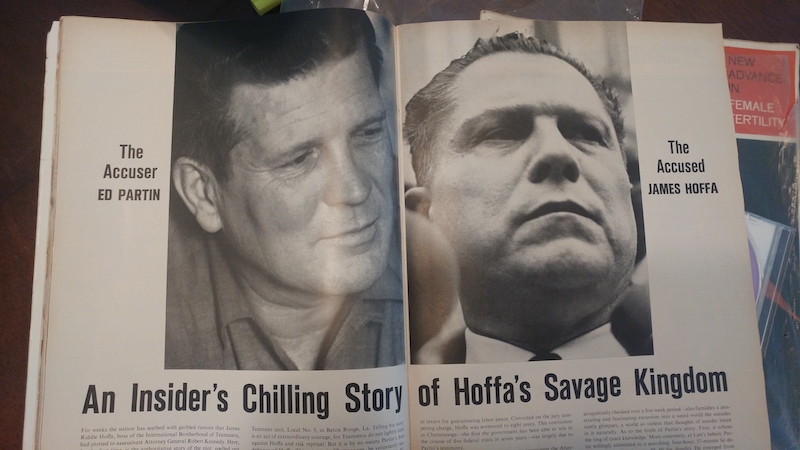
And Life magazine once again was Robert Kenedy’s tool. He figured that, at long last, he was going to dust my ass and he wanted to set the public up to see what a great man he was in getting Hoffa.
Life quoted Walter Sheridan, head of the Get-Hoffa Squad, that Partin was virtually the all-American boy even though he had been in jail “because of a minor domestic problem.”
– Jimmy Hoffa in “Hoffa: The Real Story,” 1975, published just before he vanished from a Detroit parking lot.
I’m Jason Partin.
My biologic father is Edward Grady Partin Junior, a drug dealer who went to prison in 1986 during the height of President Reagan’s war on drugs; he became a lawyer and is currently a public defense attorney in Baton Rouge, Louisiana.
My grandfather was Edward Grady Partin Senior, the Baton Rouge Teamster leader who became famous as the mole inside Jimmy Hoffa’s inner circle.
According to Chief Justice Earl Warren, my grandfather’s testimony was the sole reason Hoffa was found guilty in 1966’s Hoffa versus The United States. To protect the reputation of their only witness against Hoffa, U.S. Attorney General Bobby Kennedy and FBI director J. Edgar Hoover hid that Edward Grady Partin Senior was also a thief, rapist, murder, adulterer, racketeer, dishonorably discharged marine during World War II, weapons smuggler during the Cold War, and, as Earl Warren repeatedly pointed out, a lier with charges for perjury.
When he agreed to spy on Hoffa, my grandfather was in a Baton Rouge jail facing life in prison for manslaughter in Mississippi and for kidnapping the two young children of a fellow Baton Rouge Teamster who had lost custody of them. That was the “minor domestic problem” Hoffa used “bunny ears” until the day he vanished o sarcastically describe the whitewashing of my grandfather’s history.
Life and Look! magazines whitewashed my grandfather’s history and made him out to be an all-American hero for standing up against Hoffa and his mafia allies. Hoover personally choose the federal marshals who followed and protected my family from that point on. My grandfather died my senior year of high school in 1990. Since 1993 I’ve believed he was behind killing President John F. Kennedy, and that’s part of what this story is about.
But this memoir is only partially about either of the Edward Partins. Mostly it’s about Wendy Partin and me. Of course it will include my father and grandfather and the 1993 John F. Kennedy and Martin Luther King Junior Assassination Report, but anything I say should begin by introducing you to Wendy.
Wendy was my mother. She was born Wendy Anne Rothdram on 08 August 1955 in a middle class suburb of Toronto. When she was four years old, her mother – my Granny – fled an abusive husband and took Wendy to Baton Rouge. They lived with my Auntie Lo and Uncle Bob in until Granny found work and saved her pennies and bought a small house in an affordable neighborhood under the Baton Rouge airport flight path and in the Glenoaks school district.
Ten years later, Wendy was a petite but athletic and strikingly attractive girl with strawberry blonde hair and hazel eyes that crinkled when she laughed, and she laughed often. She was a 16 year old junior at Glenoaks High School when she met the school’s 17 year old drug dealer, Edward Grady Partin Junior. She got high and lost her virginity to Edward Grady Partin Junior on New Years Eve, December 31st, 1971.
Two weeks later Wendy learned she was pregnant with me. She couldn’t afford an illegal abortion (partially because Chief Justice Earl Warren’s Roe versus Wade case that legalized abortion was still a year away) so Wendy accepted my dad’s proposal; they dropped out of school and eloped an hour minutes up rural Highway 61 to Woodville, Mississippi.
Everyone in Woodville knew the name Edward Partin. It was and is a small rural town surrounded by pine forests and centered around a sawmill industry that lingers from the days when slavery was legal and Teamsters drove horse wagons. My grandfather was born in there in 1926; his parents were been born there soon after the civil war ended. His father, my great-grandfather Grady Partin, was a typical sawmill worker and prohibition-era bar lover who had scraps with the law. In the 1930’s Grady Partin left his wife and three sons to fend for themselves. My grandfather was the oldest; he helped take care of his mother and practically raised his two younger brothers for the next couple of years.
When he was 17, Ed Partin and his little brother – my great uncle Doug – stole all of the guns in Woodville by breaking into the local Sears and Roebuck and hauling everything two hours downriver to New Orleans. They sold the guns to low-level members of the burgeoning mafia and then immaturely flaunted their wealth in their Depression-era home town by buying motorcycles and paying for prostitutes. The local sherif arrested them. Doug was released because he was only 12, but my grandfather accepted a deal to avoid jail if he joined the marines. Two weeks after joining, he punched out the commanding officer and was dishonorably discharged but a free man. He returned as Woodville’s most notorious young man.
When all other men his age were fighting in WWII, Ed Partin took over the labor unions of both the Woodville sawmill and the Mississippi truckers who hauled away cut lumber. Most of the 1000 or so Woodville residents went through Edward Grady Partin to earn their livelihood.
In the late 1940’s Ed Partin was found not guilty of raping a young girl who lived in a brothel down the street from him, because one juror of his peers would not vote guilty. Uncle Doug would write in his autobiography that he met one of those jurors, Woodville’s barber, who told him “Ain’t no white man deserve to go to jail for anything he did to a black girl.”
In the mid 1950’s Ed Partin was too big for Woodville. He moved to Baton Rouge and took over Teamsters Local #5 and began working with Jimmy Hoffa. As Walter Sheridan wrote, Big Daddy then “forcibly” installed Hoffa’s man in New Orleans. Hoffa’s influence grew, and soon my grandfather was the point person for Teamsters for using America’s new Interstate 10 to ship goods in and out of Biloxi Mississippi, New Orleans Louisiana, Miami Florida, and Houston Texas.
In 1964, Ed Partin’s testimony against Hoffa and defiance against the mafia added to his legendary status across America, especially in his home town. By the early 1970’s, anyone named Edward Partin would have had a bed to sleep on in Woodville, Mississippi. That’s where my dad took Wendy when they eloped from Baton Rouge.
Mississippi laws didn’t require parental consent for a 16 year old girl to marry a 17 year old boy; Wendy Anne Rothdram left Woodville a day later as Mrs. Edward Grady Partin. They returned to Baton Rouge and moved into one of my grandfather’s rural houses near the swampy forests surrounding the Comite River Bridge. It was already furnished and listed under Edward G. Partin; they didn’t have to change names for utilities or the phone book and quickly settled in to a new lifestyle.
I was born nine months later.
Wendy had a series of nervous breakdowns over the next year and tried to flee our home. Once was when my dad was away with his friends buying drugs in Miami and seeing a Bob Marley show in Kingston. He had left her with no car and less than $200 for food. While alone with me, she saw a handwritten note on a coffee shop community board asking to share gas to California and she impulsively responded that she could leave that day; she left me at a daycare center near Glenoaks High school and gave the phone number of her best friend as my emergency contact. Wendy and the stranger drove back onto I-110 at the airport exit and turned west on I-10 and followed it straight for 1,830 miles to where it ended at the Pacific Ocean in Los Angeles, California.
Sun set and no one picked me up and the daycare called the phone number Wendy left them. It was for Linda White and from when Linda and Wendy were friends in high school; Linda’s dad – my PawPaw – answered the phone and rushed to the daycare and took me home. A few days later the only family court judge in East Baton Rouge Parish removed me from Partin custody and assigned PawPaw as my legal guardian.
Wendy woke up in Los Angeles and took a bus back to Baton Rouge. My dad returned soon after and learned what happened. They began fighting in court for the next couple of years while I grew up in Linda’s house.
Wendy was allowed to visit me two days a month she usually took me to a park near PawPaw’s house to play, but she was ashamed of having abandoned me and for being a single teenage mother without a high school diploma; she taught me to call her by her first name so people would think I was her little brother. It worked, and I called my mother Wendy until the day she died on 05 April 2019, when I was, coincidentally, living on the coast of California and 1,830 miles away from home.
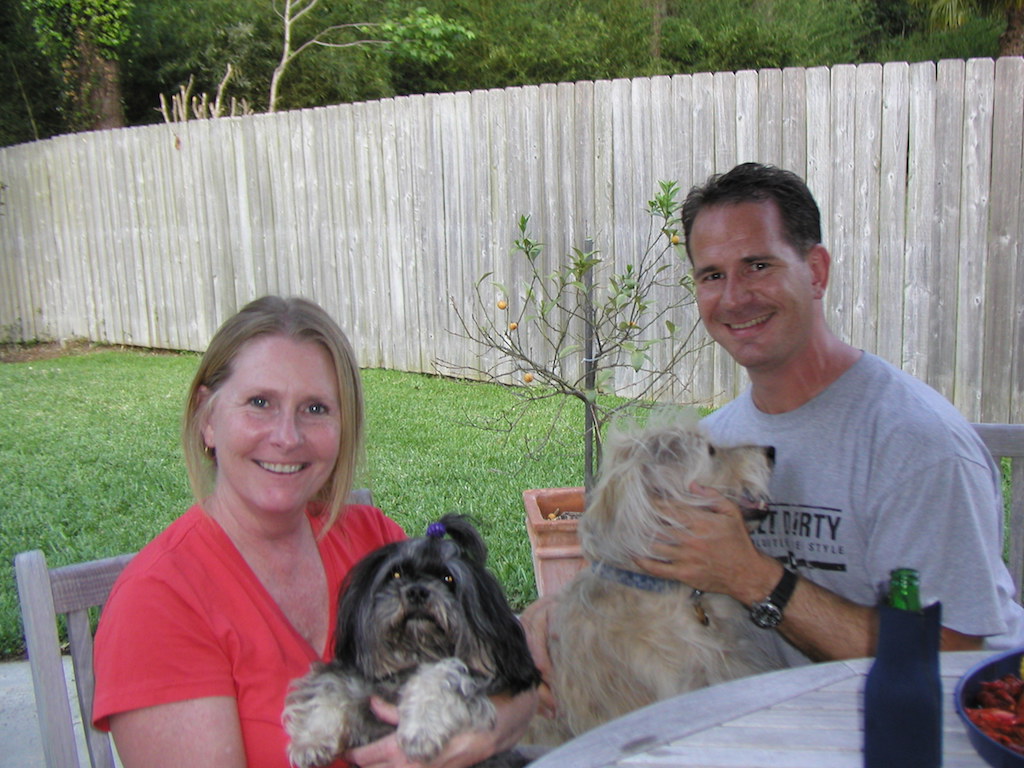
Two days before my mother died I flew home to be by her side at Baton Rouge General Hospital while she was in a coma. She passed at 8:42am. The next day I hastily wrote her obituary from a place of no sleep and shock at her passing so quickly. I downloaded a photo of her I kept on my phone from ten years prior, when she was happy with two of her rescue dogs and had just retired, a time when her coworkers would recognize her and when she still looked young enough that her old Glenoaks classmates would, too.
Later that week, The Baton Rouge Advocate published the photo and brief blurb I wrote that tried to summarize my mother’s 63 years on Earth.
Wendy Rothdram Partin, a resident of St. Francisville, LA, passed way on Friday, April 5th, 2019 at the age of 63. Wendy attended Glenoaks High School in Baton Rouge, LA, and retired from Exxon Mobil. She is survived by her son, Jason Ian Partin, of San Diego, CA. She was preceded in death by her mother, Joyce Rothdram, and her aunt and uncle, Lois and Robert Desico, all of Baton Rouge, LA. During her retirement, she became a master gardener and enjoyed helping people with their lawns. She enjoyed cooking, and took food to anyone she knew who was ill or grieving. Wendy loved animals, and worked with local shelters to foster dogs until they found permanent homes. She passed away unexpectedly from liver failure. In lieu of gifts or a service, please spend time sharing what you love with your neighbor, listen to what they love, and help each other.
To plant trees in memory, please visit _____
There was more to tell but obituaries are short and sweet, and it’s hard to share Wendy’s story without discussing Edward Grady Partin Senior.
Jimmy Hoffa summarized my grandfather in the opening line of Chapter 10 of his second autobiography, penned from prison and humorously calling Chapter 10 The Chatanooga Choo, because he said he was railroaded into prison there. To explain how he was fooled by my grandfather, Hoffa simply said: “Edward Grady Partin was a big, rugged guy who could charm a snake off a rock.”
Everyone in Baton Rouge called my grandfather Big Daddy. He was tall, built like a bull, and a former heavyweight boxer whose smile oozed confidence. He had sky blue eyes and wavy strawberry blonde hair and an ineffable aura that led people to trust him.
Big Daddy’s all-American looks and charm got him out of trouble in the 1930’s and 40’s, and in the early 1950’s it led to him to marrying my grandmother and them quickly having my dad and his four siblings. They all moved to Baton Rouge, and Big Daddy took his mother and two younger brothers with him.
Big Daddy grew to be so popular in Louisiana that governors sought his endorsement and newspapers said that if he had a college degree he’d be governor himself. But he was also controversial; people who knew him said you either loved him or hated him.
From the 1950’s until Jimmy Hoffa vanished in 1975, three Louisiana governors tried to rid the state of my grandfather the same way the Kennedys had tried to rid America of Hoffa. After he testified against Hoffa, Bobby Kennedy and J. Edgar Hoover ensured no one at a state level could prosecute my grandfather. One of the governors who from 1964 to 1972 was Governor John McKeithen, and during his two terms his quotes accumulated in the New Orleans Times Picayune and the Baton Rouge Advocate, but his words amounted to nothing but a story to share decades later.
“I won’t let Edward Partin and his gangster Teamsters run this state!” McKeithen proclaimed early in his governorship.
“[We’re going to arrest Partin] as soon as we get the evidence against him.” McKeithen promised several times over the years.
‘Partin has two Justice Department guards with him for fear Hoffa will retaliate against him,’ Gov. McKeithen said, ‘This gives him immunity.’ Newspapers quoted him as saying.
“Baton Rouge has never has such a siege of labor violence as it’s seen since Partin came back from the Chattanooga trial with two Justice Department guards to protect him.” He explained; the reporter clarified by writing: “The governor referred to an incident in Plaquemine when 45 to 50 men shot up 30 workers of the W.O. Bergeron Construction Co.”
“These [Baton Rouge Teamster] hoodlums make Marcello and the Mafia look pretty good.” McKeithen said despondently.
But Big Daddy was protected from legal prosecution by Bobby Kennedy and J. Edgar Hoover. McKeithen tried to compromise when he met with Walter Sheridan, the head of the Get Hoffa squad who was my family’s contact for our FBI protection, and begged and bargained for help.
McKeithen said: “Walter, get him out of my state. Now listen to what I am saying to you. Just get him out of my state. I’ll help you do it and I’ll give him immunity. You write it up and I’ll sign it. Just please get him across that state line.”
Walter’s response to the governor was posted in the new Orleans State Times on 08 March 1968.
McKeithen is Warned to ‘Lay Off’ Partin
“Gov. John J. McKeithen reportedly received suggestions last month during a trip to Washington not to press the state Labor-Management Commission’s investigation of Baton Rouge Teamster Boss Edward G. Partin.”
“McKeithen said he met with [Walter] Sheridan, who is now an investigator for the National Broadcasting Company, to allay any suspicion that his motives in pressing the Baton Rouge labor investigation were to get Hoffa Free.
The governor said that the meeting was pre-arranged on a mutual basis, with each desiring to talk with the other. He said that Sheridan was a focal point of persons in the Justice Department and “national magazines” interested in seeing that Hoffa is not released.”
“The governor said he felt the recent series of Life Magazine articles on organized crime in Louisianan and the alleged bribe offers to free Hoffa were promoted by Partin. Since then, he said, Life Magazine has placed full confidence in him.”
Life was America’s news source. More than 10 Million influential people subscribed to the weekly publication. By the late 1960’s, national news magazines like Look! and Life showcased Big Daddy’s rugged good looks and strong physique as being the type of labor leader who could stand up to the mafia. While Hoffa fought against Big Daddy’s testimony in daily news, America was shown photos of my family smiling and spending time in downtown Baton Rouge as an all-American, working class family and the future of labor union leadership. That whitewashing led to Jimmy Hoffa’s explanations being ignored.
Hoffa was followed by as many people as Life, and in his first autobiography published soon after he lost his final appeal against my grandfather’s testimony in the U.S. Supreme Court, this is what he wrote to America:
“It was Edward Grady Partin who volunteered the testimony that sealed my doom in the Chattanooga court.
You may have read about him. Thanks to a government sponsorship he was portrayed as something of a national hero. he somehow looked the part, too: a rugged, firm-jawed man with slightly wavy hair and the appearance of sincerity and honesty that would have made him a successful salesman. Ah, you’d say upon meeting him, there’s a true-blue blood American, a churchgoer, no doubt, a man who contributes regularly to charity, a fellow who devotes much time to community-service groups, a chap who turns over most of his paycheck to a divorced wife.
But there’s another Edward Grady Partin, one the jury never got to hear about.
This Edward Grady Partin is mentioned in criminal records from coast to coast dating from 1943, when he was convicted on a breaking and entering charge, to late 1962, when he was indicted for first-degree manslaughter. During that twenty-year period Partin had been in almost constant touch with the law. He had had a bad-conduct discharge from the Marine Corps. He had been indicted for kidnapping. He ha been charged with raping a young Negro girl. He had been indicted for embezzlement and for falsifying records. He had been indicted for forgery. He had been charged with conspiring with one of Fidel Castro’s generals to smuggle illicit arms into communist Cuba.“
Nothing stopped Big Daddy’s momentum in the 1960’s and 70’s; it wasn’t until after Hoffa vanished that he finally went to prison in 1980. Even from prison, he was influential. Local #5 unanimously voted to keep him as president and pay Big Daddy while he was in his Texas prison, just like the International Brotherhood of Teamsters had kept Hoffa in power in his New Jersey cell. Though by then governors courted him less.
In a famous exchange, from Big Daddy’s prison cell he offered to endorse returning governor Edwin Edward’s 1980 campaign. Edwards declined, saying that my grandfather was too controversial to risk his endorsement, and that he was so popular that the only way he could lose was if he were caught in bed with a live boy or a dead hooker. I don’t recall if Edwards was found in either of those situations, but he lost the 1980 election and would practically beg my uncle Doug for Local #5’s endorsement four years later, which he would receive and then be re-elected, partially because of the Teamster endorsement and definitely not because of his character. News like that made Big Daddy seem bigger than he was, even from prison.
Americans knew what Ed Partin Senior looked and sounded like, so when producers of a 1983 national two-part movie about Hoffa and Kenendy cast actors, they had to find someone who resembled my grandfather. The film was called Blood Feud, which was the public called the violent clashes between Jimmy Hoffa and Bobby Kennedy. For Big Daddy’s role, they chose a new actor named Brian Dennehy, who would go on to be one of America’s most celebrated actors known for portraying ruggedly handsome men.1
Dennehy had green eyes and was smaller than Big Daddy, but otherwise the resemblance was so close that even I was confused when watching Blood Feud on our small black and white TV in the spring of 1983. Veteran actor Robert Blake with his hair slicked back looked just like Jimmy Hoffa, and that Blake won an Academy award for “channeling Hoffa’s rage.” Ernest Borgnine – the guy from McCall’s Navy everyone knew – was a convincing J. Edgar Hoover. Some tall daytime soap opera heartthrob whose name I can never recall portrayed Bobby Kenendy. The series was heavily advertised and producers knew the Blood Feud was still on the mind of most middle aged Americans.
From his cushy penitentiary cell with a big color television, Big Daddy said he thought Blake nailed Hoffa and that Dennehy did a fine job portraying him. By coincidence in the summer of 1983, Brian Dennehy would rise to fame in another film with Blood in the name, Rambo: First Blood, as the ruggedly handsome Korean war veteran and mountain-town sherif pursuing Sylvester Stalone as Rambo through the mountains. (I never learned what Big Daddy thought of Rambo.2)
Two years later and still from his cushy cell, Big Daddy portrayed in by the wavy-haired handsome Ben Fuhrman 1985’s TV miniseries, Robert Kennedy and His Times. (I never learned what he thought of that, either.)
In 1986 Big Daddy was released early from prison due to declining health and he returned to Baton Rouge and spent most of his leisure days driving around Baton Rouge in his massive luxury Cadillac and visiting with Grandma Foster, his mother who had remarried a man name Foster and who lived a few streets over from Granny.
Big Daddy died in 1990, my senior year of high school and just before I left Louisiana for the army, which may be why I remember that his funeral seemed like a military assault on Greenoaks Funeral Home. Hundreds of Teamsters clogged the Baton Rouge arteries leading to Greenoaks with their lumbering and rumbling 18 wheeler trucks, and every Baton Rouge police car and motorcycle surrounded the parking lot, and police stood at intersections directing traffic and at the entry doors controlling crowds.
(Though to be fair, a lot of the crowd was there to see the 1954 LSU Tigers national champion football team, which reunited for the funeral and had our hometown hero, 1954 Heisman trophy winner for LSU and former pro-footballer Billy Cannon as one of Big Daddy’s pallbearers; Billy Cannon alone would have brought hoards of Baton Rouge LSU Tiger fans to any event.)
A couple of politicians and former mayors attended, and of course my dad’s side of my family was there and so were Big Daddy’s latest wife and kids, who were technically my cousins though I barely knew them. Mixed among us and listening in were a gaggle of FBI agents including Walter Sheridan. The case against Hoffa was still open, and they unabashedly served as both security for my family and as what Earl Warren called “walking bugging devices,” listening in on what was being said and asking what my grandfather’s final words to them were. Teams of reporters from most major newspapers stood outside snapping photos of everyone who entered.
The Los Angeles Times summarized what was known of Big Daddy’s history back then in a front page article. I’m mentioned, though not by name. I was Big Daddy’s oldest grandson and second oldest grandchild, but by then he had seven grandchildren and I was relatively inconsequential compared to what newspaper readers wanted to hear.
The New York Times and Los Angeles Times newspapers summarized my grandfather’s life based on what was public knowledge in 1990 by publishing this:
March 11th, 1990, BATON ROUGE, La. — Edward Grady Partin, the labor leader whose testimony sent Teamsters boss Jimmy Hoffa to prison in 1967 and who himself was convicted of extortion, has died at 66.
Partin, who died Sunday at a nursing home here, suffered from heart disease and diabetes.
A native of Woodville, Miss., Partin was business manager of Teamsters Local 5 in Baton Rouge for 30 years.
Partin, a close associate of Hoffa, helped then-Atty. Gen. Robert F. Kennedy convict the Teamsters boss in 1964 of jury tampering. Partin testified that Hoffa had offered him $20,000 to fix the jury at Hoffa’s 1962 trial on charges of taking kickbacks from a trucking company. That trial ended in a hung jury, but Hoffa eventually was convicted of jury tampering and mail fraud and served nearly five years in federal prison.
James Neal, a prosecutor in the jury-tampering trial in Chattanooga, Tenn., said that when Partin walked in the courtroom, Hoffa gasped, “My God, it’s Partin!”
The government later spent several years and three trials prosecuting Partin on labor corruption charges before he went to prison in 1980 for conspiracy to obstruct justice by hiding witnesses and arranging for perjured testimony.
While in prison, he pleaded no contest to conspiracy, racketeering and embezzling $450,000 in union money. He was released to a halfway house in 1986.
Union members at one time voted to continue paying his salary while he was in prison. He was removed from office in 1981.
Survivors include his mother, two brothers, a sister, five daughters, two sons and several grandchildren and great-grandchildren.
I left for the army soon after his funeral and the 1990-1991 Gulf war would dominate my thoughts and time for a while; but, I would see my grandfather’s name in books and films practically every year since I returned.
In the 30 years since Big Daddy died, more than 2,000 books were written about Hoffa and the Kennedys. Most built on previous ones, but few were written by people who knew Big Daddy. Most were historians or investigative journalists who dug through the mountains of paperwork with computer programs looking for the next movie rights.
But one of the books co-written by someone who knew both Hoffa my grandfather stood out; it was the 2004 memoir “I heard you paint houses: Frank ‘The Irishman’ Sheeran and closing the case on Jimmy Hoffa.” I didn’t read it until 2019, coincidentally just before Wendy passed away. That memoir provided a first-hand account of Big Daddy and Hoffa’s behind-the scenes efforts to get him to change his testimony in the 1960’s and 70’s, therefore it’s best to begin with The Irishman.
Frank “The Irishman” Sheeran was a WWII infantryman with PTSD like Rambo and countless other war veterans; he had killed probably hundreds of people in his two year deployment during an unprecedented 345 days of hands-on combat at a time when soldiers still died hearing each side scream from only a few feet away. He was honorably discharged from the army and became a hitman for the Italian mafia, who nicknamed him The Irishman.
That’s how Frank met Jimmy Hoffa. I heard you paint houses was lingo for paining a wall with splattered blood; that’s the first thing Hoffa said to Frank, and it wasn’t a question. The Irishman replied: “Yes. And I do my own carpentry work,” meaning he also disposed of the bodies.
By the time Hoffa met Frank, the Teamsters and the mafia were in an overt alliance to control the labor force of America. The Irishman became a delivery truck driver for Teamster local #107 in Philadelphia and then was elected president of local #326 in Delaware, similar to how Big Daddy was president of Local #5 in Baton Rouge. Both were called lieutenants in Hoffa’s army; Big Daddy became Hoffa’s sergeant at arms. Combined, the Teamsters and the mafia controlled almost all trucks that shipped every product made or sold in America, and practically every laborer and small business that used those products.
Frank Sheeran was one of the last survivors of Hoffa’s inner circle when The Teamsters drove America. Long after both Hoffa and Big Daddy died, Frank went to prison for racketeering and labor union law violations. He was pulled out in his late 70’s due to ill health. Charles Brandt, an established true-crime author and attorney with a reputation for coaxing truth from witnesses and convincing juries of their authority, facilitated his release and began coaxing stories out of The Irishman. Charles was aided by the coincidentally named Frank Weisman, a literary agent fascinated with Hoffa and the mafia and my grandfather and their roles in killing President Kennedy. That Frank knew what questions hadn’t been asked in all the books before, and he worked with Charles Brandt to dig deep into The Irishman’s memories.
Brandt worked with Frank The Irishman for 14 years to nurture I heard You Paint Houses into a narrative memoir that is also a treatise on Hoffa and the mafia. Aiding their effort was Frank Sheeran’s latent Irish Catholic upbringing: he wanted to confess his sins before he died.
Frank passed away a few months before his memoir was finally published. In his book, he confesses to more than a dozen unsolved murders in the 1960’s and 70’s, including painting the wall of an empty Detroit suburban house red with Hoffa’s blood on 22 July 1975. Neither Hoffa’s body nor evidence of his demise have been found, not even with modern DNA analysis that was unfathomable back when Frank was doing carpentry work; whatever they did with Hoffa’s body, it was done with prescient knowledge that everyone would be looking for evidence with the best resources money could provide. Frank The Agent helped put a few nods to Kennedy in the book, like quotes from The Irishman’s benefactors that if they could kiss the president, they could kiss Jimmy Hoffa.
Martin Scorcese bought the movie rights to I Heard You Paint Houses from Steerforth Press and raised $257 Million to make his opus about Hoffa and the mafia. Scorcese hired the best Hollywood actors and had worked with them in decades of gangster classics and centered his opus around Frank Sheeran and renamed it The Irishman. Big Daddy was portrayed by the burly Craig Vincent who had played a thug in Scorsese’s 1995 Casino, which had starred Al Pacino and Joe Pesci, two starts also in The Irishman. Scorcese adapted characters from The Irishman to match the actors America had known for decades.
Craig Vincent researched his role by watching Dennehy in Blood Feud and contacting surviving Partins, but he couldn’t mimic Big Daddy’s southern drawl and sly smile like Dennehy had. Scorcese modified the role to fit Craig’s dark complexion and northeast Italian accent and fit “Big Eddie” Partin into twenty-five minutes of film. After editing, Big Eddie was squeezed into five minutes of Scorcese’s whopping three hour and twenty nine minute film, probably the most that modern movie-goers would sit and watch. The Irishman sold out theaters the summer of 2019 and quickly recouped the quarter of a billion dollar investment.
Scorsese was an artist. In one scene, Big Eddie Partin is towering silently behind the more well known actors like Al Pacino, Robert DeNiro, Joe Pesci, and Ray Ramono. Scorcese had lowered the camera angle to make Craig Vincent appear even larger than he was in real life; it looks like he’s a puppet master controlling the men below him. (After The Irishman was released, I told Craig he did a fine job and my grandfather would have appreciated that scene.) In March of 2020 the Covid-19 pandemic shuttered all public theaters on Earth. Netflix picked up The Irishman and it set global streaming records, and over the next year approximately a Billion people all over the world saw a condensed and fictionalized version of my grandfather’s part in history.
Before Wendy died, she saw advertisements for The Irishman and heard Ed Partin’s name in the news again thirty years after he died. I never got to learn what she thought about that, other than a quick quip that said she was born WAR but marrying a Partin WARP’ed her and that’s why she drank now. She passed before Covid-19, and I had two years of the shutdown to think about her final words and immerse into what was already published on Hoffa and The Kennedys. I was looking for patterns that would help me understand what had happened to Wendy in the early 1970’s that led her to abandon me.
I ordered around 50 books from Amazon not already on my bookshelf, and I used the internet to research what was publicly known versus only existed in my memories or our family’s letters and memorabilia. Names long buried in my memories were illuminated decades later. One in particular jumped out. On McKeithen’s staff of legislative attorneys named Lottinger who would become a judge. When I began cross-referencing names during my 2020 internet search, I stumbled upon my 1976 custody court records; the presiding judge was newly appointed family court judge, JJ Lottinger.
For decades my custody report was only available in the East Baton Rouge Parish 19th Judicial District under Partin versus Partin. It was the same courthouse that had removed a young Teamster’s kids in 1964 that led to Big Daddy kidnapping them as part of what Hoffa called “a minor domestic problem,” and I assume any judge there would have known my family name. Judge JJ Lottinger assumed oversight of my case immediately after Hoffa vanished and he worked with Wendy for more than a year to ensure she had the support she needed to regain my custody.
When I read it in 2020, what surprised at first was that I had – and still have – a fuzzy memory of Judge Lottinger and Wendy and me. I can see us in what must have been his private chambers in the downtown courthouse; he had a kind smile and asked me to call him Judge JJ and I felt I could trust him. That felling persisted for more than 40 years, which was the surprise. What Judge JJ learned he documented in Partin versus Partin, and this is what he had to say about Wendy and me in 1976:
This is a suit by Edward Partin, Jr., plaintiff, seeking a divorce from his wife, Wendy Rothdram Partin, defendant, after having lived separate and apart for more than one year following a judgment of separation from bed and board. Plaintiff also seeks custody of the minor child, Jason Ian Partin, and the defendant reconvened asking that she be granted the permanent care, custody and control of the minor child.
The Trial Court had previously, by ex parte order, awarded the temporary care, custody and control of the minor to Mr. and Mrs. James Ed White. Following trial on the merits, plaintiff was awarded a divorce as well as the permanent care, custody and control of the minor child, with the temporary physical custody of the minor child to remain with Mr. and Mrs. James Ed White. The defendant has appealed this judgment as it regards the custody of the child.
This couple was married when plaintiff was 17 and the defendant was 16 years of age. Nine months following the marriage, they gave birth to young Jason. While we are not concerned with the facts surrounding the separation and divorce, it was apparently one of incompatibility as defendant testified that at the age of 17 she found herself married to a man who did not love her and so she left. Her testimony was as follows:
“As I say I was emotionally upset. I was receiving little support from Edward. I was scared, very confused. I didn’t know exactly which way to turn. I felt I had no one to listen and help with the situation at hand.”
Several weeks later she returned and lived with her husband again. She found that the situation hadn’t changed, and felt she had to get away again. She heard of a man who wanted someone to share expenses on a trip to California, so she quit her job and with her last wages left with him. She testified that she had no sexual relations with this man, and plaintiff does not accuse her of such. Following this trip she returned to Baton Rouge still emotionally upset. Her husband was suing her for separation and told her he was going to take custody of Jason. She went to live with her aunt and uncle, got a full time job with Kelly Girls paying $512.00 per month.
In February, 1975, the defendant’s mother was injured in an accident and she moved in with her to care for her. In September, 1975, following the recuperation of the mother she returned to live with her aunt and uncle.
During these above periods of time, the minor child lived with Mr. and Mrs. White. The Whites came to regard Jason as their own and, although the separation judgment awarded custody to the plaintiff with reasonable visitation privileges to the defendant, the Whites decided the defendant-mother could only see the child two days a month and that she could never keep the child over night. The reason the defendant did not contest custody at the separation trial was because at the time she felt unable emotionally and financially to care for her son.
We note that the petition for separation was grounded on habitual intemperance, as well as abandonment of the husband and the minor child. There are no other grounds listed for the separation nor for custody. The petition for the separation and custody of the minor child was not contested by the defendant, and a default judgment was granted. Defendant testified in the instant proceedings that the reason she did not contest custody in the separation proceeding was that she was not financially or emotionally capable of caring for the minor, and that knowing the Whites were going to be caring for him, she knew he would be in good hands.
Though the petition for separation had as one of its allegations “habitual intemperance”, the plaintiff in the instant proceeding testified that he had never accused his wife of drinking, nor had he ever seen her drink.
The welfare of the child is the main issue that the Court is concerned with. This issue is more important than any wishes or wants the parents may have. Fulco v. Fulco, 259 La. 1122, 254 So.2d 603 (1971), rehearing denied (1971). As a general rule, and in particular where children of young age are involved, preference is given to the mother in custody cases. This preference is very simply explained, the mother is normally better able to care for the child and look after the education, rearing, and training necessary. Estes v. Estes, 261 La. 20, 258 So.2d 857 (1972), rehearing denied (1972).
No argument is made that the mother is not now morally or emotionally fit to care for the child, or that the house in which she lives is not a proper place to rear a child. In fact, the Trial Judge admitted that it was a fine home.
The Trial Judge has not favored us with written reasons for judgment, however, we must conclude from various statements by the Trial Judge that appear in the record that he could find no fault with the defendant, nor was there anything wrong with the house in which she lived. It thus becomes apparent to this Court that the Trial Judge applied the “double burden” rule to the defendant. We have already ruled that the “double burden” rule does not apply in this situation, and thus, under the established jurisprudential rules, we can see no reason why the defendant-mother should not be granted the permanent care, custody and control of the minor child with reasonable visitation privileges granted to the father.
In consideration of our above opinion, there is no need to discuss the specification of error as to the ex parte granting of custody to the Whites.
Therefore, for the above and foregoing reasons, the judgment of the Trial Court is reversed, and IT IS ORDERED, ADJUDGED AND DECREED that the defendant-appellant, Wendy Rothdram Partin, be and she is hereby granted the permanent care, custody and control of the minor, Jason Ian Partin, and IT IS FURTHER ORDERED, ADJUDGED AND DECREED that this matter be and it is hereby remanded to the Trial Court for the purpose of fixing specific visitation privileges on behalf of plaintiff-appellee Edward Partin, Jr. All costs of the appeal are to be paid by plaintiff-appellee.
I’ll never know what motivated Judge JJ, but I know that as a little kid I trusted him, that he was kind to my mother, and that he left this thoughts in Partin versus Partin for posterity to ponder.
After my surprise at remembering Judge JJ, the irony of him focusing on Wendy not drinking stands out. I was looking for details that I may have overlooked before. Wendy not drinking was not a smoking gun pointing to Kennedy’s assassin, but it was a type of detail I was looking for. Something I had missed or taken for granted when I was younger. And it got me wondering: what drove Wendy to drink?
To get the whole story, or at least my perspective, it’s useful to start with Jimmy Hoffa. He vanished from Detroit’s Red Fox diner parking lot on 22 July 1975. His story is well known. What I write next is what I believe based on what I’ve read about the rise and fall Jimmy Hoffa and how it relates to Wendy and me.
Go to the Table of Contents
- Brian Dennehys’ breakout was in 1983’s summer hit coincidentally also with blood in the name; he costarred with Sylvester Stalone in Rambo: First Blood, and was the decorated Korean war veteran and rural mountain-town sheriff who pursued Sylvester Stalone as a Vietnam special forces veteran with PTSD named Rambo. A few years before, Stalone had portrayed a fictionalized version Hoffa in the 18-Wheeler union uprising film F.I.S.T. – the Federation of Inter-State Truckers – based loosely based on Hoffa and used Stalone, in his first film after the boxer Rocky, to show just how rough Hoffa had been; but I don’t know Dennehy’s overlap with Hoffa in Blood Feud influenced Stalone to work him in Rambo. A point I’m making is that it took Sylvester Stalone’s physique and brute force approach to convey what Robert Blake channeled and Al Pacino delivered; and all of them were probably understatements of the original. I never asked my grandfather what it was like to stand up against a man like Jimmy Hoffa, because in our mind everyone else would be asking that about Big Daddy. ↩︎
- Brian Dennehy portrayed so many war hero’s that his ego led him to lying about his service; he admitted to stealing valor and using it to help promote his tough-guy persona. Dennehy died in 2020 during the Covid-19 pandemic. I never got to discuss stolen valor with him; or ask him if he met Big Daddy when researching his role in Blood Feud, and if so what was the impression; or hear what he thought of Craig Vincent in The Irishman, which had been out a year by the time Brian Dennehy passed. ↩︎