A Partin History
But then came the killing shot that was to nail me to the cross.
Edward Grady Partin.
And Life magazine once again was Robert Kenedy’s tool. He figured that, at long last, he was going to dust my ass and he wanted to set the public up to see what a great man he was in getting Hoffa.
Life quoted Walter Sheridan, head of the Get-Hoffa Squad, that Partin was virtually the all-American boy even though he had been in jail “because of a minor domestic problem.”
– Jimmy Hoffa in “Hoffa: The Real Story,” 1975, published just before he vanished from a Detroit parking lot.
I’m Jason Partin. I was born in Baton Rouge, Louisiana on 05 October 1972.
My biologic father is Edward Grady Partin Junior, a high school dropout and drug dealer who went to prison in 1986 during the height of President Reagan’s war on drugs; he returned to school and became a lawyer and is currently a public defense attorney in East Baton Rouge Parish.
His father – my grandfather – was Edward Grady Partin Senior, the Baton Rouge Teamster leader famous as the mole in Jimmy Hoffa’s inner circle whose 1964 testimony sentenced Hoffa to prison. Hoffa’s army of attorneys fought his testimony all the way to the U.S. Supreme Court, and Chief Justice Earl Warren was the only judge to vote against using my grandfather’s testimony in 1966’s Hoffa versus the United States.
In his three page summary explaining why he dissented, Warren wrote:
Given the incentives and background of Partin, no conviction should be allowed to stand when based heavily on his testimony. And that is exactly the quicksand upon which these convictions rest, because without Partin, who was the principal government witness, there would probably have been no convictions here.
Warren lamented on for three long pages about how my grandfather was in a Baton Rouge jail cell facing life in prison for manslaughter in Alabama and for kidnapping the two children of 22 year old Baton Rouge Teamster Sydney Simpson. To get out of jail, my grandfather called the New Orleans FBI office and met with U.S. Attorney General Bobby Kennedy and FBI director J. Edgar Hoover; they freed him in exchange for spying on Hoffa, and to prepare for his future testimony they began expunging his criminal records. Kidnapping was the “minor domestic problem” that Hoffa used “rabbit ears” to sarcastically describe how Bobby and Life magazine whitewashed my grandfather’s background. Getting out of jail was one of the “incentives” Earl Warren emphasized in Hoffa vs. The United States.
Warren also alluded to what Jimmy Hoffa and Bobby Kennedy already knew, that my grandfather’s background showed he was also a lier, thief, adulterer, rapist, perjurer, and murderer who smuggled weapons to Fidel Castro’s Cuba during the cold war. That’s why Bobby and Hoover whitewashed his public image during the jury tampering trial against Hoffa.
Warren wrote:
Here the Government reaches into the jailhouse to employ a man who was himself facing indictments far more serious (and later including one for perjury) than the one confronting the man against whom he offered to inform.
After Hoffa’s trial and their mole was publicly known, Bobby and Hoover plastered my family across national media and whitewashed every crime to sound almost admirable; “a minor domestic problem” became helping a fellow Teamster reunite with his family, and my grandfather’s brutal past was written off as him being a youth of the times.
The focus on my family in Life magazine was spread across several pages and shared a highlight with newly appointed President Lyndon B. Johnson and his family in the months after President Kennedy was assassinated. Bobby focused on using Life and Look! magazines, because, in addition to Bobby being friends with the editor of Life, those magazines were read by more than 10 Million people each week and were considered America’s most reliable news and culture resources. Life painted the picture that my grandfather stood up to labor union corruption despite the threats to him and his family, and it highlighted Hoffa’s plot to kill Bobby Kennedy only eleven months before his brother, President Kennedy, was shot and killed. According to the article, my grandfather’s testimony probably saved Bobby Kennedy’s life by risking his own.
Life interviewed FBI agent Walter Sheridan, already famous as having led the 500-agent Get Hoffa Task Force who went on to become an investigative journalist for NBC television, and he confirmed everything their story wrote about my grandfather fearlessly standing up to corrupt unions and mafia strongmen. That’s what Hoffa meant by Bobby using Life as his tool, and how Walter painted the picture of Edward Partin being all-American hero.
My grandfather returned to Baton Rouge with federal agents protecting him and my family 24 hours a day. He resumed running Teamsters Local #5 with federal impunity while Jimmy Hoffa was still in jail.
I was conceived soon after. But this part of the story isn’t about me or Ed Partin Senior or Jimmy Hoffa, it’s about Wendy Partin.
Wendy was my mother; she died on 05 April 2019. Anything I have to say about my family should begin by explaining how she met my father and why I called her Wendy.
Wendy Anne Rothdram was born on 08 August 1955 in Richmond Hill, a middle class suburb of Toronto, Canada. When she was four years old, Wendy’s mother – my Granny, Joyce Hicks Rothdram – fled an abusive husband and took Wendy to Baton Rouge to temporarily live with my Auntie Lo and Uncle Bob. Within a year Granny found work as a typist in one of the burgeoning petrochemical plants north of Baton Rouge and saved her pennies and bought a small house in an affordable neighborhood under the airport flight path and in the Glenoaks school district.
Ten years later Wendy was a 16 year old junior at Glenoaks High School. She had grown into a petite but curvy 5’1″ athletic girl with long wavy strawberry blonde hair who most people said was strikingly attractive. She had hazel eyes that crinkled when she laughed, and she laughed often. Wendy Anne still had a bit of her nasally Canadian accent, though she never finished sentences with ‘eh like Auntie Lo and Granny sometimes did, so she stood out among the strong southern Louisiana accents of the 150 students at Glenoaks High School who liked to call her Wendy Anne.
That’s when she met the school’s 17 year old drug dealer, Edward Grady Partin Junior, a tall and intense young man with a slight southern Mississippi accent that mumbled our last name to sound like Partun.
My dad rarely smiled unless he was high, but he was high often. He fit the stereotype of a defiant teenager, and he was tall and strong and had long black hair and drove an expensive sports car and defied anyone to try and draft him. He said it would take an army to drag him off to war. My dad was more than just the trope of a bad boy, he was Ed Partin’s firstborn son; knowing what I know now, had the army tried to drag my dad off to war, it would have taken more than a platoon of paratroopers to get him to do something he didn’t want to do. And because of his name Ed Partin Junior was immune to prosecution by local police and judges. He was a legend at Glenoaks High school in Baton Rouge, Louisiana.
Wendy was smitten. She got high and lost her virginity to my dad on New Years Eve, 1971. Two weeks later she learned she was pregnant with me.
She couldn’t afford an abortion (partially because Chief Justice Earl Warren’s Roe versus Wade case that legalized abortion was still a year away). My dad could, but he proposed that they drop out of school and get married in Mississippi. Wendy accepted, and they drove his sports car two hours up Highway 61 to Woodville, Mississippi.
Everyone in Woodville knew the name Edward Partin. Woodville was – and is – a small rural town of only a few hundred people surrounded by pine forests and centered around a county courthouse and a nearby lumber industry from the Netterville Sawmill. My grandfather was born there in 1926. His father, my great-grandfather Grady Partin, was a typical sawmill worker and prohibition-era bar dweller who was in and out of jail; in the 1930’s Grady fled the state and left his wife, three sons, and daughter to fend for themselves during the Great Depression.
Grady’s departure was daily gossip in every Woodville household. My grandfather was the oldest of Grady’s sons by a few years; he helped take care of his mother and siblings after taking care of himself. Because Woodville was such a small town, everyone there knew everything Ed Partin did.
My grandfather was 17 the first time he was arrested in Woodville. It was the middle of the Great Depression, and after Grady Partin left them they went to bed hungry most nights. He his little brother – my great uncle Doug Partin – decided to make money by stealing all the guns in Woodville. They broke in to the local Sears and Roebuck store through a vent in the roof, and my grandfather tied a rope around Doug’s waist and lowered him down and waited for Doug to fill his arms with shotguns, rifles, and pistols. Ed heaved Doug back up hand-over-hand, again and again, until they had a pile of guns on the roof.
They loaded their loot into a car my grandfather had either borrowed or stolen (we never learned which) and sped down Highway 61 past Saint Francisville and on to New Orleans. The total trip was only about two and a half hours. In New Orleans, they found people wanting to buy guns and who were low-level members of the Marcello mafia family. The returned to Woodville with cash in their pockets and bought motorcycles and spent a few weeks riding around town and hooting and hollering and splurging on whole chickens for the family’s dinner and having what Doug would always recall as the best summer of his childhood.
The Woodville sheriff wasn’t foolish and arrested them for flaunting their newfound wealth. Doug was released because he was only 10 years old and barely old enough to cradle the arms full of guns as Big Daddy heaved him up through the roof hand over hand. But the Woodville courthouse judge found my grandfather guilty of breaking and entering and grand larceny. But World War II was underway and the military needed big men to fight, so the judge offered my grandfather a deal to avoid jail if he joined the marines.
My grandfather studied the judge’s contract for a few minutes and agreed. Though a high school dropout, my grandfather was skilled at reading details in contracts, and what the judge offered said my grandfather would be released if he joined the marines, but it didn’t say that he had to remain in the marines. Two weeks after he joined, Ed Partin Senior punched out the commanding officer and became a dishonorably discharged marine but a free man.
He wandered the country for three years full of fun and adventure. He broke his right hand while fighting professionally and returned to Woodville. By then Doug and their other brother, my great-uncle Donald Joesph Partin, were gone and serving in the air force, and all men my grandfather’s age were off fighting in the war. I don’t know where my aunt was by then. What’s known is that Ed Partin was a big, rugged man who knew how to fight and could interpret legal contracts, and he quickly took over both the sawmill union and the trucker’s union that delivered trees and carried away cut lumber.
He controlled commerce in and out and was paid three times a day every day, once when the trucks brought raw trees, once when the sawmill cut them, and again when the trucks hauled away cut lumber. All of Woodville’s commerce was controlled by Edward Partin. Everyone knew his name and could easily recognize him walking down any of the streets, especially as a burly white man who frequented a shotgun shack known to be a brothel that catered to young soldiers at nearby air force training facility that had sprung up during the war.
In 1942 Ed Partin was arrested for raping a young girl in Woodville who lived in that brothel. He was found not guilty in 1943 because of one juror of his Woodville peers; Uncle Doug would write in his 2017 autobiography that he met that jurors, Woodville’s barber, and he told Doug: “Ain’t no white man deserve to go to jail for anything he did to a black girl.”
Life magazine whitewashed the act as a local pimp filing false charges to vilify the locally admired union leader for reasons never made clear. I never learned what actually happened, but I believe that Ed Partin could do no wrong in the eyes of his Woodville peers who depended on him for the town’s economy.
But by the mid 1950’s my grandfather was married with five children and they outgrew Woodville. He brought his entire family to Baton Rouge in 1957 and took over Teamsters Union Local #5 and began working with Jimmy Hoffa and the International Brotherhood of Teamsters to grow their dominance in the south. In 1964 his testimony against Hoffa was legendary across America; by 1972 his name was legendary across the southeast, and when Wendy and my dad showed up in Woodville anyone named Edward Partin would have had a bed to sleep on and a hand in getting anything they needed.
Wendy arrived in Woodville not knowing any of that history. But she knew Mississippi laws didn’t require parental consent for a 16 year old girl to marry a 17 year old boy. Two days after arriving in Woodville, Wendy Anne Rothdram returned to Baton Rouge as Mrs. Edward Grady Partin.
She and my dad moved into one of my grandfather’s rural houses near the swampy forests surrounding the Comite River Bridge. It was already furnished and listed under Edward G. Partin. They didn’t have to change names for utilities or the phone book, and they quickly settled in to a new lifestyle. My dad began growing weed on dry patches in the swamp, and I was born nine months later.
Wendy had a series of nervous breakdowns over the next year and tried to flee our home. The final time was when my dad left her with $200 for food and rode to Miami on motorcycles with his friends to buy a truck load of drugs in the Caribbean and then travvel to Jamaica to see a Bob Marley show in Kingston. They traded motorcycles for boat tickets in Miami, where the ten-year old Teamsters Local #769 was already working with Miami mafia boss and Cuban exile Todos Santos Trafacante Junior to control shipping to and from Latin America.
Baton Rouge arrest records show that my dad returned with shipments of prescription opioids that he intended to sell in Baton Rouge. Puerto Rico had just began opening American offshore pharmaceutical manufacturing for tax breaks and to set an example for communist Cuba, which was still run by Fidel Castro and under an American embargo. A few years before my dad showed up, the president of Puerto Rico Teamsters Local #901, Frank Chavez, was so infuriated by my grandfather’s betrayal of Jimmy Hoffa that he publicly said: “I’m going to fucking kill Edward Partin!” Chavez was shot and killed by his bodyguard soon after, and none of his replacements have said anything ill of any Partin since. Ed Partin Junior would have had beds to sleep on and hands to help getting whatever he wanted. He and his other dropout friends from Glenoaks bought all the opioids they could carry in their backpacks and were gone a couple of months and didn’t call Wendy to say when they’d return.
Like in Woodville, Wendy was a young girl who didn’t know any of the Partin history. She wasn’t old enough to vote, much less pay attention to news. She not gotten pregnant with me her only concern would have been high school prom rather than feeding me with a dwindling $200 left by my dad. She didn’t have a car, and she felt trapped in her rural home near the murky Comite River.
Wendy’s high school friend, Linda White, had a car and sometimes picked Wendy up to take her around Baton Rouge. One day Wendy was holding me in her arms and looking for work on a coffee shop community note board when she saw a handwritten note asking to share gas to California. She impulsively reached into her purse and pulled out a dime and called the poster from the coffee shop’s payphone. She told the young man she could leave for California that day.
On their way out of Baton Rouge they left me at a daycare center two miles down the road from Glenoaks High School. She gave the manager Linda White’s phone number as my emergency contact. Wendy and the stranger drove back onto I-110 at the airport exit and turned west on I-10 and followed it straight for 1,830 miles to where it ended at the Santa Monica pier in Los Angeles, California.
Sun set at the daycare center and no one picked me up. The manager called Linda’s phone number and her father, the coincidentally named Ed White – my PawPaw – answered the phone. He was the custodian and groundskeeper at Glenoaks and had known my parents since they were 13 years old ninth grade kids. He knew everything he needed to know about my family and dropped what he was doing and rushed to the daycare and picked me up and took me home. He called the police and a few days later the only family court judge in East Baton Rouge Parish removed me from Partin custody and assigned PawPaw as my legal guardian.
Wendy woke up in Los Angeles and took a bus back to Baton Rouge. My dad coincidentally returned at the same time. Both learned what happened and began fighting each other in court while I learned to walk and speak with MawMaw and PawPaw at Linda White’s house.
Wendy was allowed to visit me two days a month, and she usually took me to play at a park near PawPaw’s house and the daycare center where she had left me on her way to California. She was ashamed of being a single mom and a high school dropout who had abandoned her son, and she taught me to call her by her first name so people would think I was her little brother. It worked, and though she regained custody of me a few years later, old habits are hard to break and I called my mother Wendy until the day she died.
Her liver failed in 2019 from excessive alcohol and she slipped into a coma on 03 April 2019, when I was coincidentally living on the coast of California and 1,830 miles away from Baton Rouge. I flew home and was able to spend one night by her side as she lay unconscious. She passed away early in the morning on 05 April 2019.
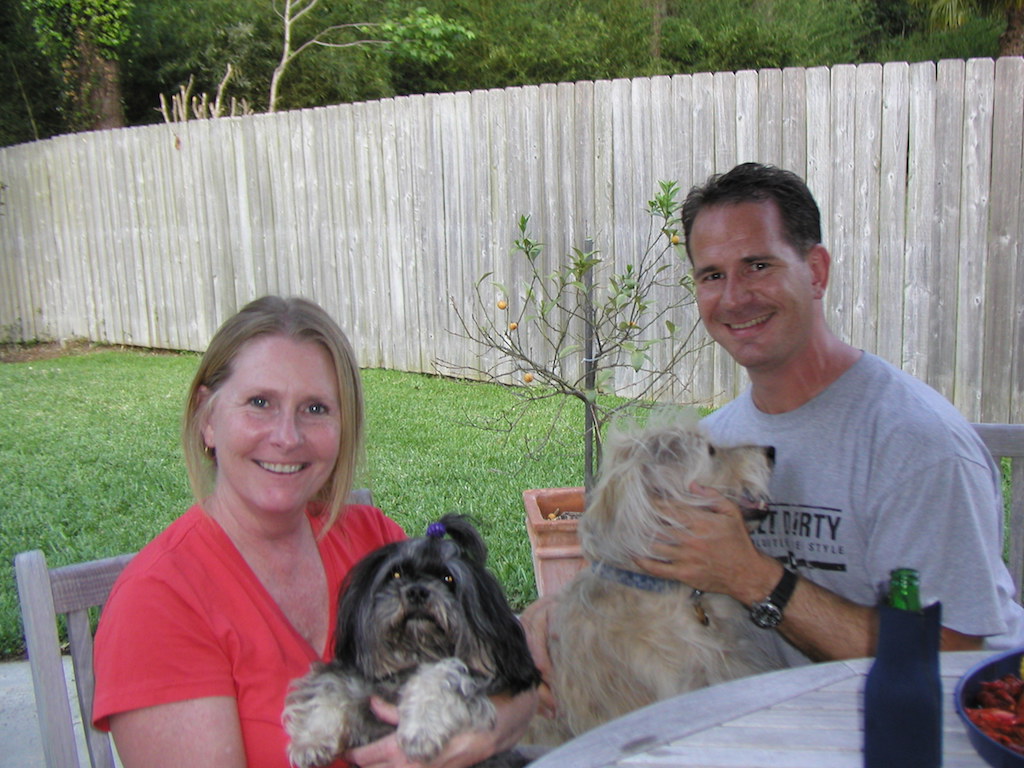
The next day I was still in shock from having only just learned about Wendy’s failing liver, and I was fatigued from three days of flights and staying be her bedside all night. I hastily wrote her obituary and then focused on the photos in my phone to find one of her for the print and online editions of the Baton Rouge Advocate. I chose a photo of Wendy and two rescue dogs from around ten years prior, when she was only 53 and would be recognized by classmates from Glenoaks when she was a teenager, but also by coworkers from her 20 years at the Exxon plastics manufacturing plant and by volunteers at the West Feliciana Parish Humane Society, where she had been volunteering for a few years.
The Baton Rouge Advocate published her photo and what I wrote on April 8th and 9th, and this is what I said:
Wendy Rothdram Partin, a resident of St. Francisville, LA, passed way on Friday, April 5th, 2019 at the age of 63. Wendy attended Glenoaks High School in Baton Rouge, LA, and retired from Exxon Mobil. She is survived by her son, Jason Ian Partin, of San Diego, CA. She was preceded in death by her mother, Joyce Rothdram, and her aunt and uncle, Lois and Robert Desico, all of Baton Rouge, LA. During her retirement, she became a master gardener and enjoyed helping people with their lawns. She enjoyed cooking, and took food to anyone she knew who was ill or grieving. Wendy loved animals, and worked with local shelters to foster dogs until they found permanent homes. She passed away unexpectedly from liver failure. In lieu of gifts or a service, please spend time sharing what you love with your neighbor, listen to what they love, and help each other.
To plant trees in memory, please visit _____
There was more to tell but obituaries are short and sweet.
I chose to include that she passed from liver failure because she had become an alcoholic later in life, and I wanted to illuminate the consequence of alcohol abuse; Granny, Auntie Lo, and Uncle Bob were all alcoholics who died in their early 60’s. I didn’t want to dwell it, but I also didn’t want to ignore the pattern.
The online version of Wendys’ obituary quickly accumulated up surprised comments from a few old friends from Glenoaks whose name I recognized, and colleagues from Exxon whom she I had mentioned but I had not met. Her neighbors that posted may have known her better than I had, because it had been decades since I left Louisiana. But I doubt any of them knew about her past with the Teamsters and mafia. She was a reserved person who rarely discussed her past.
I did not post comments online. I’ve always been offline, but that wasn’t the reason. I didn’t know what to say about Wendy’s sudden and unexpected passing. And though no one asked, I felt an urge to explain why I called my mother Wendy; I wanted people to understand why she abandoned me, and what it took for her to get me back. What I’ve said so far is too simple; saying someone had a nervous breakdown is an easy escape. I wanted to nail down the reason Wendy abandoned me as definitively as my grandfather’s testimony nailed Hoffa to a cross. But I didn’t know where to begin.
I spent most of the 2020-2022 Covid-19 pandemic researching old records and rereading a library’s worth of books, and I think I’ve distilled it down. But to explain why Wendy fled to California, I need to go a little deeper into how and why Ed Partin betrayed Jimmy Hoffa, which is next.
Go to the Table of Contents