Jimmy Hoffa
“The committee found that Hoffa and at least one of his Teamster lieutenants, Edward Partin, apparently did, in fact, discuss the planning of an assassination conspiracy against President Kennedy’s brother, Attorney General Robert F. Kennedy, in July or August of 1962. Hoffa’s discussion about such an assassination plan first became known to the Federal Government in September 1962, when Partin informed authorities that he had recently participated in such a discussion with the Teamsters president.”
– The House Congressional Committee on Assassinations John F. Kennedy and Martin Luther King Jr. Assassination Report, 1976 (declassified in 1993)
James R. “Jimmy” Hoffa was a hard working high school dropout during the Great Depression and a street-wise teenager who, like many men back then, loaded and unloaded trucks when there was work and didn’t eat when there wasn’t work.
Hoffa famously convinced men to unionize; they waited until truckloads of fresh and expensive strawberries arrived in the hot sun and refused to load them into a refrigerated grocery store. An expensive truck load of strawberries would rot and managers would lose money.
Hoffa’s precise timing and fearless pit bull stance gave him negotiating power; his men were guaranteed a minimum for showing up and a bit more when they worked, and that began Hoffa’s rise to power. Companies retaliated by hiring local muscle to stand up to Teamsters, and that mafia was almost exclusively out of work World War II veterans and experiebnced with violence.
Over the next few years, Hoffa and anyone who followed him were beaten, threatened, and arrested. But they persevered and even grew, and in 195? Hoffa was elected president of Detroit Teamsters Local #299.
Hoffa was only 5’6″ but kept in peak physical form and never drank alcohol to keep his mind sharp; and to compensate for his size he surrounded himself with the biggest, toughest Teamsters willing to take on teams of mercenaries hired by managers to keep unions away from their companies. And he allied with the mafia, who had already been hiring veterans like Frank “The Irishman” Sheeran for years to do their most important jobs.
Though not a veteran and not even a boxer or high school wrestler, Hoffa’s brute force and relentless focus impressed anyone who met him, especially because he rarely carried a gun; he kept one in his glove compartment for emergencies, but he was so adamant about never giving the police anything to arrest him for, not even a library fine, that he rarely carried a pistol. He gained respect by his intensity, tenacity, remarkable intellect and memory, and the results he produced. Almost all of Detroit’s companies eventually only used Teamster labor.
Jimmy Hoffa was elected president of The International Brotherhood of Teamsters in 1957. Over the next few years, The International Brotherhood of Teamsters grew from around 75,000 members in 1933, when Big Daddy was a kid in Woodville, to around 900,000 when Hoffa was a Teamster, to to 2.7 Million during Hoffa’s tenure. That’s when then-Senator John F. Kennedy led the labor union committee and recognized how powerful the Teamsters had become. The number of Teamsters fluctuated like the stock market, and probably hit 3 Million when the population of the entire United States of America was only around 160 Million; almost l out of 50 Americans was a Teamster and listened to what Jimmy Hoffa had to say.
The numbers had grown because the life of a Teamster had drastically improved under Jimmy Hoffa. In the early 1900’s, a Teamster worked an average of 12 hours a day 7 days a week for around $2 a day; if he were hurt he had no healthcare, and if there was a depression he had no work. If he were too ill to work, he went hungry. By the mid 1950’s, even Teamsters without a college degree or even a high school diploma could earn a living, be guaranteed a living wage if they struck and did not work to prove a point, and receive a pension if they worked under the Teamsters union for 30 years.
Hoffa spoke for more than just the Teamsters, he represented what every working class person in America hoped for; when looking through the lens of history, it’s crucial to remember that we had only been crawling out of the Great Depression and World War II for a few years when people started listening to what Jimmy Hoffa had to say.
The International Brotherhood of Teamsters grew to be the world’s largest labor union. Each one paid monthly dues of anywhere between $3 and $12; with 3 million members, that would be between $9 Million and $36 Million a month of untraceable and untaxed cash in Hoffa’s control.
That cash went into the Teamsters Pension fund, which did what the government would not; it was often used to pay union members during strikes or during sickness or recovery from an injury, and it provided a living retirement stipend for Teamsters who remained loyal for thirty years. By the mid 1950’s the Teamster’s pension fund was estimated at $1.1 Billion. That was unfathomable sum of money back then, on par with the gross domestic product of some Latin American islands. I don’t have an equivalent person for today’s world or even history; billionaires like Henry Ford, John Rockafeller, Steve Jobs, Bill Gates, and Elon Musk are known to be rich and influential, but there has been no one like Jimmy Hoffa at his peak. And it had nothing to do with the money, other than he could lend it out to others and gain more power.
The Irishman said:
“Jimmy Hoffa didn’t care anything about money. He gave it away. But he did like power.”
But Hoffa liked the power that come with having money. He grew the Teamster pension fund by lending millions to mafia families so they could build casinos and hotels. It cost around $40,000 just to meet with Hoffa and ask for a loan. After a handshake deal, Hoffa’s Teamsters would drive truck loads of construction materials and operate the heavy machinery for construction, and use their trucks to haul whatever the mafia needed to and from ports around the country. The mafia casinos didn’t advertise where they got their money, but word got around and Hoffa had a long line of people wanting to do business.
Hoffa used the fund to invest in Hollywood films; Teamster trucks hauled filming equipment and massive amounts of setups, and Teamster trailers housed famous actors. For fans patient enough to watch all of a film’s credits scroll at the end, for a generation the final frame was dominated by a massive Teamsters logo: a ship’s steering wheel to show how they drove America, and that week was framed by two massive horse heads. The logo had been around since Teamsters drove horse carriages in the 1800’s; by the 1950’s Teamster dominated the trucking industry, but everyone knew their legacy, and the two horses in their logo were pridefully named Thunder and Lightning.
During all of this, Teamsters delivered every product for sale on every shelf in America, and they carried away everything made in every American manufacturing facility or grown in American soil. Teamsters drove the United States economy.
Jimmy Hoffa became the most famous and powerful man in America who was not a Kennedy. If Hoffa ordered a national strike – which he often threatened to do – the U.S. economy would slam to a halt. Hoffa’s power attracted the attention of the United States senate labor relations committee. It was chaired by a young and handsome man known nationally as a decorated WWII veteran, Harvard graduate, Pultizer-prize winning author, future president, and elite Bostonian Irish-Catholic named John F. Kennedy.
Senator Kenendy became chair of the labor committee and set his sites on removing Hoffa and his pension fund from power. In 1960 he ran for president and defeated President Einsehower’s republican vice-president, Richard Milhous Nixon, in what became famous as the first televised presidential debates.
History books, documentaries, Wikipedia, and I all emphasize that John F. Kennedy was the first Irish Catholic United States president; but I’m parroting things I read that seemed important at the time. From my generation and experiences, I don’t see how being Irish and Catholic could be a disadvantage; I’ve seen an African American and a convicted felon and misogynist serve as president. But the Irish potato famine and mass immigration the the United States as cheap manual labor was fresh in grandparents’s minds in Frank “The Irishman” Sheeran’s day, and historians highlight Kennedy’s rise from Boston Irish to presidency as being as remarkable then as Barack Obama’s was forty years later. Universally, historians say that the debate between Kennedy and Nixon on black and white televisions across America favored Kennedy’s handsome young face and Bostonian accent over Nixon’s sweaty upper lip and mumbly speech.
And historians agree that President Kennedy appointed his little brother as U.S. Attorney General, the highest role in America for overseeing our justice system, and that Bobby Kennedy was young, inexperienced, and brash. President Kennedy tasked Bobby with two goals: get rid of Hoffa, and stop the known mafia’s growing power in America.
Rumors still persist that the Irish mafia bolstered President Kennedy; his attack on the mafia could have been specific to the Italian mafia, or it could have been that he realized if any mafia could put him in power then they effectively ran the country. Regardless of the reasons, there is no doubt that Kennedy escalated the war against Jimmy Hoffa and the American mafia and Bobby was the general in charge of that war; the president was fighting a cold war against the Soviet Union and an escalating military conflict in Vietnam, and it’s fair to say Bobby was his general on the home front against Hoffa and the mafia.
Bobby was fresh out of Boston’s famed and incestuous Harvard law school, and he was young and anxious to impress. When his brother was president, Bobby had served on a few of his committees and his reputation preceeded his role. Both of the Kennedy brothers’s close friend and biographer, the two-time Pulitzer prize winning author – and White House historian and counsel – Arthur M. Schlesinger Jr., admitted the public’s perception of Bobby when he wrote about it in 1,000 Days, published in 1966 while Bobby was still alive. He wrote:
“When, to the general indignation of the bar and the press, he was appointed Attorney General, he was widely regarded as a ruthless and power-hungry young man, devoid of principle or scruple, indifferent to personal freedom or public right, who saw life in rigidly personal and moralistic terms, divided people between the “white hats” and the “black hats and found his greatest pleasure in harassing his fellow citizens.”
Schlesinger went on to describe Bobby’s public persona as:
” – the ominous, the knock-the-chip-off-my-shoulder look, the stony blue eyes, clenched teeth, tart, monosyllabic tongue – “
In Bobby’s biography, Schelissinger delves into Bobby more deeply and paints a picture of a calm statesman and eventual presidential candidate (Schelissinger even describes Bobby meeting Big Daddy before agreeing to work with him to get Hoffa; twenty years after meeting Bobby, my grandmothers still talked about how he was just as charismatic and charming and kind as Schelissinger said). But from the public’s perspective in 1960, they watched two of the most intense people on earth battle each other on television and at news conferences.
To add fuel to the feud, Bobby, with the aid and encouragement of his father, Joe Kennedy, wrote and published a book that added fuel to the feud: The Enemy Within: The McClellan Committee’s Crusade Against Jimmy Hoffa and Corrupt Labor Unions. It systematically detailed now President Kennedy’s 1950’s investigations into Hoffa and labor unions in an unabashed effort to sway public opinion against Hoffa.
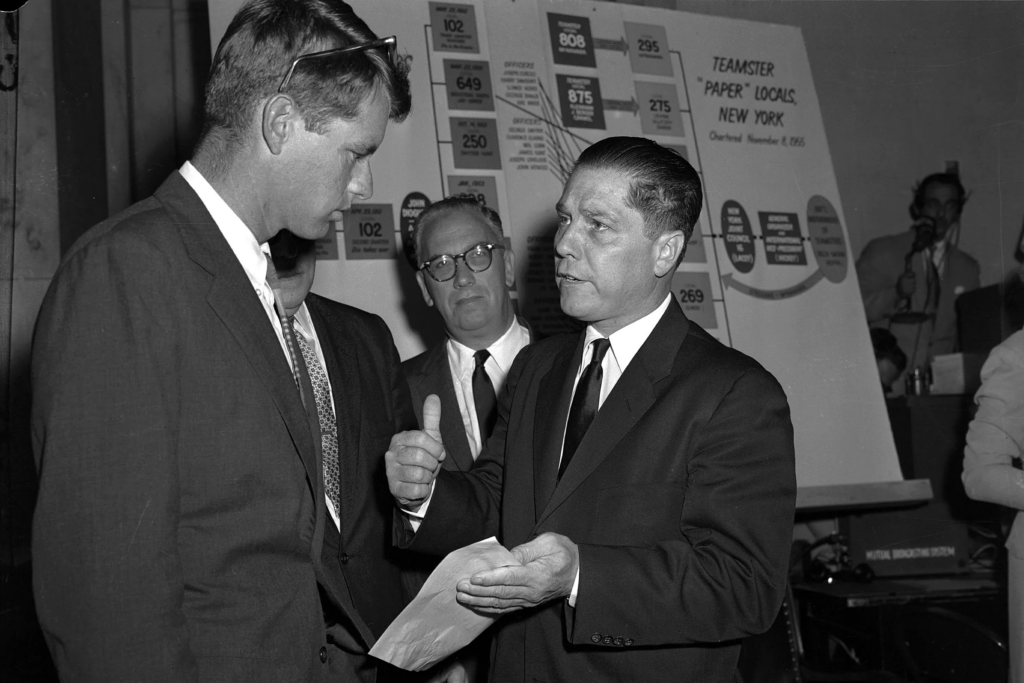
The Blood Feud escalated faster than the Vietnam conflict, and newspapers loved showing Hoffa staring up at Bobby staring down and Hoffa pointing his finger up into Bobby’s face. They even came to pushes and shoves once, with Hoffa leaping forward like a pitbull going for the juggler.
President Kennedy gave Bobby a practically unlimited budget that was on par with Kennedy’s charge to put men on the moon, and Bobby had the full might of America’s Federal Bureau of Investigation and the most advanced surveillance technology in the federal government’s arsenal. Bobby oversaw aging FBI architect J. Edgar Hoover and ordered the focus of 500 federal agents with the sole purpose of finding “something” or “anything illegal” that would remove Jimmy Hoffa from power.
Hoover assigned FBI agent and former John F. Kennedy campaign manager Walter Sheridan to head what became known asThe Get Hoffa Task Force. Hoover, who would eventually serve under eight presidents and at least a dozen attorney generals, was notoriously indifferent to young pups yapping when they stepped into office. But Bobby was different and earned a special ire in Hoover’s eye. He violated Hoover’s strict suit-and-tie dress code by walking around in an unbuttoned shirt with his sleeves rolled up, and he installed a direct phone line into Hoover’s office and demanded daily updates from the veteran, who reported to the Attorney General and had few options other than focusing on Hoffa.
Historians debate the extent of Bobby’s focus on Hoffa. In his biography of Bobby, Schlesinger Jr. wrote:
“[Bobby] Kennedy was represented as “single-minded” in that pursuit, as if chasing Hoffa consumed all his days and nights. In fact, Kennedy was one of the least single-minded men in Washington.”
And,
“When he thought thought about Hoffa, he thought hard about him; but thinking about Hoffa occupied a very small part of his time.”
And,
“Thinking about Kennedy unquestionably occupied a greater part of Hoffa’s time.”
To aide his assumption, Schlesinger quoted Hoffa’s associates Ralph and Estelle James, who said:
“Hoffa’s life was dominated by his fear of ‘that little monster.'”
In an agreement with Schlesinger and other historians, people often quote my grandfather as having Hoffa tell him, in private:
“I have to do something about that son of a bitch Bobby Kennedy. He’s got to go.”
And that Hoffa said:
“Kennedy has guts. He drives around by himself in a convertible, swims alone in his Hickory Hill pool, and has no guards in the house.“
The quotes from Hoffa disparaging Bobby could fill 15,000 documents; I don’t know anyone who doubts his hatred of the young Kennedy. I’m not a historian, but what I’ve read shows that Bobby put more energy into getting Hoffa than even his close friend Arthur Schlesinger realized or admitted. Robert Jackson, an attorney general and supreme court justice a few years before Bobby, wrote about Bobby’s single-minded focus on Hoffa as a generalized warning to posterity about positions of power and personal motivations. He said:
“It is in this realm – in which the prosecutor pics some person he dislikes or desires to be embarrassed, or selects from a group of unpopular persons and then looks for an offense, that the greatest danger of abuse of prosecuting power lies.”
The U.S. Attorney General has many responsibilities, and so does the director of the FBI. Bobby and Hoover agreed that the best man to focus on only one thing – to get Hoffa – was FBI agent Walter Sheridan, whom I’d grow to know and trust and shows up later in my story; I just wanted to explain why I call him Walter.
Walter bounced back and forth between politics and the FBI. He had managed part of President Kennedy’s campaign, and was an unabashed believer in their messages and a staunch and consistent opponent of corruption, political influence, and anything that did not directly and transparently benefit the American people. Walter had only one job, and that job was to lead a team of 500 hand-selected federal agents and get Jimmy Hoffa. Hoover gave him unlimited use of the FBI’s most advanced surveillance technology, and Bobby provided Walter with state-level legal contacts to snatch Hoffa if he was caught with even the smallest of infarctions. Walter gave updates to both Bobby and Hoover practically every day.
Every month Bobby created warrants for Hoffa’s arrest and made sure that Hoffa spent his days fighting legal battles and hopefully slipping up and allowing Walter to step in for the killing shot. If Walter was a grunt fighting tooth and nail on the front line, Bobby Kennedy was the air force relentlessly dropping bombs on a target. But Jimmy Hoffa persisted and prevailed against the many court cased hurled at him. In public he railed against Bobby and called the U.S. attorney general Booby,” like the big boob he was. Hoffa told reporters that “Booby” was “a snot nosed little brat” and “still wet behind the ears.” He said the only reason Bobby had his job was because his big brother was president. Hoffa said that without President Kennedy, there would be no Bobby.
Walter Sheridan and J. Edgar Hoover provided weekly if not daily updates to Bobby Kennedy on the war. Again and again they had nothing promising to report. But then in September of 1962 Bobby gained a big weapon against Hoffa: Edward Grady Partin Senior. Big Daddy was arrested for kidnapping the six year old and ten month old children of fellow Teamster Sydney Simpson, who had lost them in a disputed custody case. Big Daddy lent Sydney a car and given him some cash and sent a handful of burly Teamster guards to help Sydney attend to his business; that was what Hoffa would soon mock as the “minor domestic problem” that led to Big Daddy’s arrest.
A day later police filed additional charges against Big Daddy for manslaughter in Alabama. He had hit and killed a soldier (news didn’t say which branch) and fled the scene, and though not known yet, he had given his car to Doug to repair the damage and destroy any evidence, and Doug had tasked a young Teamster with it (who was later pulled over for a traffic violation and arrested for stealing the car). It was Big Daddy would also be charged with fleeing an accident and obstructing justice, and there’s no telling what other charges would swoop down for a bite on the body once people saw that Big Daddy was wounded and felt free to file old grievances. He knew he was facing life in prison, especially because – ironically, it would turn out – there’s no telling what that Teamster who was arrested in Big Daddy’s car would say to get out of jail. Big Daddy either asked or told his jailers for a phone call, and instead of calling one of his lawyers he called the FBI’s regional director in New Orleans.
I never learned how he got that number, or how what he said was elevated to Washington DC so quickly, but 48 hours after making that call J. Edgar Hoover and Bobby Kennedy freed my grandfather from his Baton Rouge jail cell (though they left poor Sydney there). Within a week Bobby was in Baton Rouge to meet him and Doug in the Local #5 headquarters off Airline Boulevard, which was an isolated part of town near the Greenoaks Funeral Home and other sprawling and sparsely populated businesses where no one would recognize Bobby and he could get a feel for Local #5 at the source. Bobby then met with Grandma Foster at her house near Glenoaks High School (though Bobby remembered it as near the Baton Rouge airport), and then he met with Mamma Jean at a location she never shared but I suspect it was near her old church off Greenwood Springs Road, which was also sparsely populated back then.
I don’t know anyone else Bobby may have met on his tour of Baton Rouge, but the result was that Big Daddy was free from jail and he traveled to Washington DC and went through a barrage of lie detector tests under Hoover’s eye; they photo-documented Big Daddy’s visit so well that Life chose a two-page spread showing it and his raw results scribbled across the top of both full pages. And they investigated Local #5 and Big Daddy’s known associates. He left Washington DC and his criminal records began vanishing in exchange for him reporting if Jimmy Hoffa said or did “anything illegal.”
Mamma Jean received custody of my dad and his siblings and was given a suburban house near a big church to live in Houston, a monthly living stipend, and a small team of federal agents to protect the Partin family 24 hours a day beginning in early to mid October of 1961 (I never learned the exact date, probably because there was overlap from when Walter’s federal agents found Mamma Jean and my family and when Hoover’s choices took over; Hoover told Life that he hand-selected the agents who would protect my grandfather, but for whatever reason did not mention Mamma Jean).
On behalf of Bobby Kennedy and the FBI, Big Daddy made another phone call; this one was to Jimmy Hoffa so they could meet and talk about some things that Hoffa may have heard of in Baton Rouge. Bobby was so involved that he was back in Baton Rouge to be near the source that would finally beat down Jimmy Hoffa.
It took The Cuban Missile and probable nuclear war to pry Bobby Kennedy off Jimmy Hoffa. President Kennedy reigned in Bobby and put him by his side in front of Executive Committee of the National Security Council. Kennedy had just created it to avert what he believed was a nuclear threat from the Soviet Union. For the next two weeks, all of the world watched the Kennedy brothers battle Moscow.
Historians debate the beginning of that crisis; some point to the end of World War II when American and the Soviet Union split Germany, some to before that; some to communist Fidel Castro taking over Cuba from CIA-backed Batista in 1957 and seizing US-owned land and taking over Havana casinos and hotels owned and operated by American mafia families, who had been meeting in Havana to plot their split of America and, increasingly, discuss ties with the growing Teamster movement that had spread labor unions to capitalist Latin America. Regardless of the starting point, President Kennedy sought to oust Castro and in 1961 he launched the Bay of Pigs invasion of Cuba in what became an international fiasco; America failed to send the air and military support they promised, and rebels were decimated in the Bay of Pigs (which Cuba calls Giron Bay).
The Bay of Pigs embarrassed the White House and infuriated the Kremlin, who agreed with Castro that it was an act of American imperialism. To make matters worse, the United States installed nuclear missiles capable of annihilating Moscow in Turkey, Italy, and the UK. In response, the Soviet Union began planning a missile base in Cuba.
By the summer of 1962, the CIA was sure that 40,000 soviet soldiers and scientists were in Cuba poised as tourists while building bases and importing nuclear missiles capable of destroying Miami.
On 14 October 1962 American spy planes captured unequivocal evidence of the missiles.
Kennedy began a naval blockade of Cuba and assembled a team of generals and statesmen led by him and Bobby. Advisors recommend air attacks to annihilate the base, which would have probably started a nuclear war. Kennedy decided to use his strengths; he went on television and explained the situation to the world in what became known as the Cuban missile crisis. For thirteen days, nuclear war seemed so probably that world leaders sat on edge and waited for the outcome; in Bobby’s memoir, Thirteen Days, it’s probably the only time he didn’t mention Hoffa in anything he wrote.
Books, documentaries, and college courses still study the details what happened in those thirteen days and there’s still a lot we don’t know, but there’s no doubt that the Soviet Union withdrew their missiles from Cuba, the United States withdrew their missiles from Europe, and Kennedy promised to never invade Cuba again.
On the home front and at the same time, during the week leading up to his 24 October 1961 court date, Jimmy Hoffa was preparing his defense and meeting with Big Daddy at his hotel headquarters in Nashville, Tennesee. He was defending himself against charges of violating a labor union law by owning and operating The Test Fleet, a Detroit trucking company, while he was president of the International Brotherhood of Teamsters. It was a conflict of interests and a misdemeanor under arguable interpretations of a new law. It was usually below the radar of any U.S. Attorney General, but The Test Fleet Case drew special attention because it was so heavily prosecuted with federal dollars.
Victor Navasky, a prominent political reporter, said:
“Never in history had the government devoted so much money, manpower and top level brainpower to a misdemeanor case.”
Even with Bobby having just spent thirteen days immersed in averting nuclear war, he now focused all of his attention on Nashville, Tennesee.
That’s when Big Daddy met Walter Sheridan. They spoke briefly on the phone, and Walter gave him his hotel name and address; it was three blocks from Hoffa’s hotel headquarters.
“I’m a big guy,” Big Daddy said.
“With blonde hair and a grey suit,” he added. “With a white handkerchief in my jacket pocket.”
They hung up and met to plot going down on Hoffa.
“He was even bigger than I imagined,” Walter said.
Walter describes Big Daddy down to the white handkerchief folded to showcase an embroidered, scripted letter P. He talks about Big Daddy’s tailored grey suit fitting him snuggly all the way down.
“It was about the size of a king-size pack of cigarettes,” Walter said.
He was talking about the wireless electronic bugging device that was top technology in 1962. Hoffa was notoriously furious when someone was even a minute late; they had about two minutes to hide the device in Big Daddy’s suit before he had to leave and meet with Hoffa in his hotel room.
“We tried a few places,” he said. “But in the end, we just had to trust what Partin said.”
The next day they met in Walter’s hotel room again.
“He seemed bigger than I remembered,” Walter said.1
Big Daddy met with Jimmy Hoffa in his hotel room headquarters and said he was out on bail. Hoffa tossed him $20,000 from the petty cash safe to help with legal expenses and asked him to stay and help. He told everyone in the room that my grandfather was now his seargent at arms; Big Daddy controlled access in and out of Hoffa’s Teamsters headquarters and legal defense team.
The jury in Nashville found Jimmy Hoffa not guilty.
Walter had been writing down everything Big Daddy told him and was sure Hoffa had influenced the jury, a federal offense much greater than anything in the Test Fleet case, and he began assembling a prosecution plan. What Big Daddy reported was happening and being observed by Walter’s agents on the Get Hoffa task force; they were sure Hoffa was influencing the Test Fleet jury, but all they had as evidence was Big Daddy’s word.
Eleven months into Big Daddy’s role as a mole in Hoffa’s inner circle, President John F. Kennedy was shot and killed on the afternoon of 22 November 1963. In the minutes that followed, Hoffa was in Florida and surrounded by Teamsters and reporters and said he was glad, because “Bobby’s just another lawyer now.” And when the country lowered flags to half mast in honor of Kennedy, Hoffa ordered more than 1,000 Teamsters union halls to fly their flags at full mast. He said he was glad Kennedy was dead. He said there was no way Johnson, the vice president who despised Bobby, would keep Bobby as attorney general.
Among Lyndon B. Johnson’s first words as president, he said we would find out who killed Kennedy. He charged J. Edgar Hoover and the full force of the FBI with the investigation, and asked Chief Justice of the U.S. Supreme Court Earl Warren to oversee a committee that assessed all information and verified the outcome. He then kept Bobby as attorney general and assigned him to Warren’s committee. It also consisted of well-known politicians, judges, and people of prominence; Hoover and Bobby are the ones that always stuck in my mind.
While working on the Warren committee, Bobby increased his attacks on Hoffa; the Blood Feud escalated while the FBI pursued who killed Kennedy. Simultaneously, the Vietnam conflict escalated with the same intensity, and almost every historian agrees this was one of the most intensely monitored times in American History. On 27 September 1964, most people were shocked when the hastily assembled Warren Report was released and mistakenly said Lee Harvey Oswald acted alone when he shot and killed Kennedy.
In 1964 and only a month after The Warren Report was released, Hoffa was on trial in Chattanooga, Tennessee, for the federal offense of jury tampering in the 1962 Test Fleet Case. Big Daddy was still Hoffa’s trusted ally and seargent-at-arms and was in town as part of Jimmy Hoffa’s entourage. In closing remarks, the chief prosecutor asked for one more witness to be called to testify, and that’s when Big Daddy walked through the courtroom door. Newspapers reported that the otherwise stoic Jimmy Hoffa’s jaw dropped, he gasped, and said: “My God, it’s Partin!”
The jury heard Hoffa say that, which may have been the most damaging thing to Hoffa next to Big Daddy’s testimony. Hoffa’s shock shows how much faith he had in my grandfather. In The Hoffa Wars, Dan Modela wrote:
Partin was one of the last Teamster he had expected to talk. Within a few minutes after Partin was given the oath, his testimony had implicated Hoffa, Ewing King, and Larry Campbell as having knowledge of the jury tampering in Nashville.
And:
With Hoffa prodding them, the nine defense lawyers made a frantic effort to suppress Partin’s testimony.
But Big Daddy smiled from the witness stand and deflected all attempts to stop his testimony. Goons in Hoffa’s corner flicked their thumb nails against their upper teeth towards Big Daddy, a mafia signal that you will die.
Life quoted Big Daddy as saying, “What did I do? I just smiled.”
Every witness at Hoffa’s hearing said Big Daddy ran the courtroom from his seat in the witness stand. As Hoffa wrote, my grandfather could charm a snake off a rock; none of the actors portraying him on film have ever gotten close to what he was like in person. Everyone who met him was instantly impressed; Walter’s comment about him seeming bigger the next time was almost universially true. The more you heard his voice and saw his smile, the bigger he became in your mind. For a few days, the jury listened to him talk and debate Hoffa’s top attorneys and their team of advisors in the hotel room. They deliberated for only around three hours and forty minutes before declaring Jimmy Hoffa guilty of jury tampering.
The judge slammed his hammer down and sentenced Jimmy Hoffa to eight years in prison based on Big Daddy’s word.
Hoffa’s attorneys immediately began their appeal process.
Back in his hotel headquarters, Hoffa shouted curses and threw chairs across the room and told his armies to get busy with both a defense against the testimony and an offense against Ed Partin.
The army attorneys fought all the way to the U.S. Supreme Court. They lost Hoffa versus The United States, and Bobby Kennedy celebrated winning his war. Jimmy Hoffa began serving in a New Jersey maximum security penitentiary on 07 March 1964 based, as Chief Justice Earl Warren wrote: “almost entirely on [Ed Partin’s word].”
Hoffa would spend the rest of his life trying to get Edward Partin to recant his testimony.
Hoffa famously vanished from a Detroit parking lot on 30 July 1975. He was declared dead in the mid 1980’s. Decades later there’s no reported evidence of his remains, and the FBI case file is still open despite the success of Martin Scorcese’s The Irishman and dozens more books published since then.
Hoffa’s 1975 fate is invariably tied to 22 November 1963, the week after Big Daddy’s release from his Baton Rouge jail cell and when President Kennedy was shot and killed. That case is still open, too.
What’s next is a brief note on the massive and classified 1976 John F Kennedy and Martin Luther King Junior Assassination Report that was finally fully released in January of 2025.
Go to the Table of Contents
- What’s so funny is that all of this is true. The meeting had been planned since Baton Rouge and therefore so was documenting everything my grandfather said or did afterwards. The details became crucial when Walter had to explain why they didn’t record anything Hoffa (then) allegedly said to Partin, and why in 1964 the prosecution’s evidence was based, as Chief Justice Earl Warren would emphasize, primarily on my grandfather’s word against Hoffa’s. Walter’s journal became evidence, and in his 1972 book it pops up again. ↩︎