A Partin History, Part 2
“The committee found that Hoffa and at least one of his Teamster lieutenants, Edward Partin, apparently did, in fact, discuss the planning of an assassination conspiracy against President Kennedy’s brother, Attorney General Robert F. Kennedy, in July or August of 1962. Hoffa’s discussion about such an assassination plan first became known to the Federal Government in September 1962, when Partin informed authorities that he had recently participated in such a discussion with the Teamsters president.”
“While the committee did not uncover evidence that the proposed Hoffa assassination plan ever went beyond its discussion, the committee noted the similarities between the plan discussed by Hoffa in 1962 and the actual events of November 22, 1963. While the committee was aware of the apparent absence of any finalized method or plan during the course of Hoffa’s discussion about assassinating Attorney General Kennedy, he did discuss the possible use of a lone gunman equipped with a rifle with a telescopic sight, the advisability of having the assassination committed somewhere in the South, as well as the potential desirability of having Robert Kennedy shot while riding in a convertible. While the similarities are present, the committee also noted that they were not so unusual as to point ineluctably in a particular direction. President Kennedy himself, in fact, noted that he was vulnerable to rifle fire before his Dallas trip.“
“Nevertheless, references to Hoffa’s discussion about having Kennedy assassinated while riding in a convertible were contained in several Justice Department memoranda received by the Attorney General and FBI Director Hoover in the fall of 1962. Edward Partin told the committee that Hoffa believed that by having Kennedy shot as he rode in a convertible, the origin of the fatal shot or shots would be obscured. The context of Hoffa’s discussion with Partin about an assassination conspiracy further seemed to have been predicated upon the recruitment of an assassin without any identifiable connection to the Teamsters organization or Hoffa himself. Hoffa also spoke of the alternative possibility of having the Attorney General assassinated through the use of some type of plastic explosives.”
– The House Congressional Committee on Assassinations John F. Kennedy and Martin Luther King Jr. Assassination Report, 1976 (declassified in 1993)
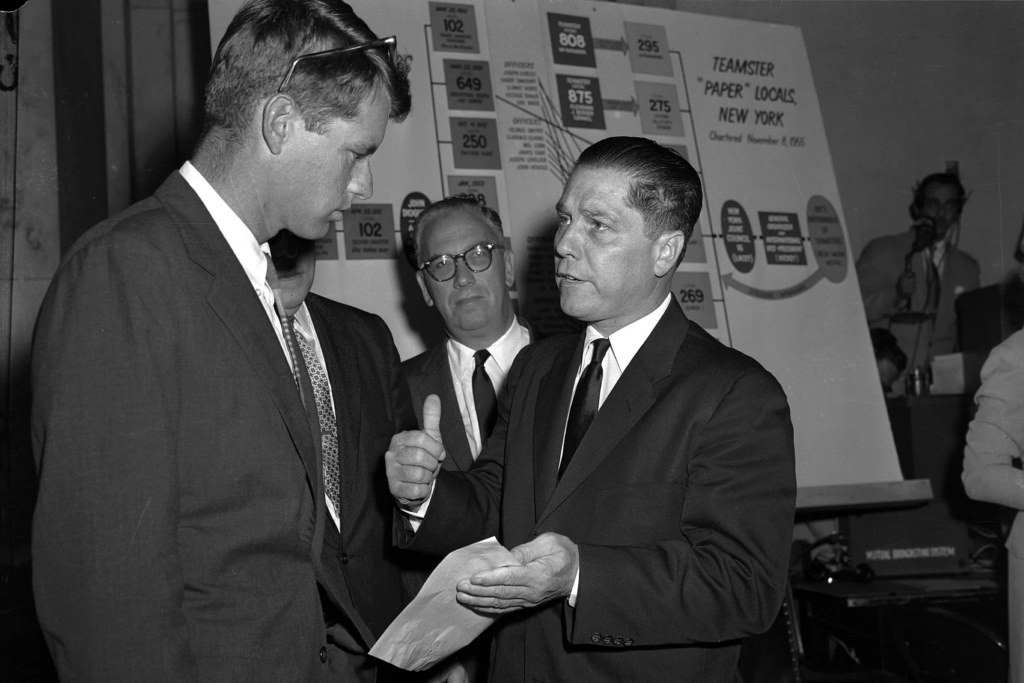
James R. “Jimmy” Hoffa was a hard working high school dropout during the Great Depression and a street-wise teenager who, like many men back then, loaded and unloaded trucks when there was work and didn’t eat when there wasn’t work. Hoffa famously convinced men to unionize; they waited until truckloads of fresh and expensive strawberries arrived in the hot sun and refused to load them into a refrigerated grocery store. The timing gave him negotiating power; his men were guaranteed a minimum for showing up and a bit more when they worked.
Over the next few years, Hoffa and anyone who followed him were beaten, threatened, and arrested; but he persevered and was elected president of the Detroit local Teamsters.
Hoffa was only 5’6″ but kept in peak physical form and never drank alcohol to keep his mind sharp; and to compensate for his size he surrounded himself with the biggest, toughest Teamsters willing to take on teams of mercenaries hired by managers to keep unions away from their companies. This was right after WWII, and dozens of thousands of men returned to America with skills more suited to strong-arming than office work; they split into labor work with Hoffa or management work against unions.
Hoffa’s brute force and relentless focus impressed anyone who met him. He was elected president of The International Brotherhood of Teamsters in 1954, around the same time Big Daddy moved to Baton Rouge and took over the Baton Rouge Local #5 Teamsters. Hoffa respected my grandfather’s approach to work and felt he was a good fit for Teamster leadership.
Baton Rouge Teamster Local #5 was only an hour or two up the mighty Mississippi River from the international port of New Orleans, Big Daddy’s Teamsters had access to America’s second largest port and international trade but with much less federal oversight. And the notoriously corrupt but charismatic Governor Huey “Kingfish” Long and his brother, Governor “Uncle Earl” Long had built the Baton Rouge Mississippi River Bridge a tad lower than required, which forced ships to stop in Baton Rouge rather than traveling farther upriver. The small Baton Rouge port was along a half-mile wide section of the mighty Mississippi River and was only a couple of slow floating hours past the sprawling New Orleans ports and its inspectors and into international waters of the Gulf of Mexico and then all entire world. When I-10 opened in the 1950’s connecting New Orleans to most of America via Baton Rouge. Baton Rouge became a hub of Teamster trucking activity.
The International Brotherhood of Teamsters was the world’s largest labor union. It began as a union of horse-carriage driving teamsters in the late 1800’s and grew to approximately 2.7 Million truck drivers by 1954. Those millions of members paid monthly dues in untraceable cash of between $6 and $10 each; that added up to around $25 Million a month of untraceable and untaxed cash paid to Hoffa via the Teamsters union. He controlled a $1.1 Billion pension fund, which was an unfathomable sum of money back then and on par with the gross domestic product of some Latin American islands. Hoffa ran his own country inside America; there were more than a thousand local Teamster halls spread across his territory.
The Irishman said:
“Jimmy Hoffa didn’t care anything about money. He gave it away. But he did like power.”
If any worker used a wheel, they could become a Teamster. Once a Teamster and if loyal, they were taken care of. Hoffa lent millions from the Teamster pension fund to mafia families to build their casinos and hotels in exchange for jobs for his Teamsters and hefty returns to the fund; he used that fund to pay a salary for striking Teamsters who remained loyal and then a retirement after a around 30 years of work. And he financed Hollywood films that used Teamsters to haul filming and set equipment in Teamster trucks, and to house actors in Teamster trailers. Films from those decades end with the Teamsters logo as the final screen: a ship’s steering wheel to show they drove America, and two horse heads named Thunder and Lightening to show their strength.
To even meet with Hoffa and discuss a loan cost around $40,000, which he would use to build more power and support more Teamsters. Heads of mafia families and Hollywood producers lined up to speak with Hoffa.
He became the most famous and powerful man in America who was not a Kennedy. Some mafia bosses may have had more influence behind the scenes, but Hoffa was in the face of America and blatantly on the side of labor. If he ordered a national strike – which he often threatened to do – the U.S. economy would slam to a halt. Every product and all food on every shelf in every store in America was brought there by Teamsters, and every product made in American factories or grown on American soil for international trade was shipped by Teamsters to ports and across the globe. Teamsters drove America. The $1.1 Billion pension fund would hold them over while they waited for Hoffa to get his way.
In the mid 1950’s, decorated WWII veteran, Pultizer-prize winning author, Irish-Catholic Bostonian, then-senator John F. Kennedy was chair of the U.S. labor relations committee. He set his sites on removing Hoffa and his pension fund from power. In 1960 Kennedy ran for president and defeated President Einsehower’s republican vice-president, Richard Mihous Nixon, in what became famous as the first televised presidential debates and for being the first time a formerly disparaged immigrant group in America became president. Kennedy’s young, handsome, and articulate Irish-Catholic face wooed voters over Nixon’s sweaty upper lip.
Kennedy assumed office in January of 1961. His first act was to appoint his brash and quick to battle little brother Bobby Kennedy as U.S. Attorney General and task Bobby with two and only two goals: get rid of Hoffa and stop the mafia’s growing power in America. Bobby was fresh out of Boston’s Harvard law school and young and anxious to impress. President Kennedy gave him the full force of America’s judicial system and an unlimited budget. Bobby oversaw aging FBI architect J. Edgar Hoover and ordered the focus of 500 federal agents with the sole purpose of finding “something” or “anything illegal” that would remove Jimmy Hoffa from power. Hoover assigned FBI agent and former John F. Kennedy campaign manager Walter Sheridan to head what became known as The Get Hoffa Task Force.
Hoffa was harassed daily and Hoover used the most advanced surveillance technology to get him. Every month Bobby initiated trivial state-level criminal charges against Hoffa and the Teamsters so they would be bogged down in court. Walter – whom I’d grow to know and trust and shows up later in my story – reported progress daily to both Hoover and Bobby. By then Bobby had installed a direct phone line between Hoover’s office and his so they’d have constant updates and could adapt to new information and plot new paths.
But Hoffa persisted and prevailed against the many court cased hurled at him. In public he railed against Bobby and called him “Booby” and “snot nosed little brat” in every press conference, saying Booby still “wet behind the ears,” and that he only had his job because the president was his big brother and they were both from a privileged family who did not know the working class of America. The hot-headed Bobby and street-brawling Hoffa exchanged insults and even pushed and shoved each other in front of reporters. Their public battle became so fierce that media dubbed it The Blood Feud.
Bobby and Hoffa were gladiators on America’s stage. President Kennedy motivated citizens with talk of sending astronauts to land on the moon. The Cold war against the Soviet Union was at it’s peak; Kennedy had orchestrated the failed invasion of communist Cuba in the 1961 Bay of Pigs fiasco, and in October of 1962 the world watched Kennedy and Khrushchev ease from the brink of nuclear war after the Soviet Union had moved nuclear missiles within striking distance of Miami during The Cuban Missile Crisis. By then media called the Get Hoffa Task Force the most expensive, fruitless effort to get one man in the history of any government; there were more important things for America to focus on than Jimmy Hoffa. But Bobby was driven and focused to impress his big brother. Between world events and while leading America’s justice system, Bobby sat in briefing rooms trying to prevent nuclear war and reporting to the president that he still could not get Hoffa despite, as media reminded everyone, the full might and resources and technology of the United States of America behind him.
But then Bobby gained a huge weapon against Hoffa: my grandfather. Big Daddy was arrested for kidnapping the two small children of a 24 year old Baton Rouge Teamster named Sydney Simpson (that was the “minor domestic problem” downplayed in the media and what Hoffa would sarcastically repeat by using “bunny ears” until the day he disappeared). Big Daddy and Simpson were placed in a Baton Rouge jail cell and the next day manslaughter reports against Big Daddy came in from Mississippi; he was facing life in prison.
According to Chief Justice Earl Warren’s comments in Hoffa versus The United States, this was Simpson’s sworn testimony:
“A few days later Partin was released from the jail. From the day when I first saw the deputy, until the date when Partin was released, Partin was out of the cell most of the day and sometimes part of the night. On one occasion Partin returned to the cell and said, ‘It will take a few more days and we will have things straightened out, but don’t worry.’ Partin was taken in and out of the cell frequently each day. Partin told me during this time that he was working with Daniels and the FBI to frame Hoffa. On one occasion I asked Partin if he knew enough about Hoffa to be of any help to Daniels and the FBI, and Partin said, ‘It doesn’t make any difference. If I don’t know it, I can fix it up.’
While we were in the cell, I asked Partin why he was doing this to Hoffa. Partin replied: ‘What difference does it make? I’m thinking about myself. Aren’t you thinking about yourself? I don’t give a damn about Hoffa. . . .'”
J. Edgar Hoover and Bobby Kennedy pulled Big Daddy from jail (and left poor Sydney there). They made a deal that became the basis of dozens of books and 1983’s Blood Feud and Big Daddy’s small part in The Irishman. But there’s more to the story and it’s been muddled with time and noise from so many conflicting books and films; who killed President Kennedy in 1963, why, and how.
This is what is known.
On 18 November 1963 President Kenendy was preparing for a trip to Dallas when Bobby and FBI director J. Edgar Hoover requested a meeting with him and said there was a possible threat on his life. The president listened while they described Big Daddy and his plot with Hoffa to shoot and kill Bobby Kennedy as he rode through a southern town in a convertible by a sniper with a scope who would not be traced back to Hoffa and the Teamsters.
The most popular version of that story is that Hoffa asked Big Daddy to obtain C4 plastic explosives from his connections with New Orleans mafia boss Carlos Marcello and known – but rarely discussed – weapons trading with Fidel Castro. Bobby wanted to blow up Bobby Kenendy’s home wiht him and his wife and children inside; that scene is famously portrayed in a close-up camera frame of Robert Blake as Jimmy Hoffa, talking to Big Daddy but lost in thought and speaking softly and looking where his arm tossed imaginary explosives. Big Daddy refused. He said he would not harm children (I can attest to that: Big Daddy’s criminal history wasn’t known to us back then, and for practical purposes he was the most caring, charming, smiling grandfather you can imagine; to his immediate family, he saved Bobby Kennedy’s family by standing up to children.) But was hidden was that after discounting blowing up Bobby’s home with C4 explosives, Hoffa and my grandfather discussed killing Bobby Kennedy by recruiting a sniper and shooting Bobby in a southern town. The JFK Assassination Report would contain most reasons why they chose a southern town and in a convertible, though was was not pointed out but was obvious to us in Baton Rouge was that the warm southern weather precluded riding with the top down, and Dallas was – and is – a right wing city; though Kennedy is looked upon favorably by history, he was a left leaning politician and was already a target of right fanatics; finding allies and patsies in the south would be easier than California or other liberal enclaves. As the JFK report says, Hoffa and Big Daddy never went beyond plotting.
Soon after that meeting, Big Daddy was arrested for kidnapping, and manslaughter charges followed a day later. He was facing life in prison, so he called the New Orleans FBI office and was released 48 hours later. I don’t know how he had the FBI’s number while in jail, or why the New Orleans FBI director escalated the call to national headquarters in Washington D.C.
J. Edgar Hoover personally oversaw Big Daddy’s lie detector tests, and Bobby Kennedy met and conversed with my grandfather and trusted his word. After a few more months of research, they were convinced the plot would be applied to President Kennedy. In the midst of the Cold War and everything else going on, Hoover and Bobby requested a private meeting with President Kennedy to get his undivided attention.
Their conversation was so intense that Kennedy would discuss it the next day with his white house historian, advisor, and close friend from their days at Harvard together; two-time Pultizer prize winning author and historian Arthur Meier Schlesinger Jr., and it would be summarized in his 1966 Pulitzer prize winning biography, “A Thousand Days: John F. Kennedy in the White House.” But, because Big Daddy and Hoffa’s records were still classified, the names were omitted and only a few people outside of that room with President Kennedyt knew my grandfather was a mole in Hoffa’s inner circle or what he and Hoffa had been planning.
When they finished talking President Kennedy said there was always a plot to kill him and that he was going to Dallas, anyway. The JFK assassination report says that he even admitted he was vulnerable to sniper fire in the open convertible. He sounded confident, but when I read that he discussed the plot with Arthur afterward I believe that even the president had doubts about his safety. But he packed his bags and left for the trip despite that nagging feeling many people get int he back of their mind that something was wrong.
Four days later President Kennedy was shot and killed at approximately 1:26 pm on 22 November 1963 by at least one 6.5mm rifle round from an Italian surplus WWII carbine as he rode through downtown Dallas in his open convertible. The main suspect in Kennedy’s death was New Orleans native Lee Harvey Oswald.
While he lived in New Orleans, Oswald trained in the Baton Rouge civil air patrol four miles from Grandma Foster’s house and under the alias Harvey Lee. That’s where I believe he met Big Daddy, though I’ve never found evidence. What’s well documented is that Lee Harvey Oswald defected to Russia in 1959, married a Soviet citizen, and had a baby with her. He grew disillusioned with the menial work and complained there, just as he had in America, about nothing in particular but simply sounded like a depressed misanthrope. Three years later, the FBI paid for all three of them to fly back to New Orleans and arranged for Oswald to have work.
The Oswald family arrived home in June of 1962 and moved into a downtown apartment. Oswald began a series of menial jobs and his complaints about nothing in particular grew, but with a short memory about his complaints in Russia. He was adamantly pro-communist and pro-Cuba and pro-Castro, and between shifts at his jobs he handed out fliers trying to rally support for some type of revolution to anyone in New Orleans willing to listen. The office for his pro-Castro moonlighting was in a building between New Orleans FBI and CIA offices, and they tracked Oswald’s every move. It wasn’t hard to do, because Oswald was so overt that he became a known character in the Crescent City of Sin; to this day, bars and taverns in New Orleans have little plaques pointing to the barstool where Oswald sat and ranted, or the door he was thrown out of by locals tired of hearing him complain, and tours show all the places where he worked and was fired.
In the spring of 1963 Oswald was offered a job in a downtown Dallas book repository. He left New Orleans and moved into an apartment with his wife and son and ordered a 6.5mm Italian carbine from a mail order catalog. He had it outfitted with a scope by a local gunsmith took a photo of him brandishing it with his .38 caliber Smith and Wesson Model 10 pistol, the same hefty revolver most police used back then. He showed it to local political activists and – though this wouldn’t be known for a few more months – attempted to shot and kill an army general in the general’s Dallas home a few months before Kennedy was killed.
Oswald’s marine records would show that he was an abysmal shot, and the Italian surplus carbine was notorious for inaccuracy; it had been mass produced for Mussolini during WWII and designed to be cheap and useful only in close warfare. Even with a scope, you’d have to be lucky to hit anything with it farther away than you could throw a football.
President Kennedy was shot by Oswald’s rifle from the 6th floor window of the book repository where Oswald worked, which was about 88 yards away from where the president and his wife were riding through downtown with the Texas governor and his wife in Kennedy’s open convertible. The governor was injured and rushed to a Dallas hospital with Kennedy. Oswald’s rifle were found at the open window; cartridges were laid out on the windowsill like a sniper expecting to take several shots, and another round was inexplicably found beside the Texas governor’s hospital gurney. Oswald’s prints were all over the room and rifle, and repeated FBI and independent analysis continues to show that a round recovered from Kennedy was fired from that rifle.
Oswald was missing. Two hours later he nervously emerged from a nearby movie theater and impulsively shot and killed Dallas police officer JD Tippit with the pistol he had brandished in photos with his rifle. As he was arrested for Tippit’s murder, Oswald exclaimed: “I’m just a patsy!” (that was two years before Chief Justice Earl Warren oversaw Miranda versus Arizona, which led to the Miranda Rights being read to anyone arrested so they know their right to remain silent and wait for an attorney). Oswald’s words sparked conspiracy theories even then.
President Kennedy was pronounced dead around that same moment and an hour later Oswald was charged with multiple counts of murder. It was quickly concluded that Oswald’s rifle had been used in the attempted assassination of the army general, and markings on that recovered bullet matched the ones that killed Kennedy. Few people doubted Oswald was involved, but his words and the shock of one person changing the course of history instantly led to most of the world believing a larger conspiracy was behind Kennedy’s assassination.
Two days later Oswald was handcuffed and being led out of the Dallas police station when Dallas nightclub owner, mafia runner, and Hoffa associate Jack Ruby walked past police and removed a small Colt .38 detective’s special from his trench coat pocket and used it to shoot Oswald from an arms-reach away and on international live television. A reporter snapped a photo of a handcuffed Oswald doubling over and his face screaming in pain, and Ruby’s hand holding the pistol from two feet away with Ruby’s middle finger on the trigger and his first finger aligned with the barrel; that was known to be mafia guidance for accuracy when firing at with a small pistol whipped from your pocket. Two hours later Oswald died in the same hospital where President Kennedy had been pronounced dead.
There was no doubt Ruby was guilty of killing Oswald. At his trial records showed he called Hoffa and several of Hoffa’s lieutenants multiple times in the weeks leading to Kennedy and Oswald’s deaths, but no correlation could be proved. Ruby pleaded temporary insanity and claimed that he adored the Kennedy’s and was so distraught that acted on impulse to protect Kennedy’s wife from a lengthy trial by killing Oswald. But Ruby slipped out that he planned on shooting more than once, which implied he planned the murder rather than acting impulsively. A few months later a jury would find Ruby guilty of first-degree murder and he was sentenced to life in prison, though before he died he reversed his testimony and said he was set up and there was a conspiracy and that the FBI was giving him pills that caused cancer; he died from complications secondary to lung cancer two years into his life sentence. (He was a lifelong smoker.) Oswald was never tried because the U.S. does not try deceased people, and probably no one will ever know what he meant about being a patsy.
When news broke that Kennedy had been murdered, Jimmy Hoffa was sitting with colleagues in Florida and surrounded by reporters. He told them: “Bobby’s just another lawyer now,” and ordered all Teamster local halls to fly their flags full mast and. He would soon tell anyone who asked that he was glad Kenendy was dead, but that he had nothing to do with it. He repeated that he was happy to finally be rid of Bobby, and that he expected newly appointed president Lyndon B Johnson would him with a more experienced and less problematic attorney general.
But Johnson kept Bobby as attorney general and tasked him with finding who killed JFK. The U.S. attorney general oversees all U.S. FBI and justice investigations, so Bobby was expected to participate. But he wouldn’t lead the effort. A team was assembled of politicians (including future president Gerald Ford), a wealthy banker, and a former CIA director was assembled; and Johnson asked Chief Justice of the Supreme Court Earl Warren to oversee the investigation.
Warren was famous in his own right. He was a WWI veteran and attorney who became governor of California, and was controversial for supporting the unconstitutional detainment of 250,000 Japanese-Americans including the ones held in remote California concentration camps. Despite controversy, his transparency and almost religious adherence to the U.S. Constitution were unassailable (though it’s ironic that man of those Japanese families were American citizens who were not given the right to an attorney, which Warren would champion later in life).
Warren ran for president in the 1952 but was overshadowed by WWII war hero General Eisenhower, who became president and appointed Warren as Chief Justice of the nine-justice Supreme Court in 1953. One of his first cases was Brown versus The Board of Education, which began making segregated schools illegal in 1954; that case alone made him a household name. Despite his personal views, Warren was a devout believer in a systematic approach to justice.
Judge Warren and his committee were followed internationally by a world suspecting that a bigger conspiracy was at work: The Soviet Union, Fidel Castro, the mafia, and factions inside the FBI and CIA were – and still are – the most discussed suspects. Some people saw an collaboration on a global scale linked to the industrial military complex that President Eisenhower had famously warned of in his final speech; the evidence they saw was a rapid escalation of American’s involvement in Vietnam after Kennedy’s death (Kennedy had intended to use fewer than 50,000 elite soldiers trained in what is now known as the Kennedy Special Forces Center and train Southern Vietnam instead of fight for them, but Johnson quickly ramped up to 550,000 drafted soldiers with an average age of 19 and added another ten years to the war). Who killed Kennedy and why was the most discussed global topic of 1964 and for many years that followed.
To most people’s disbelief, the hastily assembled Warren Report mistakenly concluded that there was no conspiracy and that Lee Harvey Oswald acted alone when he shot and killed President John F. Kennedy and Jack Ruby acted alone when he shot and killed Oswald. They reached their verdict after only ten months. Members of the committee interviewed hundreds of people including Big Daddy, and they had access to all FBI reports including the 1962 report brought to President Kennedy’s focused attention four days before he was shot and killed. I don’t know why The Warren Report was so flawed; and, to be fair, most people only read the conclusions rather than the entire book-length, hard-bound copy sold publicly all over the world; had they read that, they would have read what I’ve said so far and more; some people did, and a slew of books began spreading so many partially informed views and opinions that they muddied the waters. But only a very small minority of people believed the Warren Report, especially as eye-witnesses began surfacing who reported hearing other shots as Kennedy was killed, and saw men shuttled away from a grassy knoll overlooking downtown Dallas and herded onto waiting trains that left the scene by local police.
Around the time Warren released that report, Bobby Kennedy and J. Edgar Hoover decided to use Big Daddy against Hoffa. They were willing to risk exposing their most valuable informant that had been feeding Walter Sheridan and the Get Hoffa Task Force information. Hoffa was on trial in Chattanooga Tennessee for another Bobby-influenced charge of influencing jurors in a 1962 minor state-level labor trial where Hoffa was found not guilty of using his Teamster role to benefit a Detroit trucking company owned by his wife called The Test Fleet.
Hoffa’s 1964 trial for obstructing justice in 1962 was its own national spectacle. Hoffa was known to do publicity photos before juries were selected for his trials and then banned from influential media; he would pose with famous African American boxers, like Joe Lewis, to gain sympathy from inevitable African American jury members in the south. This was before the Civil Rights movement and Martin Luther King Junior’s assassination, and no one was politically correct; and because of socio-economics, many of the south’s African American’s were assumed to be more susceptible to bribes and offers than white men. A common way to bribe Hoffa’s jurors was to offer someone in their family a plush Teamster job and guaranteed pension, but that wouldn’t be known for decades. The most common way to influence a juror was simply to offer them a lot of untraceable cash from the Teamster pension fund.
“The Negro” juror would be referenced throughout the news and even cited by Earl Warren, the man who oversaw Brown versus The Board of Education ten years prior would simplify that man’s role into “a Negro.” Warren would write:
There was other evidence at the trial that petitioner Campbell, a union associate of Hoffa’s, and petitioner Parks, Campbell’s uncle, had made bribe offers to Gratin Fields, a Negro juror. On November 7, according to Partin, Hoffa told Partin that he had “the colored male juror in [his] hip pocket,” and that Campbell “took care of it.” Hoffa told Partin that Campbell, a Negro, was related to Fields, and that while Fields had refused the bribe he would not “go against his own people.”
As America would soon hear, Hoffa was running the Teamsters from his hotel room in 1962, just like in 1964, and would be convicted of handing Big Daddy $20,000 from the room’s petty cash safe and asking him to convince “the Negro” to accept a bribe. Big Daddy never spoke with the gentleman and no money exchanged, but he knew all details about all jurors and tied circumstantial evidence together with his testimony. Any conviction against Hoffa would have to be based on Big Daddy’s word. Bobby Kennedy and J. Edgar Hoover were focused on solving the president’s murder, yet were still receiving daily updates from the head of the Get Hoffa Task Force, Walter Sheridan.
Hoffa was a notoriously calm man in courtrooms. He remained unfazed when a man burst in the Chatanooga courtroom and pointed a pistol pointed at him; Hoffa’s menttee, a stout pitbull without a leash who had boxed in youth named Chuckie O’Brien, leapt across Big Daddy and tackled the man and pistol whipped him with his own gun before courtroom security guards could pry him off. For the rest of the trial, Chuckie patrolled the courtroom hallways during the day and lurked with a .410 shotgun in Hoffa’s hotel at night and kept bumping into Big Daddy but suspected nothing. Hoffa increased his diligence and tightened his inner circle.
It had been two years since Hoffa allegedly implied Big Daddy bribe a juror in 1962, so they had to pile up circumstantial evidence for the new jury to review. Bobby and Hoover were waiting to see if it would be prudent to expose their mole and use Big Daddy’s testimony; once they did, they’d either have to win or they’d lose their most cherished informant. Walter set up the FBI’s headquarters in a hotel a few blocks from Hoffa’s hotel and met with Big Daddy daily. Everything they said was relayed to Bobby and Hoover, who also had FBI agents planted in the courtroom trying to predict Hoffa’s defense. Allegedly, Hoover even bugged private meetings between Hoffa and his attorneys, hoping to hear an advantage they could use in the prosecution’s case.
FBI agents loomed everywhere around the trial in Chattanooga, and Hoffa’s men stood guard at his hotel. Teamsters, mobsters, and corporate managers were in and out of Hoffa’s room throughout the trial. Hoffa told them that Ed Partin was standing at the door and was to be trusted. When prosecutors seemed to know details about Hoffa’s case, Hoffa had begun to suspect a leak in his inner circle, but big Daddy was so trusted that he was never considered and Hoffa kept him closer to prevent anyone from eavesdropping on Teamster business and his court strategy.
Jimmy Hoffa’s face was a chiseled chunk of granite in the courtroom. But when prosecutors called their surprise and Big Daddy stood up from Hoffa’s inner circle and faced the jury, Hoffa’s rigid jawline dropped and his skin turned pale and he probably sealed his own fate when he gasped: “My God, it’s Partin!” The jury only deliberated for three hours before believing Big Daddy’s word and convicting Hoffa of obstructing justice by jury tampering.
The shock sent ripples across time; Chuckie, among his final words before passing away in 2020, would say: “Fucking Partin. I should have killed him when I had the chance.” Anyone loyal to Hoffa felt the same, and the phrase “I’m going to fucking kill Partin” was uttered across Teamster locals from New Jersey to Puerto Rica. At the trial, two mafia hitmen sitting by the FBI agents flicked their thumb nails against their two front teeth and at Big Daddy, a signal of an impending hit on him and his family. Life magazine reported that Big Daddy just smiled confidently, which, along with the unrealized threats by Hoffa loyalists, would add to my grandfather’s strong-man image nationally and of course in Baton Rouge.
Immediately after Big Daddy’s role became public, Hoover announced that he was assigning federal marshals to follow and protect my family from inevitable Teamster and mafia retaliation. Bobby used his contacts at Life and Look! magazines to quickly whitewash Big Daddy’s past and showcase him as an all-American hero for standing up to Hoffa’s corrupt Teamsters and their mafia connections. By then, Big Daddy’s most controversial criminal chargers were missing and have not been found since.
Hoffa had the best and lawyers his $1.1 Billion pension fund could afford. By then even his son, James R. Hoffa Junior, was an attorney and motivated to help his father. Hoffa’s army of attorneys left the courtroom and immediately began trying to discredit Big Daddy and appeal based on violations of the 4th and 6th Amendments in our Bill of Rights. The 6th is relatively long and complex and related to what would become the simplified Miranda’s rights; it overlaps with the 1st Amendment’s right to remain silent and ensures a suspect can have a lawyer present so they aren’t manipulated into saying something incriminating or out of context. The 4th Amendment was penned by hand in the 1700’s and concisely protects people against unwarranted search and seizure. It says:
The right of the people to be secure in their persons, houses, papers, and effects, against unreasonable searches and seizures, shall not be violated, and no Warrants shall issue, but upon probable cause, supported by Oath or affirmation, and particularly describing the place to be searched, and the persons or things to be seized.
Hoffa’s attorneys petitioned that Big Daddy could have influenced Hoffa’s words and therefore violated the 6th Amendment, and that his unwarranted task to find “something” or “anything of interest” violated the 4th Amendment. They rose through appeal courts with that violation leading their charge.
Hoffa, to combat Bobby Kenendy’s whitewashing of the only witness against him, used his fame to lash out at Big Daddy’s character. He wrote:
It was Edward Grady Partin who volunteered the testimony that sealed my doom in the Chattanooga court.
You may have read about him. Thanks to a government sponsorship he was portrayed as something of a national hero. he somehow looked the part, too: a rugged, firm-jawed man with slightly wavy hair and the appearance of sincerity and honesty that would have made him a successful salesman. Ah, you’d say upon meeting him, there’s a true-blue blood American, a churchgoer, no doubt, a man who contributes regularly to charity, a fellow who devotes much time to community-service groups, a chap who turns over most of his paycheck to a divorced wife.
But there’s another Edward Grady Partin, one the jury never got to hear about.
This Edward Grady Partin is mentioned in criminal records from coast to coast dating from 1943, when he was convicted on a breaking and entering charge, to late 1962, when he was indicted for first-degree manslaughter. During that twenty-year period Partin had been in almost constant touch with the law. He had had a bad-conduct discharge from the Marine Corps. He had been indicted for kidnapping. He ha been charged with raping a young Negro girl. He had been indicted for embezzlement and for falsifying records. He had been indicted for forgery. He had been charged with conspiring with one of Fidel Castro’s generals to smuggle illicit arms into communist Cuba.
Hoffa’s word had no power over Life and Look! magazines, which were the most distributed weekly publications and trusted source of news for Americans back then. J. Edgar Hoover oversaw the photos they used, including a head-to-toe photo of Big Daddy in his early 20’s, handsome and smiling and shirtless and wearing nothing but boxing shorts and simple gym shoes. Another two-page layout showed Big Daddy’s squiggly 1962 lie detector results and a photo of him strapped down to a chair with electrodes all over him and FBI scientists wearing white lab coats questioning him and interpreting the squiggling lines for readers.
Other photos were probably more from Bobby’s perspective, and they showed Big Daddy walking picket lines with Baton Rouge teachers offering them the support of Teamsters if necessary, and a slew of two-page spreads showing Big Daddy being a loving father to my dad and his four siblings in scenes around the Baton Rouge state capital building and LSU’s nearby campus. As an extra sell, the Partin family shared that issue with the new first-family, the Johnsons, as if showing America a united team and on the right path between the new government and new union leadership. There was no reason to doubt Edward Partin’s word.
Big Daddy’s charm oozed from the pages of Life; that’s how he gained the moniker all-American hero that Hoffa would scoff about in public when he ranted about the “minor domestic problem” that Big Daddy was up against when Bobby set him free.
Hoffa’s army of attorneys clawed their case through appeal courts and all the way to the U.S. Supreme Court, one of only a few dozen cases out of thousands petitioning to reach the docket. One verdict could set the president for future generations and essentially rewrite the U.S. Constitution. Attorney General Bobby Kenendy followed every step, and newspapers fed the final results to America.
As for why Big Daddy was so supported by Bobby Kennedy and J. Edgar Hoover, Charles Brandt in The Irishman cites his interviews with aging FBI agents familiar with the case against Hoffa. They told him that prisons are filled with high-profile people who were able to avoid prosecution for major crimes but were sentenced based on minor charges and prosecuted to the maximum penalty possible; Hoffa going to prison for jury tampering was similar to the famous 1930’s Chicago mobster Al “Scarface” Capone spending his final years in prison for tax evasion and was put there not by the FBI, but by his accountant. Though it was the still the Cold War, Bobby asked a senate committee investigating Big Daddy for arms smuggling into Cuba to drop their investigation for the sake of keeping his testimony against Hoffa secure. I assume they felt netting a bigger fish was worth helping a smaller one off the hook.
What happened after the supreme court accepted Big Daddy’s testimony in Hoffa versus The United States lingers in our judicial system and affects American politics and world events every day even today. To learn why, it’s helpful to learn what was said in the 1966 U.S. Supreme Court case of Hoffa versus the United States, which is the next chapter of this story.
Go to the Table of Contents