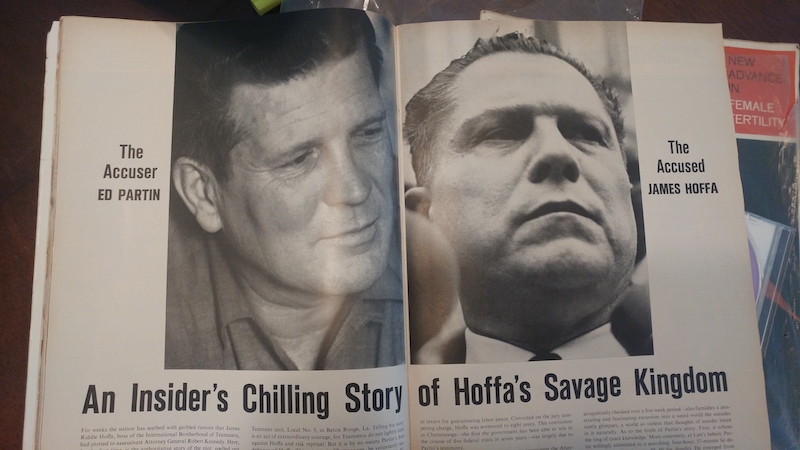
A Partin History: Part 2
Jimmy Hoffa: “Would you like to be a part of this, Frank? Would you like to be a part of this history?”
Frank Sheeran: “Yes, I would. Whatever you need me to do, I’m available.”
– Frank Sheeran in “I Heard You Paint Houses: Frank ‘The Irishman’ Sheeran and Closing the Case on Jimmy Hoffa,” 2004
Frank “The Irishman” Sheeran was a WWII infantryman with PTSD like Rambo and countless other war veterans; he had killed probably hundreds of people in his two year deployment during an unprecedented 345 days of hands-on combat at a time when soldiers still died hearing each side scream from only a few feet away. He was honorably discharged from the army and became a hitman for the Italian mafia, who nicknamed him The Irishman.
That’s how Frank met Jimmy Hoffa. I heard you paint houses was lingo for paining a wall with splattered blood; that’s the first thing Hoffa said to Frank, and it wasn’t a question. The Irishman replied: “Yes. And I do my own carpentry work,” meaning he also disposed of the bodies.
By the time Hoffa met Frank, the Teamsters and the mafia were in an overt alliance to control the labor force of America. The Irishman became a delivery truck driver for Teamster local #107 in Philadelphia and then was elected president of local #326 in Delaware, similar to how Big Daddy was president of Local #5 in Baton Rouge. Both were called lieutenants in Hoffa’s army; Big Daddy became Hoffa’s sergeant at arms. Combined, the Teamsters and the mafia controlled almost all trucks that shipped every product made or sold in America, and practically every laborer and small business that used those products.
Frank Sheeran was one of the last survivors of Hoffa’s inner circle when The Teamsters drove America. Long after both Hoffa and Big Daddy died, Frank went to prison for racketeering and labor union law violations. He was pulled out in his late 70’s due to ill health. Charles Brandt, an established true-crime author and attorney with a reputation for coaxing truth from witnesses and convincing juries of their authority, facilitated his release and began coaxing stories out of The Irishman. Charles was aided by the coincidentally named Frank Weisman, a literary agent fascinated with Hoffa and the mafia and my grandfather and their roles in killing President Kennedy. That Frank knew what questions hadn’t been asked in all the books before, and he worked with Charles Brandt to dig deep into The Irishman’s memories.
Brandt worked with Frank The Irishman for 14 years to nurture I heard You Paint Houses into a narrative memoir that is also a treatise on Hoffa and the mafia. Aiding their effort was Frank Sheeran’s latent Irish Catholic upbringing: he wanted to confess his sins before he died.
Frank passed away a few months before his memoir was finally published. In his book, he confesses to more than a dozen unsolved murders in the 1960’s and 70’s, including painting the wall of an empty Detroit suburban house red with Hoffa’s blood on 22 July 1975. Neither Hoffa’s body nor evidence of his demise have been found, not even with modern DNA analysis that was unfathomable back when Frank was doing carpentry work; whatever they did with Hoffa’s body, it was done with prescient knowledge that everyone would be looking for evidence with the best resources money could provide. Frank The Agent helped put a few nods to Kennedy in the book, like quotes from The Irishman’s benefactors that if they could kiss the president, they could kiss Jimmy Hoffa.
Martin Scorcese bought the movie rights to I Heard You Paint Houses from Steerforth Press and raised $257 Million to make his opus about Hoffa and the mafia. Scorcese hired the best Hollywood actors and had worked with them in decades of gangster classics and centered his opus around Frank Sheeran and renamed it The Irishman. Big Daddy was portrayed by the burly Craig Vincent who had played a thug in Scorsese’s 1995 Casino, which had starred Al Pacino and Joe Pesci, two starts also in The Irishman. Scorcese adapted characters from The Irishman to match the actors America had known for decades.
Craig Vincent researched his role by watching Dennehy in Blood Feud and contacting surviving Partins, but he couldn’t mimic Big Daddy’s southern drawl and sly smile like Dennehy had. Scorcese modified the role to fit Craig’s dark complexion and northeast Italian accent and fit “Big Eddie” Partin into twenty-five minutes of film. After editing, Big Eddie was squeezed into five minutes of Scorcese’s whopping three hour and twenty nine minute film, probably the most that modern movie-goers would sit and watch. The Irishman sold out theaters the summer of 2019 and quickly recouped the quarter of a billion dollar investment.
Scorsese was an artist. In one scene, Big Eddie Partin is towering silently behind the more well known actors like Al Pacino, Robert DeNiro, Joe Pesci, and Ray Ramono. Scorcese had lowered the camera angle to make Craig Vincent appear even larger than he was in real life; it looks like he’s a puppet master controlling the men below him. (After The Irishman was released, I told Craig he did a fine job and my grandfather would have appreciated that scene.) In March of 2020 the Covid-19 pandemic shuttered all public theaters on Earth. Netflix picked up The Irishman and it set global streaming records, and over the next year approximately a Billion people all over the world saw a condensed and fictionalized version of my grandfather’s part in history.
Before Wendy died, she saw advertisements for The Irishman and heard Ed Partin’s name in the news again thirty years after he died. I never got to learn what she thought about that, other than a quick quip that said she was born WAR but marrying a Partin WARP’ed her and that’s why she drank now. She passed before Covid-19, and I had two years of the shutdown to think about her final words and immerse into what was already published on Hoffa and The Kennedys. I was looking for patterns that would help me understand what had happened to Wendy in the early 1970’s that led her to abandon me.
I ordered around 50 books from Amazon not already on my bookshelf, and I used the internet to research what was publicly known versus only existed in my memories or our family’s letters and memorabilia. Names long buried in my memories were illuminated decades later. One in particular jumped out. On McKeithen’s staff of legislative attorneys named Lottinger who would become a judge. When I began cross-referencing names during my 2020 internet search, I stumbled upon my 1976 custody court records; the presiding judge was newly appointed family court judge, JJ Lottinger.
For decades my custody report was only available in the East Baton Rouge Parish 19th Judicial District under Partin versus Partin. It was the same courthouse that had removed a young Teamster’s kids in 1964 that led to Big Daddy kidnapping them as part of what Hoffa called “a minor domestic problem,” and I assume any judge there would have known my family name. Judge JJ Lottinger assumed oversight of my case immediately after Hoffa vanished and he worked with Wendy for more than a year to ensure she had the support she needed to regain my custody.
When I read it in 2020, what surprised at first was that I had – and still have – a fuzzy memory of Judge Lottinger and Wendy and me. I can see us in what must have been his private chambers in the downtown courthouse; he had a kind smile and asked me to call him Judge JJ and I felt I could trust him. That felling persisted for more than 40 years, which was the surprise. What Judge JJ learned he documented in Partin versus Partin, and this is what he had to say about Wendy and me in 1976:
This is a suit by Edward Partin, Jr., plaintiff, seeking a divorce from his wife, Wendy Rothdram Partin, defendant, after having lived separate and apart for more than one year following a judgment of separation from bed and board. Plaintiff also seeks custody of the minor child, Jason Ian Partin, and the defendant reconvened asking that she be granted the permanent care, custody and control of the minor child.
The Trial Court had previously, by ex parte order, awarded the temporary care, custody and control of the minor to Mr. and Mrs. James Ed White. Following trial on the merits, plaintiff was awarded a divorce as well as the permanent care, custody and control of the minor child, with the temporary physical custody of the minor child to remain with Mr. and Mrs. James Ed White. The defendant has appealed this judgment as it regards the custody of the child.
This couple was married when plaintiff was 17 and the defendant was 16 years of age. Nine months following the marriage, they gave birth to young Jason. While we are not concerned with the facts surrounding the separation and divorce, it was apparently one of incompatibility as defendant testified that at the age of 17 she found herself married to a man who did not love her and so she left. Her testimony was as follows:
“As I say I was emotionally upset. I was receiving little support from Edward. I was scared, very confused. I didn’t know exactly which way to turn. I felt I had no one to listen and help with the situation at hand.”
Several weeks later she returned and lived with her husband again. She found that the situation hadn’t changed, and felt she had to get away again. She heard of a man who wanted someone to share expenses on a trip to California, so she quit her job and with her last wages left with him. She testified that she had no sexual relations with this man, and plaintiff does not accuse her of such. Following this trip she returned to Baton Rouge still emotionally upset. Her husband was suing her for separation and told her he was going to take custody of Jason. She went to live with her aunt and uncle, got a full time job with Kelly Girls paying $512.00 per month.
In February, 1975, the defendant’s mother was injured in an accident and she moved in with her to care for her. In September, 1975, following the recuperation of the mother she returned to live with her aunt and uncle.
During these above periods of time, the minor child lived with Mr. and Mrs. White. The Whites came to regard Jason as their own and, although the separation judgment awarded custody to the plaintiff with reasonable visitation privileges to the defendant, the Whites decided the defendant-mother could only see the child two days a month and that she could never keep the child over night. The reason the defendant did not contest custody at the separation trial was because at the time she felt unable emotionally and financially to care for her son.
We note that the petition for separation was grounded on habitual intemperance, as well as abandonment of the husband and the minor child. There are no other grounds listed for the separation nor for custody. The petition for the separation and custody of the minor child was not contested by the defendant, and a default judgment was granted. Defendant testified in the instant proceedings that the reason she did not contest custody in the separation proceeding was that she was not financially or emotionally capable of caring for the minor, and that knowing the Whites were going to be caring for him, she knew he would be in good hands.
Though the petition for separation had as one of its allegations “habitual intemperance”, the plaintiff in the instant proceeding testified that he had never accused his wife of drinking, nor had he ever seen her drink.
The welfare of the child is the main issue that the Court is concerned with. This issue is more important than any wishes or wants the parents may have. Fulco v. Fulco, 259 La. 1122, 254 So.2d 603 (1971), rehearing denied (1971). As a general rule, and in particular where children of young age are involved, preference is given to the mother in custody cases. This preference is very simply explained, the mother is normally better able to care for the child and look after the education, rearing, and training necessary. Estes v. Estes, 261 La. 20, 258 So.2d 857 (1972), rehearing denied (1972).
No argument is made that the mother is not now morally or emotionally fit to care for the child, or that the house in which she lives is not a proper place to rear a child. In fact, the Trial Judge admitted that it was a fine home.
The Trial Judge has not favored us with written reasons for judgment, however, we must conclude from various statements by the Trial Judge that appear in the record that he could find no fault with the defendant, nor was there anything wrong with the house in which she lived. It thus becomes apparent to this Court that the Trial Judge applied the “double burden” rule to the defendant. We have already ruled that the “double burden” rule does not apply in this situation, and thus, under the established jurisprudential rules, we can see no reason why the defendant-mother should not be granted the permanent care, custody and control of the minor child with reasonable visitation privileges granted to the father.
In consideration of our above opinion, there is no need to discuss the specification of error as to the ex parte granting of custody to the Whites.
Therefore, for the above and foregoing reasons, the judgment of the Trial Court is reversed, and IT IS ORDERED, ADJUDGED AND DECREED that the defendant-appellant, Wendy Rothdram Partin, be and she is hereby granted the permanent care, custody and control of the minor, Jason Ian Partin, and IT IS FURTHER ORDERED, ADJUDGED AND DECREED that this matter be and it is hereby remanded to the Trial Court for the purpose of fixing specific visitation privileges on behalf of plaintiff-appellee Edward Partin, Jr. All costs of the appeal are to be paid by plaintiff-appellee.
I’ll never know what motivated Judge JJ, but I know that as a little kid I trusted him, that he was kind to my mother, and that he left this thoughts in Partin versus Partin for posterity to ponder.
After my surprise at remembering Judge JJ, the irony of him focusing on Wendy not drinking stands out. I was looking for details that I may have overlooked before. Wendy not drinking was not a smoking gun pointing to Kennedy’s assassin, but it was a type of detail I was looking for. Something I had missed or taken for granted when I was younger. And it got me wondering: what drove Wendy to drink?
To get the whole story, or at least my perspective, it’s useful to start with Jimmy Hoffa. He vanished from Detroit’s Red Fox diner parking lot on 22 July 1975. His story is well known. What I write next is what I believe based on what I’ve read about the rise and fall Jimmy Hoffa and how it relates to Wendy and me.
Go to the Table of Contents