A Part in History, Part I
But then came the killing shot that was to nail me to the cross.
Edward Grady Partin.
And Life magazine once again was Robert Kenedy’s tool. He figured that, at long last, he was going to dust my ass and he wanted to set the public up to see what a great man he was in getting Hoffa.
Life quoted Walter Sheridan, head of the Get-Hoffa Squad, that Partin was virtually the all-American boy even though he had been in jail “because of a minor domestic problem.”
– Jimmy Hoffa in “Hoffa: The Real Story,” 19751
I’m Jason Partin. My father is Edward Grady Partin Junior, a former drug dealer who was released from prison in 1987 and is now a public defense attorney in Louisiana; my grandfather was Edward Grady Partin Senior, the Baton Rouge Teamster leader famous for infiltrating Jimmy Hoffa’s inner circle in 1962, and was released from prison in 1986, the year I joined my high school wrestling team.
Everyone in Baton Rouge called my grandfather Big Daddy. His surprise testimony in 1964 sentenced Hoffa to eight years in prison, and he was indicted by a 1968 Grand Jury by New Orleans attorney general Jim Harrison as part of the only trial ever conducted for President John F. Kennedy’s assassination. After Hoffa vanished in 1975, Big Daddy’s protected status was gone and his crimes including racketeering, kidnapping, manslaughter, theft, embezzlement, and more finally caught up with him; he was sentenced to federal prison in 1980.
In 1983, Big Daddy was portrayed by the famous actor Brian Dennehy in the movie about Hoffa and his decade-long battle against the Kennedys, “Blood Feud.” Brian was less famous than my grandfather back then, but he was an up-and-coming star known for his “rugged good looks,” green-blue eyes, and charming smile.
Producers felt that Brian could convince viewers that was the Ed Partin described in Hoffa’s second autobiography, published a few months before he vanished: “Edward Grady Partin was a big, rugged guy who could charm a snake off a rock.” That phrase, plus all of the national magazine photos and interviews where Big Daddy spoke in his drawl, made Brian a good fit for a country that knew what how my grandfather looked and sounded. Big Daddy had a big color television in his plush Texas federal penitentiary cell, and he felt Brian did a fine job.
(Coincidentally, Brian’s breakout role came that same year, when he starred alongside Sylvester Stalone in another film with blood in it’s name, “Rambo: First Blood.” Brian portrayed a Korean War veteran and the rugged small mountain-town sheriff who led the hunt for Rambo, a former special forces Vietnam veteran wandering America with PTSD. He would survive a scandal in which he stole valor, falsely claiming combat service in Vietnam to promote his tough image, and he would die in 2020 during the Covid-19 pandemic, a month before his final film debuted online, in which he ironically portrayed an aging Korean War veteran in modern times.)
In 1992, two years after Big Daddy died, President Bill Clinton released part of the classified President John F. Kennedy and Reverend Martin Luther King Junior assassination report, which reversed the mistaken 1964 Warren Report that said New Orleans native Lee Harvey Oswald acted alone when he shot and killed President Kenedy; it said that the three main suspects of orchestrating Kennedy’s murder were Jimmy Hoffa, New Orleans mafia boss Carlos Marcello (an associate of Big Daddy’s), and Miami mafia boss Todos Trafacante Junior; it also implied that Big Daddy was involved behind the scenes, but no one could find definitive evidence, because by then most records had vanished.
In 2019, Big Daddy was portrayed by the burly actor Craig Vincent in Martin Scorcese’s opus about the Jimmy Hoffa and the American mafia, “The Irishman.” Scorsese raised $270 Million and hired a long list of Hollywood’s most famous actors know for gangster films, like Al Pacino, Robert DeNiro, Joe Pesci, and about a dozen others. Craig was chosen to portray Big Daddy because he had worked with Scorsese before, playing a big, brutal, thug in alongside Pacino and Pesci in the Las Vegas mobster film Casino.
Scorsese based his film on a memoir by one of Big Daddy’s peers, Frank “The Irishman” Sheenan, a former WWII combat infantryman, Teamster leader, and mafia hitman who spent 13 years in prison before writing a memoir that says he killed Hoffa in 1975. He said he was making a film for entertainment that sold tickets, not a documentary, so he centered the film around Frank and changed Big Daddy’s southern accent to match Craig’s northeastern Italian accent. Big Daddy was renamed “Big Eddie” Partin for the film, and most parts in Franks memoir about him were omitted to shorten Scorcese’s already whopping 3 hour and 24 minute film, which tested the patience of even the most dedicated film aficionados.
When Craig researched his role, he wanted to know Big Daddy’s personality traits that allowed him to fool so many mafia families, FBI agents, and presidents. Craig called my great-uncle, Big Daddy’s little brother, Douglas Wesley Partin, who ran the Baton Rouge Teamsters for 30 years after Big Daddy went to prison in 1980. Doug was almost 90 years old by then, in a Mississippi veteran’s nursing home and of little use. Craig also called my dad’s little brother and my uncle, Kieth Partin, who was the current local Teamster’s president, and was too attached to his father to see the traits from an actor’s perspective; the same was true with Aunt Janice, who had married and changed her last name but ran an online genealogy website on our Partin family.
By the time Craig and I spoke, his role had been shaped by Scorcese. My answer was long, and Craig and I spent a few hours chatting every time we spoke, unable to nail down any one thing that would capture Big Daddy’s essence. Craig’s role was edited from 20 minutes down to five, and Scorsese solved the dilemma in one scene where he lowered the camera angle to show Big Eddie standing behind all the big-name actors, unobserved, with the camera angle exaggerating how he towered over them.
I think Big Daddy would have smiled broadly at that scene, especially because it was ambiguous and fulfilled the prophesy of his final words: “No one will ever know my part in history.”
The Irishman sold out movie theaters the summer of 2019. It was picked up by Netflix when Covid-19 shuttered theaters worldwide, similar to how Brian Dennehy’s final film was released online because of the pandemic. The Irishman became available 24 hours a day practically everywhere on Earth and it set global streaming records; hundreds of millions of people all over the world got a small, fictionalized glimpse at Big Daddy.
I thought about that when, like many people, I had two years of quarantine to focus on a project; I spent most of mine trying to answer Craig’s question, looking back through time over the thirty years that had passed since Big Daddy uttered his self-fulfilling epitaph.
This is the result.
There are many Jason Partin’s on the internet. One is my cousin, Big Daddy’s nephew, a former Zachary High School football star who went on to play for Mississippi State and now owns a physical therapy center in Baton Rouge; you can see that his smiling face on Lamar Advertising billboards along Baton Rouge’s I-10 interstate between New Orleans and the Mississippi River Bridge, and along I-110 billboards between Baton Rouge and Zachary. A few Jason Partin’s are criminals, but most are average people in towns across America. One is a mixed martial artist with a few Youtube videos; coincidentally, he looks like a younger version of me.
I’m the Jason Partin listed as an inventor on a handful of patents for medical implants that accelerate healing of broken bones, though some of the patents use my entire name, Jason Ian Partin. When The Irishman came out, I was the Jason Partin whose smiling face was on The University of San Diego Shiley-Marcos School of Engineering’s website, where I led a few engineering courses and ran the university’s innovation laboratory, named Donald’s Garage after Donald Shiley, a medical device innovator whose widow donated $21 Million to start the lab in his name. My cousin Jason and I have the same smile, which we inherited from Big Daddy’s father, Grady Partin, though by then few people remembered Big Daddy much less knew I was related to him. That same photo was used on The University of California at San Diego’s website for their innovation center called the Basement, where I was an advisor for the Jacobs School of Engineering entrepreneurship program.
A few veteran forums mention my name in connection with the first Gulf war, where I served as a paratrooper with the 82nd Airborne, and for a handful of lesser known events in the 1990’s when I served on the quick-reaction force of presidents George Bush Senior and Bill Clinton, but no photos from that time are online, except for a few blurred photos from disposable film cameras scanned and uploaded to a few Facebook pages for the 82nd’s 504th Parachute Infantry Regiment.
I’m also the Jason Partin listed by the Louisiana High School Athletic Association, www.LHSAA.org, as having won a silver medal in the 145 pound category of Baton Rouge’s city wrestling tournament in 1990. Though not mentioned in local news, my finger was broken in that match. Two weeks later, I attended Daddy’s funeral with my two left middle fingers buddy-taped and stood beside an army of reporters, a handful of FBI agents, and what seemed to be half of the 3 million Teamsters in America. The New York Times listed me simply as one of his surviving grandchildren. There were five of us. I was the second oldest, a 17 year old unaware I was watching history from my perch beside my grieving aunts, uncles, cousins, and great-grandmother. I left Louisiana two months later and lost my accent, and only a few aging men who followed Hoffa’s saga in the 60’s and 70’s have connected my name to Big Daddy since then.
When I think about Craig’s question, I keep going back to Big Daddy’s funeral and my broken finger. It was broken by the gold medal winner and that year’s undefeated state champion, coincidentally named Hillary Clinton, captain of Baton Rouge’s Capital High School and my nemesis for the four months leading up to Big Daddy’s funeral. That was two years before Arkansas governor Bill Clinton would become President Clinton, the world would learn Hillary Rodham Clinton’s name, and the massive JFK assassination report would be released. In the deluge of books and documentaries that followed, Big Daddy was always mentioned but no one was able to connect his role to the bigger picture. As opinions about Hoffa and Kennedy swamped media and people vied for movie deals, facts became murkier than the Mississippi River that flows through Baton Rouge.
To me, Craig’s answer is hidden among the people who attended his funeral and the family who was just as fooled as Hoffa; and it’s also obscured by a person you’ve probably never heard of, my wrestling coach, Coach Dale Ketelsen. He was Belaire’s only coach, a physically diminutive man who was a former olympian, U.S. marine, All-American wrestler, USA Wrestling’s man of the year, and a deacon of his church for 24 years; he led Louisiana State University to being ranked 4th in the nation before becoming the drivers’ education teacher at an underserved high school in Belaire subdivision and starting a wrestling team there in the 1980’s, just like he had done at an Iowa high school a decade before he started LSU’s program in 1968. The New York Times didn’t cover his funeral, yet Coach probably did more to shape the lives of people and Baton Rouge than Big Daddy ever did, and to me that answers Craig’s question more than anything I could say about Big Daddy.
This is the story of me wresting Hillary Clinton under Coach’s guidance. The only way I see to answer Craig’s question is to talk about how I saw my family through the lens of a 16 year old kid focused more on the 1989-1990 wrestling season than my grandfather’s part in history. Coach and Big Daddy both shaped my life, which led to a broken finger, service in the first Gulf war, a career healing bones, and a lifelong interest in who killed President Kennedy and why.
To me, that story is more important than any film made yet.
Go to the Table of Contents
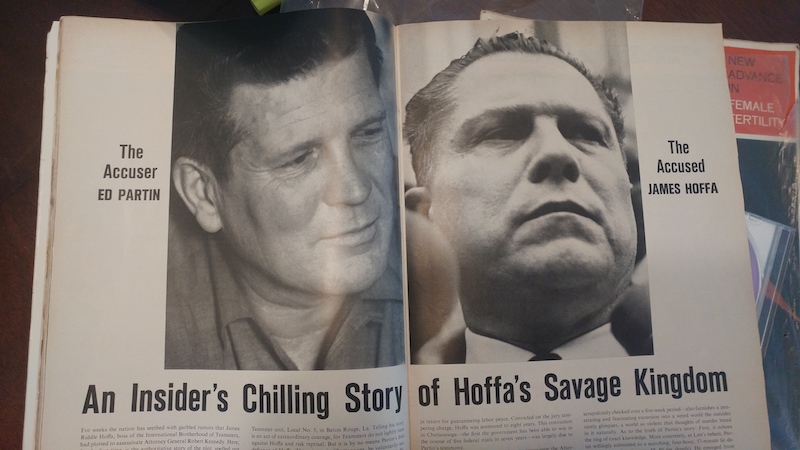
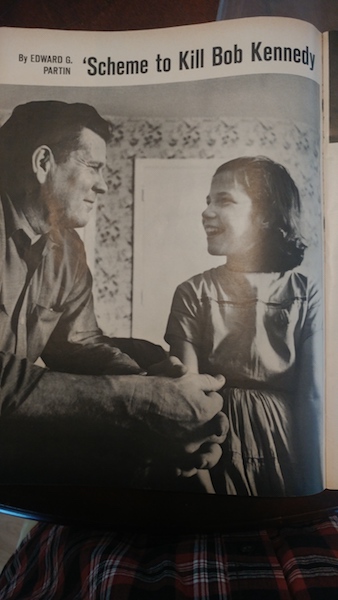
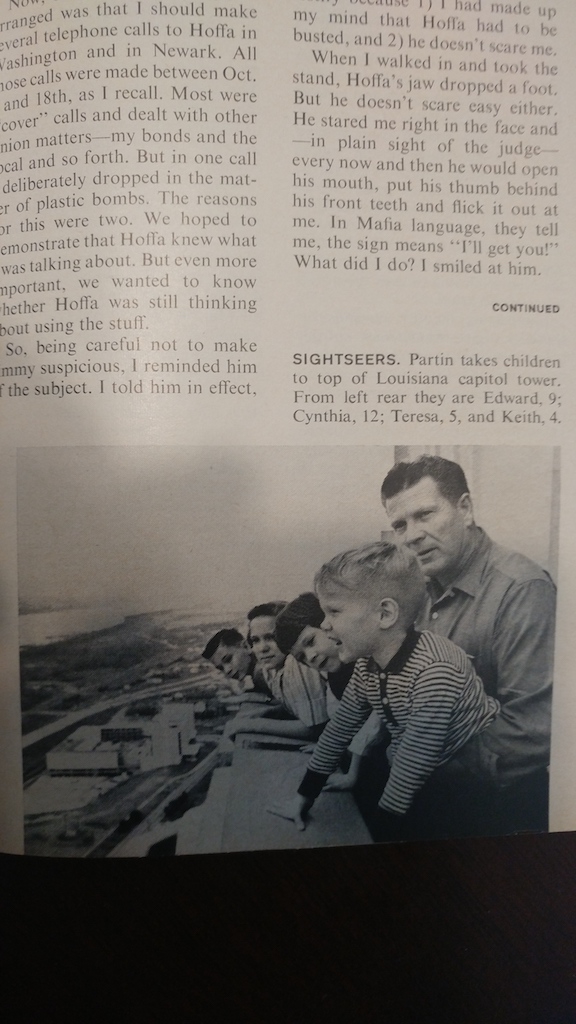
- From “Hoffa: The Real Story,” his second autobiography, published a few months before he vanished in 1975 ↩︎