Introduction to A Part in History
But then came the killing shot that was to nail me to the cross.
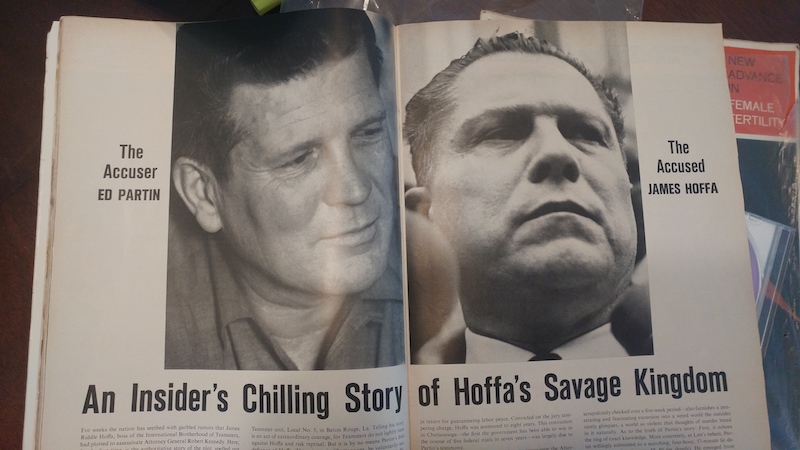
Edward Grady Partin.
And Life magazine once again was Robert Kenedy’s tool. He figured that, at long last, he was going to dust my ass and he wanted to set the public up to see what a great man he was in getting Hoffa.
Life quoted Walter Sheridan, head of the Get-Hoffa Squad, that Partin was virtually the all-American boy even though he had been in jail “because of a minor domestic problem.”
– Jimmy Hoffa in “Hoffa: The Real Story,” 1975
Today Jimmy Hoffa is famous mostly because he was the victim of the most infamous disappearance in American history. Yet during a twenty-year period there wasn’t an American alive who wouldn’t have recognized Jimmy Hoffa immediately, the way Tony Soprano is recognized today. The vast majority of Americans would have known him by the sound of his voice alone. From 1955 until 1965 Jimmy Hoffa was as famous as Elvis. From 1965 until 1975 Jimmy Hoffa was as famous as the Beatles.
– Charles Brandt in “I Heard You Paint Houses: Frank “The Irishman” Sheeran & Closing the Case on Jimmy Hoffa,” 2004
I’m Jason Partin.
Hillary Clinton broke my left ring finger on 03 March 1990. It healed askew, and to this day my two middle fingers have a gap above the middle finger that looks like Dr. Spock’s split-finger salute on Star Trek, the one he used when he wished someone to “Live long, and prosper.”
As a hobby, I’m learning the art of storytelling by writing a blog on JasonPartin.com.
This is it.
Sometimes, I’m high when I work on this blog, so please be patient with whichever iteration you’re reading now.
My father is Edward Grady Partin Junior, a public defense attorney listed in the Baton Rouge phone book as Edward G. Partin, Attorney at Law. When I was in middle school during President Reagan‘s war on drugs. When I was twelve years old and on summer break from middle school in Baton rouge, my dad and I were surrounded in his Arkansas cabin by 24 armed deputies with a warrant signed by an Arkansas judge and the district attorney. We were drug out of our Arkansas cabin by local Yahoos and hauled out of the Ozark Mountains, and in 1986 he was sent to a federal penitentiary coincidentally in Arkansas, and coincidentally in the same year that my his father was released from a Texas penitentiary four years early.
He was ostensibly released because of diabetes and an undisclosed heart condition, which he had, but in reality the government no longer needed him.
My grandfather was Edward Grady Partin Senior, the Baton Rouge Teamster leader famous as the surprise witness who sent Jimmy Hoffa to prison in 1964, ten months after President John F. Kennedy was shot and killed. He died two weeks after Hillary broke my finger, and I attended his funeral with my two middle fingers buddy-taped; that’s why I still associate my Dr. Spock split-finger salute with President Kennedy and my grandfather’s part in history.
In law school, my dad – just like every law student in America – studied his father’s testimony in the 1966 supreme court case “Hoffa versus The United States.” Of nine supreme court justices, only Chief Justice Earl Warren voted against using Ed Partin’s testimony send Hoff prison.
By then, Warren was a household name because of many things, most recently the 1964 Warren Report, spearheaded by new American president, Lyndon B. Johnson, that mistakenly said Lee Harvey Oswald, a New Orleans native, acted alone when he shot and killed President Kennedy, and that Jack Ruby, an associate of John Hoffa and my grandfather, shot and killed Oswald on live international television two days later, on November 24th, 1963, the first day that almost a million people simultaneously watched a live execution. He also was practically responsible for influencing the outcomes of Roe versus Wade, Brown versus The Board of Education, and the case about a rapist freed because he wasn’t aware of his Miranda Rights (as of now, only Roe versus Wade had been redacted, and the jury’s still out on what happened to Jimmy Hoffa).
In his written summary of why Warren was the only Justice to vote against using my grandfather’s testimony, Warren mentions my grandfather 148 times, beginning with: “Here, Edward Partin, a jailbird languishing in a Baton Rouge jail…” and eventiually writing, for posterity to ponder, that to accept my grandfather’s testimony would “pollute the waters of justice,” and forever change America’s right to an attorney before saying anything (knowing their Miranda Rights), the right to have an attorney present during questioning, and the right to be safe from illegal search and seizure (which requires a warrant signed by a judge specifying what is to be searched, where it is, why it is illegal, and what will be done with it – or whatever is found – after).
Those rights have been guaranteed by our founding fathers in the Bill of Rights’s Fourth Amendment since 1792, but 150 years latter the U.S. supreme court voted to accept my grandfather’s word and the process used to obtain it, and therefore in 1964 the fourth amendment was bent in favor of a police state.
My dad has a lot to say about that.
Hoffa’s army of attorneys and mafia allies fought my grandfather’s testimony for a decade. To keep him in prison, President Kennedy’ little brother, U.S. Attorney General Bobby Kennedy, was tasked with only two things: take down Jimmy Hoffa, and remove the American mafia from power. Bobby tasked FBI director J. Edgar Hoover, who would create and lead the FBI for 45 years and under eight presidents, to make my grandfather seem like an all-American hero to be trusted and respected.
Because of inevitable retaliation by Hoffa and the mafia, Hoover hand-selected his top federal marshals to protect my family until Jimmy Hoffa’s disappearance in 1975, three years after I was born.
The Partins became what was known as America’s first family of paid informants, which is different than anonymous informants in protection programs because our name was showcased nationally. Edward Partin became probably the most famous and recognizable person in Louisiana, and watched on television and in movies by dozens of millions of American and unknown international residents fascinated by the spectacle.
Everyone in Baton Rouge called my grandfather Big Daddy. He was a big, handsome, charming man who was almost always smiling, and was so convincing that Hoffa’s jury took only four hours to believe his word against Hoffa’s. In Hoffa’s second autobiography, published by Stern and Day in 1975, a few months before Hoffa vanished, all he could say about how my grandfather fooled him was:
“Edward Grady Partin was a big, rugged guy who could charm a snake off a rock.”
I agree.
In 1983, Big Daddy was portrayed by the ruggedly handsome actor Brian Dennehy in “Blood Feud,” a rare two-part televised series with enough marketing to ensure everyone in America saw it. The iconic actor Robert Blake, whose intense and square-jawed face looked like Hoffa’s, won an academy award for “channeling Hoffa’s rage,” a daytime soap opera heartthrob whose name I can’t recall portrayed Bobby Kennedy, and Ernest Borgnine portrayed J. Edgar Hoover.
Blood Feud focused on Hoffa’s plot to kill Bobby Kennedy by blowing up his home and family. He asked if Big Daddy could get military plastic explosives, C4, from his childhood colleague, Carlos Marcello, the New Orleans mafia boss. Big Daddy refused, saying he wouldn’t kill kids (though he would soon be arrested and mysteriously freed for kidnapping two kids, the two and six year old children of a Baton Rouge Teamster named Sydney Simpson). America dubbed Big Daddy an all-American hero, and that whitewashed kidnapping charge was the “minor domestic problem” that Hoffa used “bunny ears” to sarcastically describe for the rest of his life. In addition to being a kidnapper, Big Daddy was also a rapist, murderer, thief, adulterer, and racketeer who, ironically pointed out by Chief Justice Earl Warren in Hoffa versus The United States, was also a habitual perjurer who bore false witness to jurors and newspapers most of his life, though those parts of his background were mostly hidden from Life Magazine and the producers of Blood Feud.
In 1993, newly elected president, Bill Clinton was the first U.S. president to release any part of the classified John F. Kennedy and Martin Luther King Junior Assassination Report. It was finalized in 1976, but kept confidential for many complex reasons. The JFK and MLK Assassination Report reversed the Warren Report, saying that Kennedy was probably killed as part of a larger conspiracy, multiple shooters were likely involved, and that a few months before Kennedy was shot in the back of his open convertible, Big Daddy and Hoffa had also plotted to shoot Bobby Kennedy with a lone sniper as he road through a southern town in a convertible. I don’t know the reason Clinton released part of it, but I’ve read and heard that it was because potential voters demanded it after ten million of them watched Oliver Stone’s film JFK, which connected Oswald to the CIA, FBI, Castro, the mafia, and the Teamsters.
In 2019, Big Daddy was portrayed by the burly actor Craig Vincent in Martin Scorsese’s opus about Hoffa, “The Irishman,” based on a 2004 memoir called “I heard you paint houses,” by Charles Brandt and Frank “The Irishman” Sheeran, a mafia hitman, Teamsters leader, and colleague of Big Daddy’s who claims to killed Hoffa in a suburban Detroit home in 1975.
To paint houses was mafia lingo for coloring a wall red with splattered blood, and Hoffa’s Teamster story is intertwined with America’s mafia stories and Kennedy’s assassination. I grew up knowing these names like they were Santa Clause and the Easter Bunny, and The Irishman got it right, which is probably why Scorcese scooped up the rights.
Scorsese was the most celebrated mafia and gangster film producer in history. He raised $257 Million to make his film for what he said was entertainment to sell tickets, not a documentary. He spent a decade recruiting all the best name actors, like Robert DeNiro, Al Pacino, Joe Pesci, and a dozen more names known for bringing in audiences to buy tickets.
Craig Vincent was chosen for a small role portraying Big Daddy. Craig was – and is – a 6’6″ Italian-American with a barrel chest, dark complexion, and northeastern tough-guy accent. He had worked with Scorcese and the other actors in 1995’s Casino, playing a big, brutal, southern man with a cowboy hat, so he was a reliable choice. To adapt to Craig’s accent and darker complexion, Scorsese changed Big Daddy to be “Big Eddie” Partin.
Craig researched his role by calling my uncle, Keith Partin, who was current president of the Baton Rouge Teamsters, and by speaking with me, who was harder to find. He asked us what were the personality traits that allowed my grandfather to fool the Teamsters, mafia, and FBI. Kieth told him a few days worth of stories, but I couldn’t answer concisely.
Craig’s question got me thinking. I still don’t know how to answer concisely.
Scorcese had to edit Big Eddie’s role down from twenty minutes to only five so they could squeeze my grandfather into an already whopping three hour and 29 minute film. It sold out theaters the summer of 2019, and hundreds of millions of dollars profit on their $257 Million investment, but Covid-19 shuttered public spaces worldwide soon after.
Netflix streamed it beginning in November of 2019, and by 2020 The Irishman had set global streaming records. Almost a Billion people saw a simplified version of my family’s part in history.
I felt Craig did a good job of portraying Big Eddie Partin.
The Hillary who broke my finger was not Hillary Rodham Clinton, who became a household name when Arkansas governor William “Bill” Clinton became president in 1992. The Hillary who broke my finger was the returning three-time undefeated Louisiana state champion wrestler, captain of the revered Baton Rouge Capital High School Lions wrestling team, and winner of the 1990 Baton Rouge city tournament on 03 March 1990. My victory was overshadowed in local news by my grandfather’s death and funeral, but I had long since grown used to being identified more by my Partin family than anything I did. Soon after his funeral, I graduated high school, left for the army, fought in the first Gulf war of 1990-1991, and briefly served on President Bush Senior’s quick reaction force until President Clinton took office and I first read the John F. Kennedy assassination report.
Every four years, I read what was released by each new president. I don’t know why presidents Ford, Carter, Reagan, and Bush Senior kept the entire report classified, nor why presidents Bush Junior, Obama, Trump during his first term, and Biden still kept some parts classified. Some people said it was to protect witnesses, hide social security numbers and other sensitive information, or to protect former president George Bush Senior, who had been director of the Central Intelligence Agency for years. In his second election as president, Donald Trump released the final parts in 2025, but it didn’t provide much more insight than what Clinton released in 1992, at least from my perspective.
Like how Hoffa spent six years in prison pondering how Big Daddy fooled him and plotting how to regain power in the Teamsters, I spent two years of the pandemic pondering how answer Craig’s question about Big Daddy and wondering how to show that it still matters.
By the time of Covid-19, I was looking back through time with the eyes almost half a century old. For most of my life, I had read practically every book by or about Big Daddy, Jimmy Hoffa, and President Kennedy, trying to understand how to use history to help America and democracy improve based on facts. But no one knows everything, which is why I decided to write a memoir instead of a true crime, or like Frank “The Irishman” Sheeran may have unknowingly done, historical fiction. No one knows all versions of a story, and Frank died before Covid and therefore is unable to clarify questions left unanswered. Hoffa’s body hasn’t been found, the FBI case is still open, and the world still doesn’t have closure on President Kennedy’s murder.
What I realized was that Craig’s question didn’t have a concise answer, and that to share what I’ve learned in the thirty years since Big Daddy’s funeral, I’d have to begin with wrestling Hillary Clinton and go from there.
Go to the Table of Contents